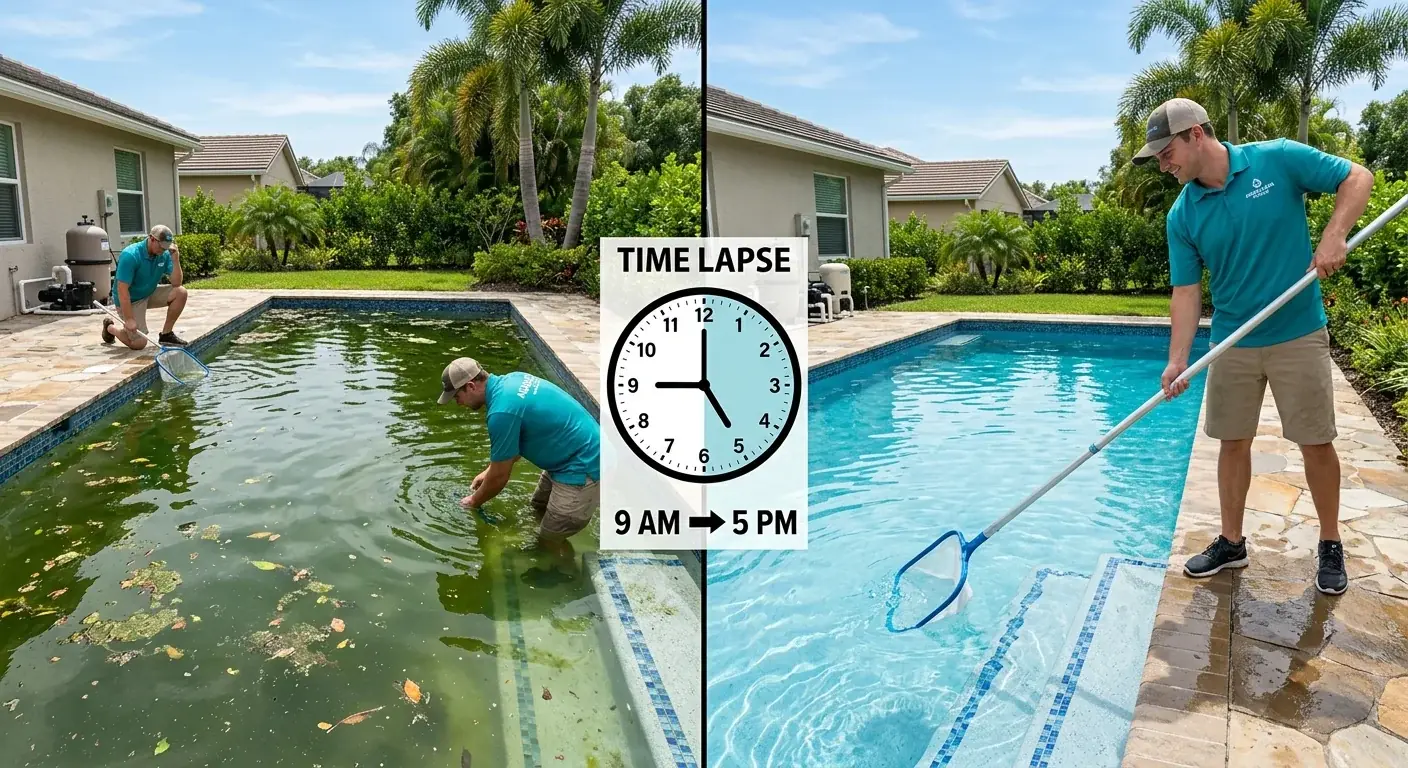
A green pool clears in one to three days if the tint is light. Pea-soup green takes three to five days. Dark green needs five to seven. A black-green pool can take a week or longer, even with professional treatment. The timeline depends on how far the algae has spread, how well your equipment runs, and whether your chemistry is balanced before you start.
Faster action means a less severe problem. A pool that has been green for a weekend is a very different job from one that has been green for a month. Here is what each stage looks like and what actually happens day by day.
The four stages of green
Light green tint
The water has a slight green cast. You can still see the bottom clearly. Algae hasn’t fully bloomed yet. This usually happens after a brief period of neglect or a minor chemical imbalance. The fix is straightforward: shock the pool, run the filter, and optionally add algaecide. Most light-green pools clear within one to three days.
Pea-soup green
The water is cloudy and the bottom is barely visible. Algae is actively producing spores at this stage. Clearing it requires multiple rounds of shock, heavy brushing, and nonstop filtration. Expect three to five days before the water looks normal again.
Dark green
The pool resembles a forest pond. Visibility is near zero. This stage demands higher shock doses, clarifiers, and frequent backwashing. The volume of dead algae strains your filter equipment. Plan for five to seven days of active treatment.
Black green
This is weeks or months of neglect. The water is fully opaque. Thick algae and debris coat the bottom. Mosquito larvae are sometimes present. Flocculant is used to drop the algae so it can be vacuumed to waste. Massive shock doses are needed. A partial or full drain-and-refill is possible. This is a professional job. Attempting it yourself risks damaging your equipment.
Day one: the shock phase
Before you add any chemicals, remove leaves, twigs, and toys from the water. Brush the walls and floor. This breaks up the algae colonies and exposes them to the chlorine you are about to add.
Test your pH and alkalinity before shocking. Green pools often show very low chlorine readings, but the pH matters just as much. If pH is too high, chlorine loses effectiveness and the shock won’t work as intended.
Shock means adding three to five times the normal chlorine dose, sometimes more. For a medium-green pool, that means several pounds of granular shock or gallons of liquid chlorine. Once the dose is in, run the pump continuously.
Within 12 to 24 hours, the green should shift to a cloudy gray or bluish tone. If it is still green after a full day, the pool was under-dosed or the pH is too high. A strong chlorine odor is normal at this stage. The color change doesn’t mean the water is clear. Dead algae is still suspended in the water.
For more on the shock process itself, see our guide on how to shock a pool.
Days two and three: filtration and brushing
By the second day, the water looks cloudy white, gray, or bluish. That cloudiness is suspended dead algae cells. Your filter is now doing the heavy lifting.
The pump must run 24 hours a day during this phase. Brush at least once daily, sometimes twice. Focus on corners, steps, and any rough surfaces where algae clings.
Your filter type determines the maintenance routine. A cartridge filter needs to be removed and rinsed thoroughly. A D.E. filter requires backwashing followed by re-charging. A sand filter needs regular backwashing. A dirty filter drastically slows the clearing process. If you are unsure which type you have or how to maintain it, our breakdown of pool filter types in San Diego covers the basics.
By day three, you should be able to see the bottom of the shallow end. Re-test the water and replenish any depleted chlorine. Adding a clarifier at this point helps bind the remaining fine particles so the filter can catch them.
Why recovery can exceed a week
Sometimes the timeline stretches well past the estimates above. Here is why.
Black-green blooms need repeated heavy shock treatments. Vacuuming to waste discharges dirty water outside the filter, which means you are losing water and need to refill. In extreme cases, a full drain plus acid wash is the only path forward.
Equipment problems are a common bottleneck. An undersized or failing pump limits circulation. A dirty, old, or wrong-size filter slows everything down. Worn media, whether sand, D.E. grids, or cartridges, needs replacement before the pool can clear. A pump that won’t prime or a malfunctioning skimmer also impedes recovery.
Chemistry plays a role too. High pH reduces chlorine effectiveness. High cyanuric acid, also called stabilizer, also weakens chlorine. If your CYA is elevated, you may need to partially drain and refill before shock will work. Our post on cyanuric acid levels explains how to test and correct this.
Inconsistent brushing or filter cleaning extends the timeline. Skipping even one day of brushing can set you back.
High phosphates feed algae and cause quick rebound. Phosphate sources include decaying organics, fertilizers that drift in from landscaping, and some pool chemicals. Phosphate removal is a separate treatment step that many homeowners don’t know about. If your pool keeps turning green after treatment, phosphates may be the reason.
San Diego’s hard water adds another layer. Calcium buildup on pool surfaces creates rough spots where algae takes hold more easily. If your pool has visible calcium deposits, clearing the algae is only half the battle. The surface itself may need attention to prevent the next bloom. Our post on hard water and San Diego pools goes deeper on this.
What a professional does differently
A trained technician starts with a full water analysis. This identifies the algae type, the severity, and any underlying imbalances in pH, chlorine, or phosphates. The equipment gets inspected too. A pro will spot a failing pump, a clogged filter, or a worn skimmer before those problems drag out the recovery.
Professionals have access to commercial-grade algaecides that aren’t available to homeowners. Large-volume liquid chlorine kills algae faster than granular shock. Specialized flocculants and clarifiers speed up the clearing process. Technicians manage continuous filtration and backwash timing so the filter never gets overwhelmed.
Daily follow-up visits let the pro monitor progress and adjust chemistry in real time. That level of attention is difficult to replicate on your own, especially if you are working full time or unfamiliar with pool chemistry.
Handling bulk chemicals also carries risk. Professionals are trained in safe dosing, storage, and application. Overdosing or mixing incompatible products can damage your pool finish, your equipment, or your health.
For a broader look at what algae you might be dealing with, our algae types and treatment guide breaks down the common varieties.
San Diego specifics that affect the timeline
The county’s climate works both for and against you. Warm temperatures accelerate algae growth, especially from late spring through early fall. A pool that sits unattended for even a few days in July can go from clear to pea-soup green quickly.
Coastal areas like Encinitas, Del Mar, and La Jolla deal with salt air that corrodes metal components on pool equipment. Corroded clamps, fittings, and heater parts can create small leaks or reduce pump efficiency without being obvious. Inland areas like El Cajon, Santee, and Alpine see higher temperatures and more dust, which means more debris in the water and faster algae growth.
North County neighborhoods such as Carlsbad, Oceanside, and Vista often have older pool equipment that was installed before variable-speed pumps became standard. Older single-speed pumps may not provide enough turnover to clear a green pool efficiently. If your pump is more than a decade old, it could be a hidden factor in a slow recovery.
South Bay pools in Chula Vista, National City, and Bonita sometimes sit in shaded yards with limited sunlight. Shade slows chlorine’s natural breakdown, which sounds helpful, but it also means algae can establish in low-light areas where brushing is harder to reach.
Regardless of where you are in the county, the principles are the same. Test, shock, brush, filter, and repeat. The difference is how long each step takes based on your specific conditions.
Preventing the next bloom
Once your pool is clear, the goal is to keep it that way. Maintain consistent chlorine levels. Run your pump long enough each day to turn over the full volume of water. Brush weekly, even when the pool looks fine. Test your water at least once a week during warm months.
If your pool has turned green more than once, something in your routine or your equipment isn’t working. A professional inspection can identify whether the problem is chemical, mechanical, or both. Our post on green pool cleaning in San Diego covers prevention in more detail.
If your equipment is aging or has been struggling through repeated algae blooms, it may be time to look at upgrades. Our guide on pool equipment upgrades walks through what makes sense and when.
When to call us
If your pool is dark green or black, or if you have been treating it for several days with no improvement, it is time to bring in a licensed professional. Attempting to clear a severe bloom on your own can damage your pump, filter, or pool finish, and the chemical costs add up fast.
Call us at (858) 400-4404 and we’ll connect you with a licensed local pool specialist.
Frequently asked questions
How long does it take to clear a green pool?
It depends on severity. A light green tint can clear in one to three days. Pea-soup green takes three to five days. Dark green needs five to seven days. A black-green pool can take a week or more, even with professional help.
Can I swim in a green pool?
No. Green water contains algae, bacteria, and other contaminants. Swimming in it risks skin rashes, ear infections, and gastrointestinal issues. The slippery surface also creates a fall hazard.
What should I do first when my pool turns green?
Test your pH and alkalinity right away. Then perform a heavy shock treatment. Make sure your filter is clean and running continuously. If the water is dark green or worse, call a professional.
Why does my pool keep turning green after I treat it?
Recurring green water usually points to low chlorine, poor filtration, high phosphates, unbalanced pH, or weak circulation. A professional diagnosis can identify which factor is causing the rebound.
Is it cheaper to clear a green pool myself or hire a pro?
DIY can seem cheaper at first. But severe cases require large volumes of chemicals and can damage equipment if handled wrong. Professionals often clear the pool faster and avoid costly mistakes.
Need professional help in San Diego County?
Splash Pool SD connects you with a licensed specialist for any service in this post.