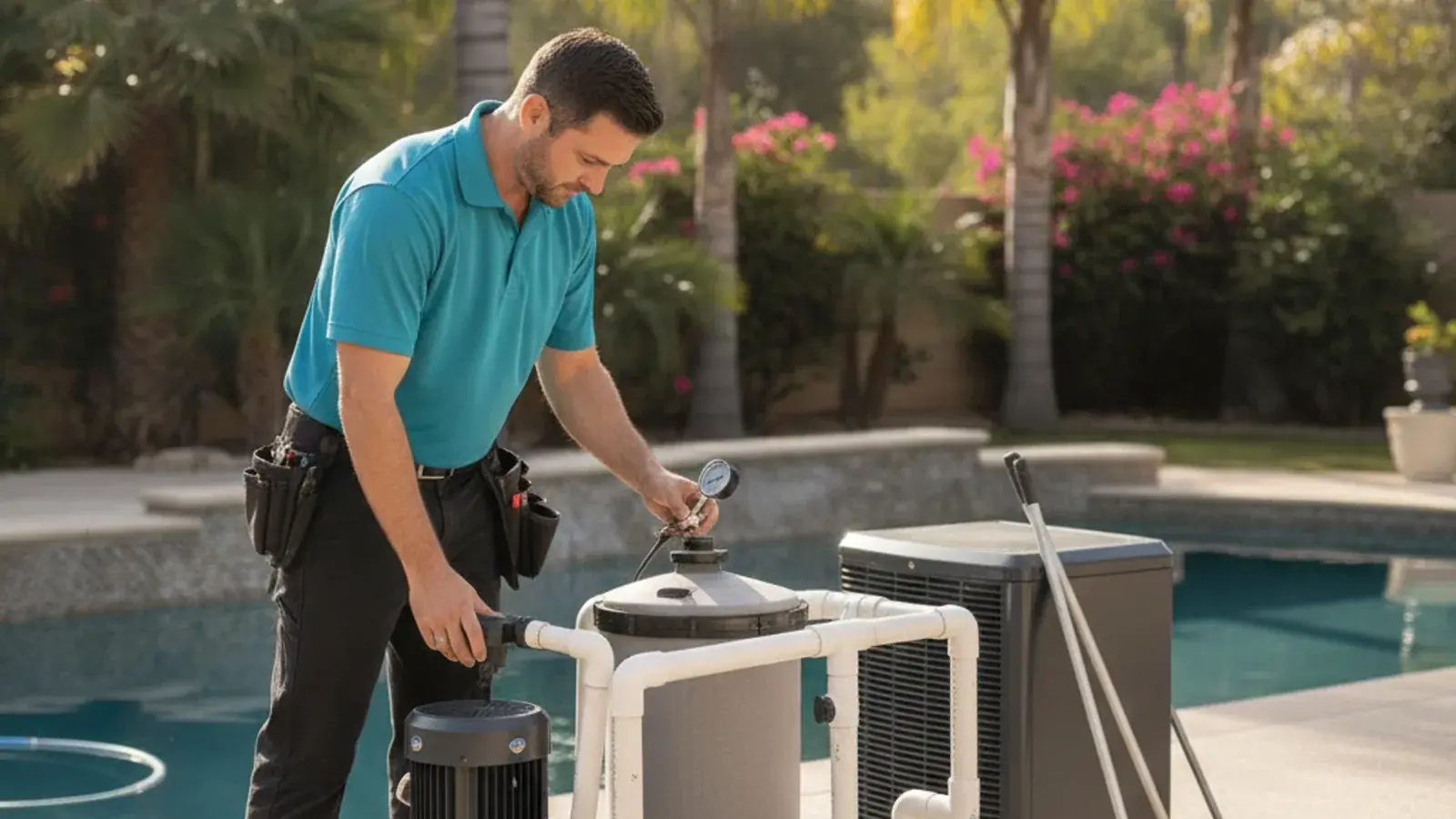
Most pre-2015 pools in San Diego County still run a single-speed pump, and that pump is almost always the first upgrade worth doing. Power draw falls much faster than flow rate, so the same water moves at lower speed with far less energy. Everything else on the pad, filter, heater, salt cell, deserves a closer look before you spend anything. This guide walks through what earns its cost, what can wait, and how to time upgrades so you aren’t paying for two mobilizations.
Start with the pump
Pre-2010 single-speed pumps dominate electric bills across the county. A variable-speed pump solves that by running longer at lower speeds, moving the same volume of water for a fraction of the energy. HomeGuide estimates a variable-speed pump at $800 to $2,000 installed as a general planning range. Your actual quote depends on pool size, plumbing configuration, equipment brand, and access to the pad.
California Energy Commission Title 20 governs what you can install as a replacement. Any dedicated-purpose pool-pump motor of 0.5 horsepower or larger, manufactured on or after July 19, 2021, must be variable-speed. This is a replacement-motor rule, not a mandatory swap schedule. If your current pump runs fine, you don’t have to pull it today. But when it does fail, the replacement must meet this standard. Confirm the applicable requirement before ordering parts.
Before you commit, record your current pump model and note whether it is single-speed or variable. Document any noise, leaks, or priming trouble. If you can, measure watts and run hours, then compare against your electricity rate. That math tells you how fast a new pump pays for itself. Read more in our variable-speed pump guide for San Diego.
Filters and heaters: upgrade on symptoms, not calendars
Filters and heaters don’t follow a replacement schedule. You upgrade them when specific symptoms appear: a cracked housing, short-cycling, rust at the base. If none of those are present and the unit is under manufacturer warranty, leave it alone.
When a filter does need attention, the type matters. Cartridge and DE filters behave differently and cost differently to replace. HomeGuide publishes a general filter replacement planning estimate of $250 to $1,700. Ask whether yours is cartridge or DE before requesting a quote. Our post on pool filter types in San Diego covers the differences.
Heaters follow the same logic. Record the model and describe the visible issue. A single failed part, like an ignitor or thermostat, may be a repair rather than a full replacement. Compare repair versus replacement on a written scope. Consider warranty terms and parts availability. The decision isn’t based on age alone.
If replacement is the right call, HomeGuide lists gas or propane heaters around $1,500 to $4,500 installed, and heat pumps around $2,000 to $6,000. Your final number depends on fuel type, pool size, and whether new gas line or electrical work is needed. We break this down further in our heater replacement cost guide.
Salt cell conversion
A salt cell generates chlorine from dissolved salt, which cuts manual dosing and is gentler on skin and eyes. It is worth it for owners tired of buying and storing chlorine. The conversion usually doesn’t require replacing your existing pump or filter.
Angi publishes a general in-ground conversion planning estimate of $1,000 to $2,500. Actual cost depends on pool volume, existing equipment compatibility, and whether any plumbing modifications are needed.
Before you commit, note your metal fixtures and heater model for compatibility. A worn salt cell is replaceable as a maintenance item down the road. Request written warranty and care instructions. A specialist confirms your pad tolerates the switch before work starts. Our salt water conversion cost breakdown goes deeper on what drives the number.
Bundling upgrades with other projects
If your pool is already scheduled for resurfacing or leak repair, bundling equipment upgrades almost always saves money. The pad is already open. Labor is already committed to the site visit. Exposed plumbing makes a pump or valve swap faster. You avoid a second mobilization cost and a second period without pool access.
During resurfacing the pool is already drained and offline anyway. Waiting to swap equipment means paying for a separate visit later. If you are planning a resurfacing project, ask about equipment in the same scope. Our post on what drives equipment replacement cost covers the variables.
What not to upgrade yet
If a component is under manufacturer warranty and shows no symptoms, leave it alone. Record each model number and ask whether an upgrade is needed now. Note pump run hours and visible wear, but don’t replace working gear on speculation.
A working manual timer doesn’t need a smart controller. If you are adding equipment anyway, ask about automation in the same scope. That brings us to the next point.
Automation as an add-on
Automation is best paired with an upgrade you are already doing. It isn’t recommended as a standalone project on gear that works fine. A universal controller usually handles mixed ages and brands, so you avoid a full rip-and-replace just for app control.
Pairing a new pump, heater, or salt cell with an app-based controller lets you adjust schedules remotely and catches problems early, like a heater that won’t fire or odd cycling patterns. If you are already opening the pad, the marginal cost of adding automation is low compared to doing it as a separate project.
Staging a full pad upgrade
A full pad upgrade replaces the pump, filter, and heater together. The quote depends on equipment selection and site conditions. You may need new electrical or gas line work. Filter type, cartridge versus DE, changes the scope.
If the full package isn’t in the budget at once, staging works. Pump first, then filter, then heater. Each stage is a separate visit, so you pay more in total labor than a bundled job. But it spreads the cost over time without sacrificing quality on any single component.
When to call us
Equipment upgrades involve electrical, plumbing, and sometimes gas work that requires a licensed professional. A correct diagnosis saves you from replacing a part that still has life left. Call us at (858) 400-4404 and we’ll connect you with a licensed local pool specialist.
Frequently asked questions
Do I have to replace my single-speed pump in California?
No mandatory swap schedule exists. California Energy Commission Title 20 requires that any dedicated-purpose pool-pump motor of 0.5 horsepower or larger, manufactured on or after July 19, 2021, must be variable-speed. So when your pump does need replacing, the replacement must be variable-speed. You are not required to pull a working pump early.
Should I upgrade my pool filter at the same time as my pump?
Only if the filter shows symptoms like a cracked housing, short-cycling, or rust at the base. If it is running fine and under warranty, leave it alone. If the pad is already open for other work, ask the pro whether bundling makes sense for your setup.
Is a salt water conversion worth it in San Diego?
It is worth it for owners tired of buying and storing chlorine. The salt cell generates chlorine from dissolved salt, which cuts manual dosing and is gentler on skin and eyes. Angi publishes a general in-ground conversion planning estimate of $1,000 to $2,500. A specialist confirms your pad tolerates the switch before work starts.
Can I add pool automation without replacing everything?
Yes. A universal controller usually works across mixed ages and brands. Automation is best added alongside an upgrade you are already doing, not as a standalone project on gear that is working fine.
Need professional help in San Diego County?
Splash Pool SD connects you with a licensed specialist for any service in this post.