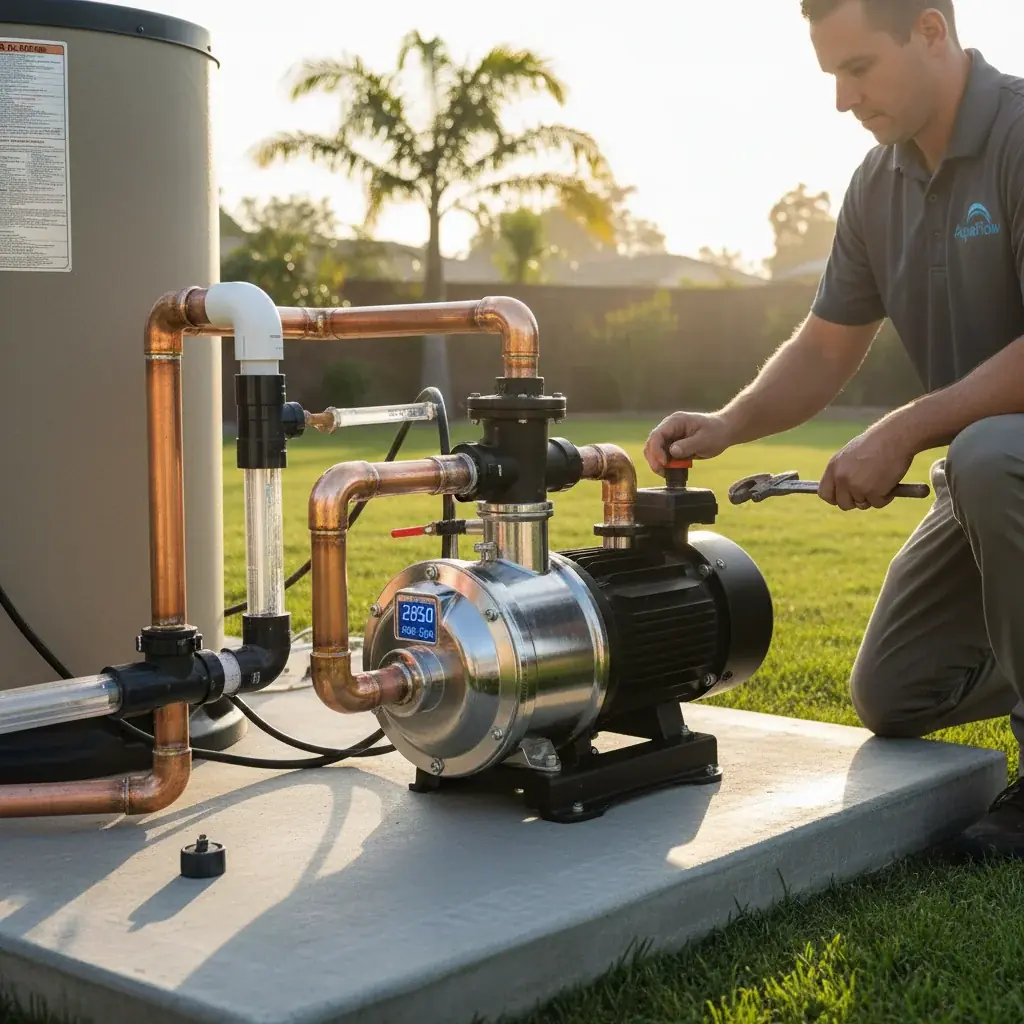
Most San Diego pool owners who switch to a variable speed pump save $500 to $900 per year on their SDG&E bill, depending on pool size, daily run time, and which rate tier they sit in. That isn’t a best-case projection. It reflects the gap between a single-speed motor pulling over 1,100 watts at full RPM and a variable speed unit drawing 150 to 300 watts at low speed for the same filtration job.
If you are still running a single-speed pump eight hours a day, SDG&E’s current tiered rates, which can exceed $0.45 per kWh in the upper tiers during summer, mean that pump alone costs around $1,300 to $1,600 per year. A variable speed pump cuts that number sharply.
Title 20 makes this more than a suggestion
California’s Title 20 appliance efficiency rule, enforced by the California Energy Commission, has required variable speed or variable flow pumps for replacements above 1 HP since January 1, 2017. If you are replacing an older single-speed pump, you can’t legally install another single-speed unit of the same size. Licensed contractors won’t do it, and suppliers won’t sell you one.
The rule covers pumps only. It doesn’t touch your filter, heater, or salt system. But it does mean that when your current pump fails, a variable speed replacement is the only legal path forward for anything above 1 HP.
Why variable speed actually uses less power
A single-speed pump runs at a fixed 3,450 RPM regardless of what the pool needs. A variable speed pump uses a permanent magnet motor, the same type found in electric vehicles, and dials down to around 600 RPM for light filtration.
Power consumption drops with the cube of speed reduction. That is a fluid dynamics principle, not a marketing claim. Cut the RPM in half and you draw roughly one-eighth the electricity. At low speed, a variable speed pump pulls 150 to 300 watts compared to the 1,100 to 1,200 watts a 1.5 HP single-speed draws at full tilt.
San Diego pools run year-round. There is no winter closing season. That means the pump operates every month, and the savings compound across all twelve.
Time-of-use scheduling stacks the savings
SDG&E’s time-of-use rates offer off-peak pricing from 9 PM to 6 AM. Every major variable speed pump has a built-in multi-speed scheduler that lets you program filtration during those hours automatically. This stacks rate savings on top of the speed reduction savings.
If you skip the scheduler and run the pump manually, you lose both benefits. The timer isn’t optional if you want the full return.
Brand options the pros install
The matched pro will recommend a pump based on your existing equipment, budget, and automation setup. Here are the three brands most commonly installed in San Diego.
Pentair IntelliFlo
This is the most commonly installed variable speed pump by local pros. The motor has excellent reliability, and warranty support is straightforward. It integrates cleanly with automation systems. The VSF model adds flow sensing to speed control, which helps when your chemistry or cleaner is sensitive to flow rate. It carries a higher retail price point than the others.
Hayward EcoStar and TriStar VS
Hayward prices these more aggressively than Pentair. The EcoStar is a reliable workhorse for tighter budgets. The interface has a steeper learning curve than Pentair’s. One thing to know: older Hayward automation systems integrate poorly with their variable speed pumps, so check compatibility first.
Jandy VS FloPro
Jandy is owned by Fluidra, the same parent company as AquaLink. This pump is the best fit if you already have Jandy automation or a Jandy heater on your pad. It keeps your equipment on a single ecosystem. It is strong for new installs but not always the default choice for a straightforward swap.
All three brands qualify for SDG&E rebates when installed by a licensed contractor.
Installation cost and SDG&E rebate
Variable speed pump installations in San Diego range from $900 to $1,800 for most residential pools. What moves the price within that range includes pool size, equipment brand, plumbing condition, access to the pad, and whether a permit is needed. The matched pro will give you a firm quote before work starts.
SDG&E offers rebates for qualifying variable speed pump installations. The rebate amount varies by program tier and changes periodically, so confirm current terms with SDG&E or your installer before scheduling. The install must be done by a licensed contractor to qualify.
California requires a C-53 Swimming Pool license for this work. You can verify any contractor’s license through the CSLB license check tool online. An unlicensed install can void the pump warranty and creates electrical liability risk. Read more about checking a pool contractor’s license in California.
Common settings mistakes that kill your savings
A variable speed pump only saves money if it is programmed correctly. These are the mistakes that show up most often on San Diego equipment pads.
Running max RPM constantly
Some installers set a single high-speed program and leave. The pump runs at 3,450 RPM around the clock, and you get zero savings over your old single-speed. Standard filtration needs only 1,500 to 2,000 RPM. Reserve high speed for your pressure cleaner, waterfall, or spa jets.
Too few hours at low speed
Low speed plus only four hours of run time means insufficient turnover. Chemistry destabilizes and algae develops. San Diego heat demands at least 1.5 turnovers per day. Calculate your pool volume with length times width times average depth times 7.5, then match the flow rate at your chosen RPM to that gallon count. We cover run time guidance in our post on how long to run your pool pump in San Diego.
Ignoring the built-in scheduler
Every major variable speed pump has a multi-speed timer. If you operate the pump manually, you defeat the time-of-use savings and any automation benefits. Program it once and let it run.
Skipping the prime check
Long suction lines require verified priming at startup. Running the pump dry, even briefly, damages the seal. Confirm a full prime before enabling the automated schedule.
Misreading filter pressure
Low RPM produces lower filter pressure than a single-speed pump did. Homeowners see the lower reading and assume the filter is dirty. They over-backwash as a result. Learn your clean pressure baseline at each programmed RPM, then set your backwash trigger from that number.
What the installation looks like
A direct swap on an existing pad takes two to four hours. Most variable speed pumps run 230V, the same as your current single-speed. If the plumbing needs resizing, unions are corroded, or wiring is undersized, add one to two hours. Panel-side work like a new breaker or subpanel gets referred to a licensed electrician.
The pro will program your speeds, set the scheduler, verify prime, and walk you through the interface. For a full breakdown of what to expect on installation day, see our guide on pool equipment installation.
Payback timeline
A variable speed pump lasts roughly ten years. With annual savings of $500 to $900, most San Diego owners recoup the installation cost in two to four years. After that, the savings are pure margin for the remaining life of the motor. The pool pump typically accounts for 15 to 25 percent of total home electricity use, making this the highest-impact single equipment upgrade available to most pool owners.
If your pump is already failing, our post on pool pump replacement cost in San Diego walks through what drives the number. And if you are considering a broader equipment refresh, the pool equipment upgrade guide covers what pairs well with a new pump.
When to call us
Variable speed pump installation involves 230V electrical connections, plumbing unions, and multi-speed programming. It isn’t a DIY swap, and Title 20 means the replacement must be done right the first time. Call us at (858) 400-4404 and we’ll connect you with a licensed local pool specialist.
Frequently asked questions
Is a variable speed pump legally required in California?
Yes. Title 20, enforced by the California Energy Commission, requires variable speed or variable flow pumps for any replacement above 1 HP. This has been in effect since January 1, 2017. A licensed contractor cannot install a single-speed replacement of the same size.
How much can I save on my SDG&E bill with a variable speed pump?
Most San Diego homeowners save $500-$900 per year depending on pool size, run time, and current rate tier. Scheduling filtration during off-peak hours pushes savings higher.
Does SDG&E offer a rebate for variable speed pumps?
Yes. SDG&E offers rebates for qualifying variable speed pump installations. The amount varies by program tier and changes periodically, so confirm current terms before scheduling.
How long does installation take?
A straightforward swap on an existing pad takes two to four hours. Plumbing resizing, corrosion, or electrical updates can extend that to a full day.
What's the most common mistake after installing a variable speed pump?
Running the pump at maximum RPM constantly. Standard filtration only needs 1,500 to 2,000 RPM. High speed should be reserved for pressure cleaners, waterfalls, or spa jets.
Need professional help in San Diego County?
Splash Pool SD connects you with a licensed specialist for any service in this post.