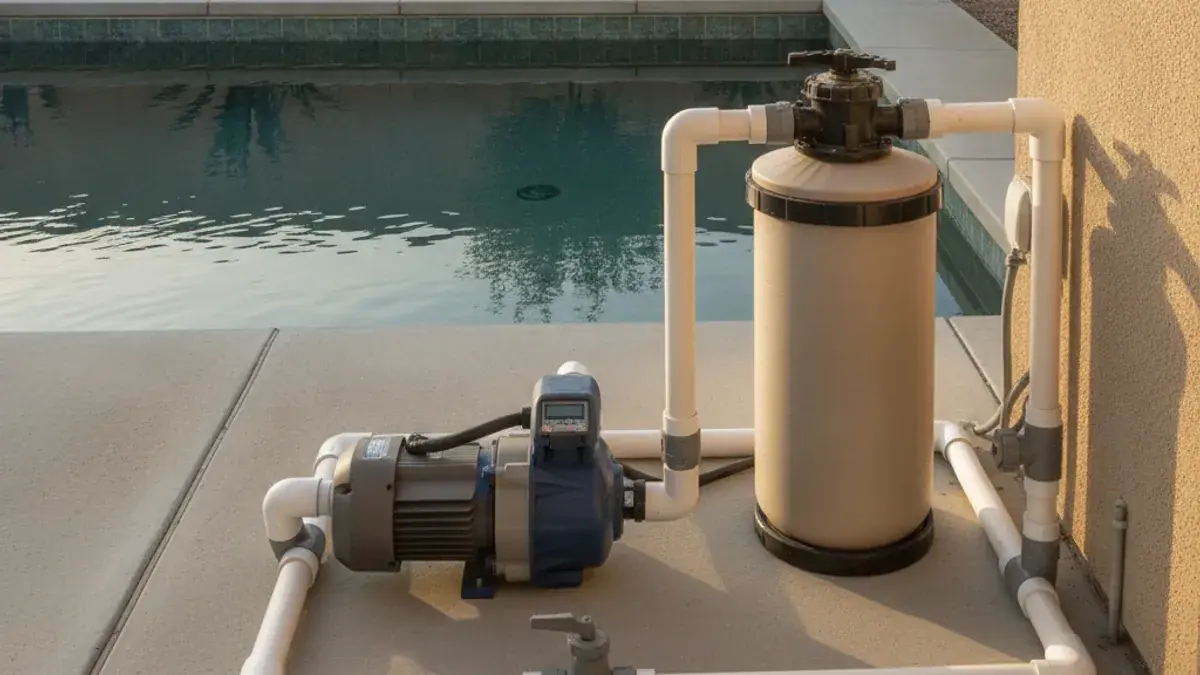
Most San Diego pools need about 8 hours of pump runtime per day on a single-speed motor, or 10 to 12 hours on a variable-speed pump at low RPM. The goal is one full turnover of your pool’s water every 24 hours. In summer, when heat accelerates chlorine loss and algae growth, push that to 1.5 turnovers.
That answer changes based on your pool’s volume, your pump’s flow rate, and the time of day you run it. Here’s how to dial it in for San Diego County.
How turnover works
Turnover means every gallon in your pool has passed through the filter at least once. The math is straightforward.
First, find your pool’s volume in gallons: length × width × average depth × 7.5. Then divide that number by your pump’s flow rate in gallons per hour. The result is your minimum runtime.
A few examples at 3,000 gallons per hour:
- A 12-by-24-foot pool at 4.5 feet average depth holds about 9,700 gallons. Turnover takes roughly 3.5 hours.
- A 15-by-30-foot pool at 5 feet average depth holds about 16,875 gallons. Turnover takes roughly 5.6 hours.
- An 18-by-36-foot pool at 5.5 feet average depth holds about 26,730 gallons. Turnover takes roughly 8.9 hours.
Round up and add a margin hour. You can find your pump’s exact flow rate on its spec sheet or the manufacturer’s flow curve. Larger pools benefit more from a variable-speed pump because the longer runtime at low speed costs less per hour.
Single-speed vs variable-speed runtime
A single-speed pump runs at a fixed 3,450 RPM and draws about 2.3 kilowatts. A variable-speed pump running between 1,200 and 1,800 RPM draws roughly 0.3 kilowatts at low speed. That difference is why a variable-speed pump can run longer for less money.
The slower filtration also traps finer particles, so water often looks clearer on a variable-speed schedule. California Title 20 mandates variable-speed pumps on all replacements, so if your single-speed motor fails, the replacement will be variable-speed. SDG&E offers rebates for variable-speed upgrades, which can offset part of the purchase. Check the current rebate terms directly with SDG&E before you buy.
For more on choosing between brands and models, see our guide to variable-speed pool pumps in San Diego. If you’re weighing a rebate, we also cover variable-speed pump rebates.
Schedule around SDG&E time-of-use rates
SDG&E bills on a time-of-use structure. The on-peak window runs from 4 to 9 p.m. and is the most expensive period of the day, sometimes above $0.55 per kWh in summer. Super off-peak falls roughly between midnight and 6 a.m., which is the cheapest window. Early morning and late evening sit at mid-range pricing.
The practical move: schedule your pump for super off-peak and early morning. Keep it off during the 4 to 9 p.m. window. Shifting hours this way can roughly halve what the pump adds to your bill.
All variable-speed pumps have built-in schedulers that let you program multiple run blocks. If you still have a single-speed pump, a mechanical or digital timer does the same job. Splitting runtime into two blocks, say 5 a.m. to 9 a.m. and 10 p.m. to 2 a.m., works fine. Total hours matter, not whether they run in one continuous stretch.
Seasonal adjustments for San Diego
Summer brings more swimmers, more debris, and faster chlorine burn. During a heat wave or heavy-use stretch, push to 1.5 turnovers. That may mean 10 hours on a single-speed or 12 hours on a variable-speed pump.
Winter is the opposite. Cooler water holds chlorine longer, and most pools see less use. Drop to 4 to 6 hours, or one full turnover, whichever is longer. Never go below one turnover, even in the coolest months. Stagnant water invites problems that cost more to fix than the electricity you saved.
San Diego’s hard water adds another layer. Calcium buildup in plumbing can reduce flow over time, which quietly extends your real turnover period. If you notice weaker returns at the jets, your actual flow rate may be lower than the spec sheet says. Our post on hard water and San Diego pools covers what to watch for.
What happens when you under-run
Cutting runtime too far creates dead spots where chlorine never circulates. Warm, still water is exactly what algae wants. A pool can go from clear to cloudy to green within days.
Recovery means shock treatment, extended filter runtime, and sometimes a professional cleanup. The electricity you saved almost never covers that cost. If you’re tempted to cut hours to save money, shift those hours to off-peak instead. A variable-speed upgrade lets you run longer at a fraction of the energy cost.
If your pump is already struggling to keep up, it might be a mechanical issue rather than a scheduling one. Our guide on pool pump repair in San Diego covers the common failure points.
Exceptions that call for continuous circulation
A few situations justify running the pump around the clock for a short period:
- A heat wave with temperatures well above normal.
- An active algae bloom you’re treating.
- The first 24 hours after adding a large dose of chemicals.
Once the event passes, return to your normal schedule.
When to call us
If your pump won’t hold prime, trips the breaker, or you can’t figure out whether your flow rate matches your pool’s volume, a licensed pool equipment specialist can diagnose it on site. The pros we match you with handle turnover verification, schedule tuning, and pump upgrades across San Diego County.
Call us at (858) 400-4404 and we’ll connect you with a licensed local pool specialist.
Frequently asked questions
How many hours should I run my pool pump each day in San Diego?
A single-speed pump needs about 8 hours daily to achieve one full turnover. A variable-speed pump running at low RPM typically needs 10 to 12 hours. In summer, push toward 1.5 turnovers because heat burns through chlorine faster.
Is it cheaper to run my pool pump at night in San Diego?
Yes. SDG&E charges the most during the 4 to 9 p.m. on-peak window, sometimes above $0.55 per kWh in summer. Super off-peak runs roughly midnight to 6 a.m. and is the cheapest period. Scheduling your pump for early morning and overnight cuts the electricity cost significantly.
Can I run my pool pump only a few hours to save money?
Dropping below one full turnover per day risks dead spots where chlorine never reaches. Algae can turn a clear pool green within days. The cost of shock treatment and extended cleanup almost always exceeds the electricity you saved.
Do I need to run my pool pump 24 hours a day?
No. Total hours matter, not continuity. You can split runtime into two blocks, such as early morning and late evening. Continuous operation is only warranted during a heat wave, an active algae bloom, or right after adding chemicals.
How do I calculate my pool's turnover time?
Multiply length times width times average depth times 7.5 to get gallons. Then divide that number by your pump's flow rate in gallons per hour. A 15-by-30-foot pool at 5 feet average depth holds about 16,875 gallons, which a 3,000 GPH pump turns over in roughly 5.6 hours.
Need professional help in San Diego County?
Splash Pool SD connects you with a licensed specialist for any service in this post.