Good questions. Straight answers.
42 of the things homeowners ask before hiring a pool service company in San Diego. If your question isn't here, give us a call.
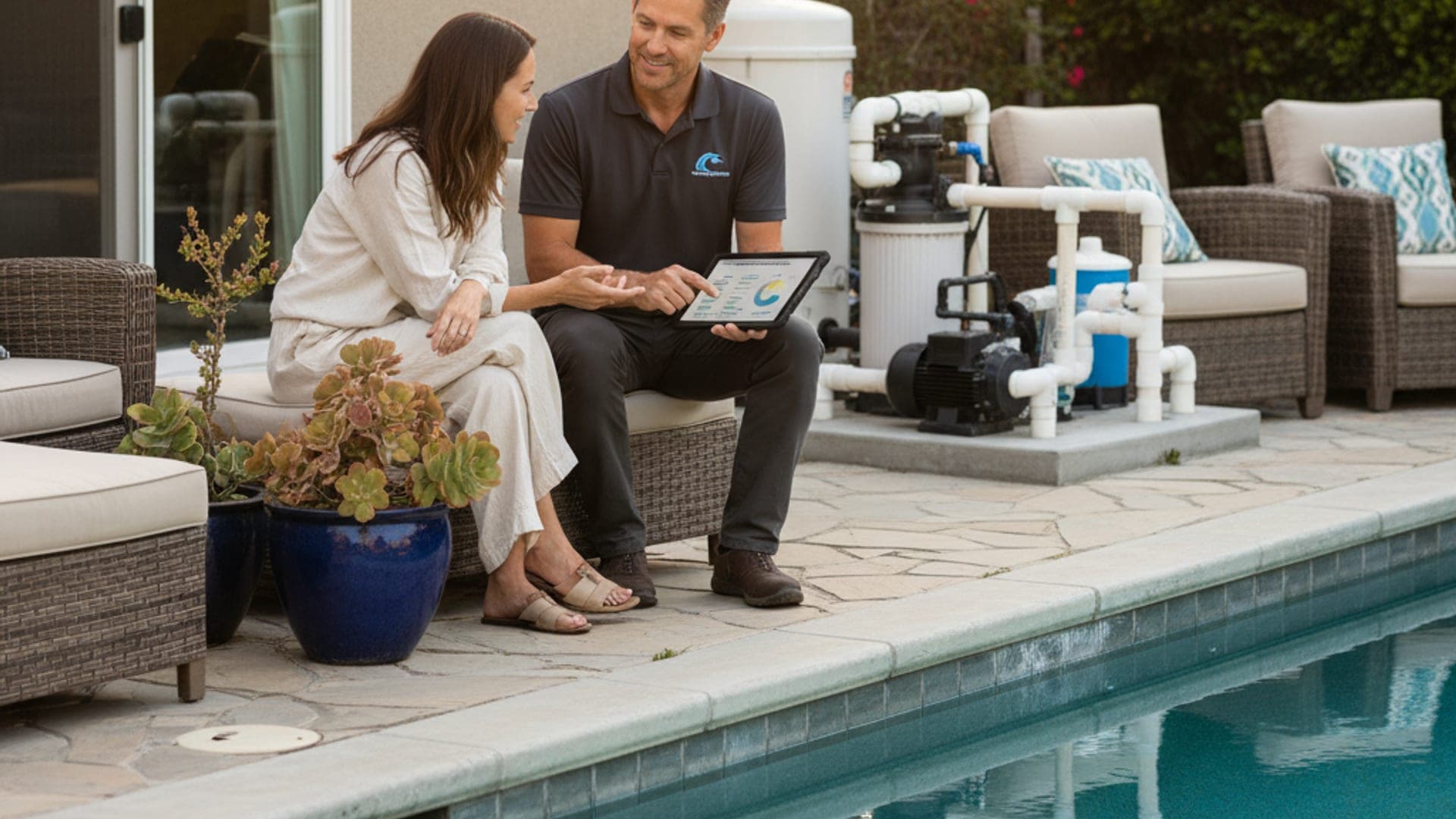
What's the process behind the Splash Pool SD referral network?
What actually happens when you use Splash Pool SD?
Tell us what's happening with your pool and we'll connect you to a licensed repair specialist in our San Diego County network who handles that exact kind of job. You work directly with the pro who comes out.
Which cities are covered by the network?
The network reaches all 67 cities across San Diego County: coastal spots like Del Mar and Solana Beach, inland North County (San Marcos, Escondido, Poway), East County (El Cajon, La Mesa, Santee), South Bay (Chula Vista, National City), and the backcountry (Ramona, Alpine).
Is there a charge for being matched with a specialist?
The connection costs nothing. You pay only the specialist performing the repair, and they'll explain pricing to you before any work begins.
Do I get to pick the company, or is one assigned to me?
Matching is based on the job you describe and which network member handles that repair type in your area. If something doesn't feel right, let us know and we'll direct you to someone else.
How quickly can a specialist come look at my pool?
That depends on the specialist and how urgent the problem is. Call (858) 400-4404, describe what's happening, and we'll tell you the soonest window the right pro actually has.
What kinds of services does the network cover?
Emergency calls, leak detection, salt water conversion, resurfacing and replastering, equipment installation and upgrades, pool repair, hot tub and spa service, plus fountain and water feature work. That covers the full range.
What kinds of pool repairs does the network handle?
My pump won't start at all. Can it be fixed or do I need a replacement?
It depends on what failed. A dead capacitor or seized motor bearing is repairable, while a burned-out motor typically calls for replacement. A specialist can determine which within minutes of testing.
How can I tell whether the issue is the pump, the filter, or something else?
From the outside, you usually can't. Low flow, strange noise, and pressure swings can each point to different parts of the system. That's precisely why a real diagnosis beats guessing.
My filter pressure gauge is reading much higher than normal. What does that indicate?
Usually a sign the filter needs cleaning or the media is worn out. Ignoring it stresses the pump. A tech can tell you which one in a few minutes on site.
My heater is showing an error code. Is that something that can be repaired?
Most codes point to something a pro can fix in the field, such as an ignition issue, a faulty pressure switch, or a dirty flame sensor. A specialist reads the code first, then quotes the repair.
Do you cover underground plumbing leaks, or just visible ones?
Underground plumbing is a standard part of pool repair. It usually requires a leak detection pass first to locate where the line is compromised before anyone begins digging.
Once a tech arrives on site, how much time does a standard equipment repair usually require?
It comes down to what the diagnosis reveals and whether a part must be ordered. Note the equipment model, describe what you observe, and ask what can be finished during this visit versus a follow-up trip, with the scope documented in writing.
What does professional pool leak detection involve?
How do specialists locate a leak I can't see?
They pressure test the plumbing lines, use dye testing at suspect spots, and sometimes employ electronic listening equipment for underground lines. The goal is to pinpoint the source before anything gets opened up.
How can I tell whether my pool has a real leak or is just losing water to evaporation?
For a quick test, put a mark at the water line, leave the pump off for 24 hours, and compare the drop against a bucket of water placed on a step. If the pool level falls noticeably more than the bucket, it likely signals a leak rather than evaporation.
Does finding a leak require tearing anything up?
No, it isn't. The detection step itself is non-invasive. Only after the source is confirmed does any digging or opening of plumbing take place, so you won't pay to have things opened based on a guess.
If the leak ends up being in the plumbing rather than the pool shell, what happens?
The process stays the same; only the repair changes. Plumbing leaks are located along the line and fixed at that spot, while shell leaks get patched or, when extensive, handled during resurfacing.
How much water loss counts as normal in San Diego, and how much signals a real problem?
Don't estimate; measure it. Do a bucket test: place a weighted bucket on a step and fill it so the water level inside matches the pool. Evaporation drops both equally, so if the pool level falls more than the bucket over 24 hours, that gap is a leak. Water loss only while the pump runs points to the pressure side.
At what point should pool equipment be replaced rather than repaired?
Is the cost of upgrading to a variable-speed pump justified?
In most San Diego cases, yes. Time-of-use electricity rates make single-speed pumps expensive to run, and a variable-speed pump moves the same water at a lower speed for far less power, because draw falls much faster than flow does. Efficiency rules also govern what a replacement pump may be, so ask the specialist which requirement applies before parts are ordered.
What's the typical lifespan of pool equipment before replacement becomes necessary?
It varies with run hours, hard water and scale, sun and heat on the equipment pad, and maintenance history. Hard water areas trend toward the shorter end. Ask the licensed specialist to inspect the pad and to put any remaining manufacturer or workmanship warranty in writing.
Is hard water genuinely harmful to equipment, or is that exaggerated?
It's real. Mineral-heavy water common in East County and inland North County scales up salt cells, clogs heater exchangers, and crusts cartridge filters faster than in softer-water areas.
What equipment brands do specialists in the network install?
Mostly Pentair and Hayward for pumps and filtration, with Jandy showing up often for automation. Pros pick based on reliability and parts availability in this market, not just rebate eligibility.
Is it possible to automate equipment so it's controlled from a phone?
Yes. Pentair IntelliCenter and Jandy iAqualink are the common installs, letting you run pumps, heaters, lights, and water features remotely once wired in.
Do I need to replace the entire equipment pad all at once?
No. Most homeowners replace one failed component at a time. A specialist can flag what's aging during a repair visit so the next failure isn't a surprise.
What signs indicate that a pool needs resurfacing?
How do I know it's time for a full resurface rather than just patching a small area?
When roughness is widespread, staining won't lift, or cracks spread across the surface, patching is usually just delaying the inevitable. A specialist can tell you whether a patch will actually hold.
What actually distinguishes plaster, quartz, and pebble finishes from each other?
Plaster is the smoothest and least expensive option but wears fastest. Quartz blends in aggregate for more durability at a similar feel. Pebble finishes last longest but have a rougher, textured surface underfoot.
How long is a pool actually out of commission during resurfacing?
Roughly one to two weeks start to finish: draining and chipping out the old surface, tile or coping work if included, applying the new finish, then refilling and a multi-week chemistry curing period before heavy use.
Does resurfacing usually include new tile and coping?
Often, yes, and it makes sense timing-wise. The pool is already drained and accessible, so matching new tile to the new finish in the same project avoids paying for access twice.
Is it possible to change the pool shape or add features during a resurfacing project?
Sometimes. Adding steps, a tanning ledge, or minor shape adjustments can piggyback on a resurfacing job since the shell is already exposed. Bigger structural changes are a separate conversation.
Is it worth converting to a salt water pool?
Does switching a chlorine pool over to salt require major work?
Generally no. The disinfection method stays the same under the hood; a salt cell simply generates the chlorine automatically rather than you adding it by hand. For most pools the conversion amounts to adding plumbing and equipment, not tearing everything apart.
Will the salt corrode the equipment I already have?
Current pool equipment comes salt-rated from the factory. Older metal fixtures such as ladders, lights, and handrails may corrode more quickly and could need replacement during the conversion.
How does routine upkeep differ between a salt pool and a chlorine pool?
The water typically feels softer and chlorine spikes happen less often, though salt cells still require periodic cleaning and will eventually wear out. It cuts down on hauling chlorine but doesn't remove upkeep entirely.
Is every pool a candidate for conversion, or does plumbing play a role?
The majority of residential pools can be converted. The key consideration is whether the equipment pad and plumbing run have enough room for the salt cell, which a specialist verifies before providing a quote.
Does the service cover spa and hot tub repair?
Do the pros work on spas connected to a pool as well as standalone hot tubs?
Both are covered. Attached spa systems and separate freestanding hot tubs fall into the same service category, though the diagnostic approach differs slightly between them.
My spa jets have lost pressure. Is that something a specialist can fix?
Yes, it's a frequent request. Common causes include a blocked line, pump failure, or suction-side air leak. A pro diagnoses it on site.
My spa heater won't reach the set temperature. What typically causes that?
Common culprits include a safety switch triggered by low flow, a worn heating element, or a faulty thermostat sensor. Flow gets checked first since it's the most frequent cause.
Is it possible to repair a broken fountain or water feature?
My water feature pump is noisy or barely flowing. Can that be fixed?
Usually. Weak flow and noise often point to a damaged impeller, a blockage in the plumbing, or a pump approaching end of life. Getting a diagnosis first makes sense before committing to full replacement.
Does the service cover decorative fountains that aren't tied to a pool system?
Absolutely. Whether a fountain or water feature shares plumbing with your pool or operates on its own, it's covered by the same service.
Why has my waterfall or sheer descent feature started flowing unevenly?
Uneven flow often signals a blockage in the line, a misaligned weir, or a pump that needs tuning. A specialist can typically fix it without replacing the entire feature.
What should I do if I have a pool emergency?
What actually qualifies as a pool emergency?
If there's a possible gas leak or any electrical shock in the water, that's a 911 situation, not something to wait on through a pool referral. Major leaks and other equipment issues that don't pose a life-safety risk can be described when you request a separate emergency pool service match.
What happens if my pool emergency occurs on a weekend?
If you suspect a gas leak, leave immediately and call 911 from a safe location, as SDG&E directs. If you suspect electrical shock in the water, turn off power and call 911. Do not wait for a pool referral on those hazards. If the issue is ordinary equipment repair and not a life-safety emergency, call (858) 400-4404 and describe what you see. Fee and availability depend on the independent company.
What questions should I have ready about emergency service costs?
Ask whether after-hours or emergency dispatch carries a different price than a standard service call, and request that figure in writing before anyone is dispatched.
What steps should I take if I suspect a gas leak or electric shock near the pool?
When a gas leak is suspected, get out right away and dial 911 from somewhere safe, as SDG&E directs. If electrical shock in the water is suspected, shut off power and call 911. These steps come before any repair or renovation matching request.
Still have questions?
Call the shop and we'll help you figure out if we're the right fit for your pool.