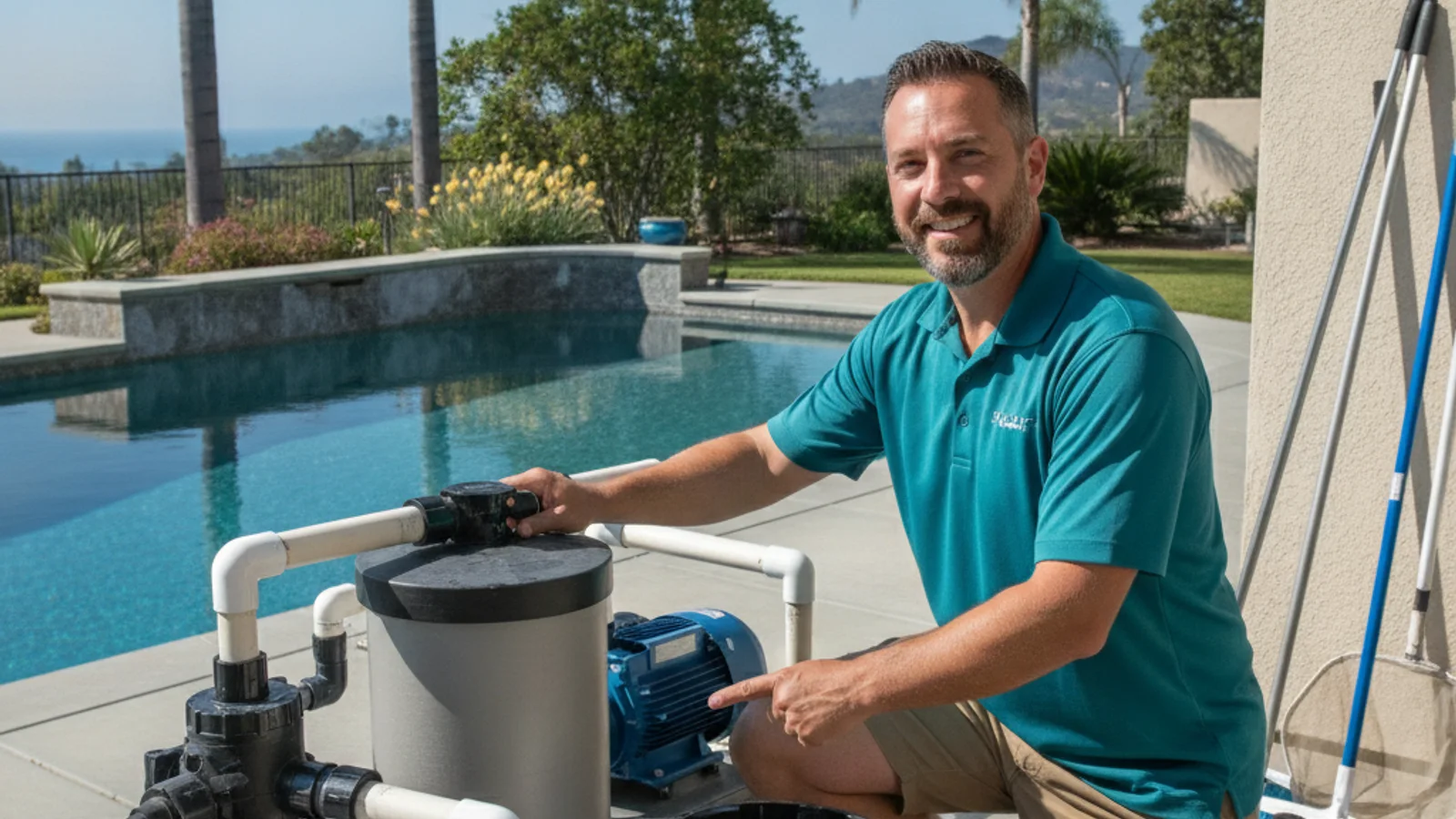
Sand, cartridge, and DE filters all clean pool water, but they handle San Diego’s varied conditions very differently. Inland yards with mineral-heavy fill water stress filters in one way. Coastal pads with salt air stress them in another. Choosing the right type means matching the tank to your specific water and climate, not picking a brand off a shelf.
How each filter type works
Sand filters
Water gets pushed downward through a bed of sand. Trapped debris stays in the sand until you backwash. Backwashing reverses the flow and flushes dirty water out through a dedicated waste port. After each backwash cycle, you need to refill the pool to the proper level.
If sand appears in the pool, the laterals or an internal component has failed. That isn’t a normal condition and needs professional attention.
Cartridge filters
Cartridge filters have no backwash cycle. There is no waste setting. You shut the pump off, depressurize the tank, and pull the pleated elements out. Rinse them or replace them as needed.
This saves water compared to backwashing, but it isn’t maintenance-free. Inland mineral film cakes the pleats, and a garden hose often can’t remove it. Coastal salt air corrodes the clamp band and hardware over time.
If debris blows through the jets after a rinse, a pleat is torn or water is bypassing the element.
DE filters
Diatomaceous earth powder coats internal grids inside the tank. The powder catches particles finer than sand or cartridge media can. After every backwash, the grids must be recast with fresh powder.
DE powder is a handling product. Follow the manufacturer’s personal protective equipment guidance when working with it. Backwash water carries spent powder to waste, so confirm discharge rules before opening any valve.
Pale powder coming through the return jets means a torn grid or manifold damage. Recasting a failed grid won’t hold. The grid itself needs replacement.
Inland mineral water vs coastal salt air
San Diego County isn’t one climate or one water supply. The difference matters for filter choice and maintenance.
Inland: El Cajon, Santee, Escondido
These areas sit on mineral-heavy fill water. Scale builds on sand beds, cartridge pleats, and DE grids. Scale can seize multiport valve internals so the handle won’t turn.
Signs of mineral problems:
- Sand not settling after backwash, which points to a scaled or channeled bed
- Cartridge loading within a day of cleaning, which points to mineral caking
- Multiport valve stuck from scale, not from dirty media
A full drain is different from a backwash. If you need to drain, confirm discharge rules separately with your water provider.
Coastal: La Jolla, Coronado, Imperial Beach, Carlsbad
Salt air corrodes clamp bands, valve handles, gauge fittings, and screws. The filter media itself may still function while the hardware around it fails.
Signs of salt-air damage:
- Rusted cartridge clamp band, which is a hardware issue, not a media issue
- Multiport valve stuck from corrosion, not from dirty media
- Weak returns plus low pressure, which may indicate a pump issue rather than a filter problem
No single filter type is best for all San Diego yards. An inland plaster pool doesn’t face the same conditions as a coastal salt-air pad. A licensed specialist matches the tank, fill water, and local air to recommend the right setup.
No per-city grains-per-gallon hardness data has been published for this topic. Your matched pro can test your fill water on site.
Identifying the filter on your pad
Before calling anyone, read the printed label, plate, or sticker on the tank. Photograph it. That label tells the manufacturer, model, and type.
Quick visual clues:
- A clamp band around the lid usually means cartridge.
- Cartridge tanks lack a multiport backwash valve.
- Sand and DE share a round-vessel silhouette.
- Both sand and DE may show a multiport or push-pull valve.
- DE clues include powder bags, a slurry pot, or specific label wording.
Never open a pressurized filter tank. Shut the pump at the timer or breaker first. Let a qualified specialist relieve pressure before anyone opens the lid.
Manufacturers list micron ratings on product sheets if you need to compare filtration fineness.
Backwash discharge rules
Backwashing drops the water level, and that water has to go somewhere legal. There is no countywide discharge rule confirmed for this page. Carlsbad guidance doesn’t apply to El Cajon. Each water district sets its own rules.
Start with the San Diego County Water Authority as a regional reference. Then check your utility bill. It names the actual provider for your address. Contact them before you open a waste valve.
Never dump backwash to a driveway, gutter, or canyon.
What to document before calling a pro
Having this ready speeds up the diagnosis:
- Photograph the tank label and the entire equipment pad
- Include the pump and any waste line in the shot
- Note whether the tank has a clamp lid or a multiport valve
- Record the pressure gauge reading
- Note whether the needle moves when the pump stops
- Distinguish cloudy pool water from water pooling on the slab
- Record your neighborhood, since inland vs coastal matters
- Note whether DE powder is stored on site
- Record if the pump hums, leaks, or loses prime
Don’t run the pump against a packed filter. That can damage the pump and the tank.
Licensing and what the law says
California Business and Professions Code section 7048, as amended effective January 1, 2026, exempts only casual minor work that requires no permit. Advertising as a contractor voids the exemption. Employing someone to do the work also voids it.
Filter replacement requires a licensed professional. Verify any contractor through the CSLB license lookup tool before hiring. Home improvement contract downpayments are capped by statute. Confirm the contract type before paying any deposit.
What drives the price of a filter replacement
Several factors move the cost: pool size, finish type, equipment access on the pad, the brand and model of the new filter, and whether a permit is required. Your matched pro quotes the full scope before any work starts. For a deeper breakdown, see our guide on what drives pool equipment replacement cost.
If you are unsure whether to repair or replace, this post on filter repair vs replacement walks through the decision. And if your water is the underlying problem, our piece on hard water and San Diego pools covers what mineral-heavy fill does to equipment over time.
For broader equipment context, pool filter replacement in San Diego covers the process from start to finish.
When to call us
If your filter is leaking, losing pressure, blowing media into the pool, or you need a full replacement, that work requires a licensed pool professional. Splash Pool SD matches you with licensed independent specialists in your area. Call us at (858) 400-4404 and we’ll connect you with a licensed local pool specialist.
Frequently asked questions
How do I tell if my pool has a sand, cartridge, or DE filter?
Check the printed label or sticker on the tank. A clamp band around the lid and no multiport valve usually means cartridge. Sand and DE both use round vessels with multiport or push-pull valves. DE systems often have powder bags or a slurry pot nearby. Photograph the label before anyone guesses the type.
Do cartridge filters need backwashing?
No. Cartridge filters have no backwash cycle and no waste setting. You shut the pump off, depressurize the tank, and pull the pleated elements out to rinse or replace them. This saves water compared to backwashing but still requires regular hands-on maintenance.
Where can backwash water legally go in San Diego County?
There is no single countywide discharge rule confirmed for this topic. The water district serving your specific address sets the rules. Check your utility bill for the provider name, then contact them directly. Never dump backwash to a driveway, gutter, or canyon.
Which filter type is best for San Diego hard water?
No single type wins for every yard. Inland areas like El Cajon, Santee, and Escondido have mineral-heavy fill water that scales sand beds, cakes cartridge pleats, and coats DE grids. Coastal areas face salt-air corrosion on hardware instead. A licensed specialist matches the tank to your fill water and local air conditions.
Does filter replacement require a licensed contractor in California?
Yes. California Business and Professions Code section 7048, as amended effective January 1, 2026, exempts only casual minor work that needs no permit. Filter replacement requires a licensed professional. You can verify any contractor through the CSLB license lookup tool before hiring.
Need professional help in San Diego County?
Splash Pool SD connects you with a licensed specialist for any service in this post.