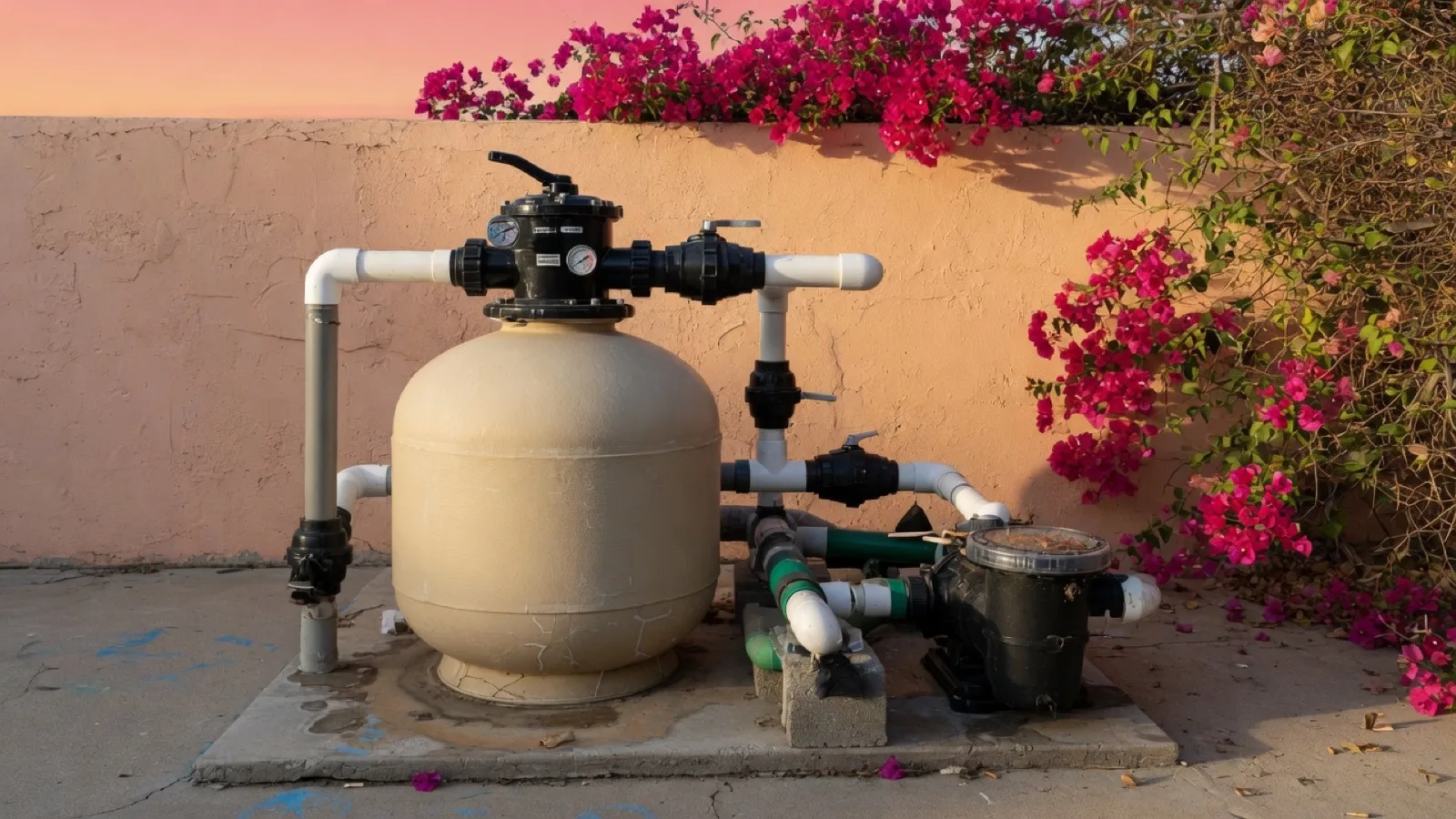
A sand filter that still backwashes can still be done. The bed fails in ways a calendar never sees. Water punches a hole through packed sand. Oils and scale glue the top into mud balls. A cracked lateral dumps media into the pool. Inland San Diego fill makes all three more common than a coastal pad that sees softer hose water.
This is not a “replace every few years” pitch. CLAIMS on this site do not carry a sand lifespan, and we will not invent one. The tank label and the manufacturer’s service sheet for that model name the media (often #20 silica on many residential tanks) and the fill weight. The licensed pro reads those, then looks at what the bed is actually doing.
If you are still choosing a tank type, start with sand vs cartridge vs DE. If the tank itself is cracked, leaking at the clamp, or the valve is toast, that is filter repair or replacement.
Signs the sand is spent, not just dirty
A healthy sand bed loads up, you backwash, the gauge drops, and the water clears. Spent media breaks that loop.
Pressure that will not come down. You backwash until the waste runs clear, return to Filter, and the gauge sits where it was. That is a packed or calcified bed, not a missed cycle. Hard water in East County scales the grains together. A chemical clean of the bed can sometimes recover oil and scale. It cannot restore grains that have gone round.
The pool stays dull after a real backwash. Channeling is the usual story. Water has opened a path through the sand and is barely filtered. The gauge can look fine because the hole is easy to push through. You only see it when the tank is open and the top of the bed has ridges and holes instead of a level surface.
Mud balls. Dark, greasy clumps in the top of the media. Sunscreen, body oil, and dust from canyon lots in Poway glue the sand. Backwashing does not break them.
Sand on the plaster. That is a broken lateral or a damaged hub until a pro proves otherwise. New sand will not stay in a tank with a cracked lateral. Do not keep pouring bags in to “top it off.”
Note your clean pressure after a backwash while the bed is still working, and keep that number. It is the only baseline that tank has. We do not publish a universal “backwash at X psi” figure. Follow the label on that valve and that tank.
What opening the tank actually involves
Never open a pressurized filter. Pump off, air relief open, pressure at zero, then the clamp or lid. Sand is heavy when it is wet. Laterals are plastic fingers at the bottom of the tank. A shovel through the bed snaps them.
A licensed pro will:
- Confirm the tank is a sand filter, not DE grids hiding in a similar vessel.
- Photograph the label for media type and charge weight.
- Dump or vacuum the old media, inspect every lateral, and replace any that are cracked or missing screen.
- Reload the specified media to the specified level, not “until it looks full.”
- Restart, check for sand in the returns, and record the new clean pressure.
That sequence is why this is not a Saturday errand. California Business and Professions Code section 7048, as amended effective January 1, 2026, exempts only casual minor work that needs no permit and stays under $1,000 aggregate. Filter media replacement on an inground system is not that exemption. Verify the contractor on the CSLB license check.
San Diego water and why inland beds die first
The San Diego County Water Authority blend is imported water plus local supply, and it is not the same at every hose bib. Inland cities (El Cajon, Santee, Escondido, Ramona) tend to leave more mineral on equipment. Coastal pads (Ocean Beach, Imperial Beach, La Jolla) add salt air that eats tanks and clamps instead.
Mineral load cakes the top of a sand bed. That is channeling weather. Salt air rusts the tank clamp and the multiport screws. Neither one is a reason to guess a year. It is a reason to tell the pro which city the pad sits in.
Backwash discharge is its own rule. There is no single countywide “dump it here” answer on this site. The water district on your bill sets where waste water may go. Never send it to a gutter or a canyon.
Repair the laterals or change the tank
Sand in the pool plus a tank that still holds pressure is often laterals only. A tank with a hairline at the belly, a seized multiport, or a clamp that will not seal is a different estimate. Ask the matched pro to separate:
- media only
- laterals and hub
- valve
- tank
If a line is not on the written estimate, it is not confirmed. Splash Pool SD matches you with licensed independent pool contractors. We do not hold the trade license, own the truck, or warranty the work.
How to describe the fault when you request a match
Say it is a sand filter (round tank, multiport or push-pull on top), not a cartridge. Name the brand and model from the label if you can photograph it. Say whether the gauge drops after backwash. Say whether sand is showing up on the floor. Say the city.
Call (858) 400-4404 and we will match you with a licensed local pool specialist.
Frequently asked questions
How often should I change the sand in my pool filter?
There is no calendar that fits every San Diego pad. The tank label and the maker's service sheet for that model decide the media type and the fill weight. The decision to change sand is about what the bed is doing: channeling, mud balls, pressure that will not drop after a real backwash, or sand returning to the pool through a broken lateral. A year count alone is not a diagnosis.
What is channeling in a sand filter?
Channeling is a hole the water has punched through the sand bed. Flow then bypasses the media, so the gauge can look calm while the pool stays dull. Hard inland fill in El Cajon, Santee, and Escondido cakes the top of the bed and makes those channels more likely. A licensed pro confirms it with the tank depressurized, never with the clamp still under pressure.
Why is there sand in my pool?
Sand on the floor is not a media-change reminder. It usually means a cracked lateral, a failed laterals hub, or a valve problem that is letting media into the return. Pouring new sand on a broken lateral sends that sand straight back out. The pro inspects the laterals when the tank is open.
Can I open the sand tank myself?
Never open a pressurized filter tank. Shut the pump off and depressurize the system before anyone touches a clamp, lid, or multiport. Sand tanks hold a lot of weight. Laterals snap if someone digs with a shovel. This is licensed work under California's contractor rules when the job is not a casual, unpermitted task under the $1,000 B&P 7048 threshold.
Is this the same as choosing sand vs cartridge vs DE?
No. The types page explains how each tank works. This page is the sand-bed failure itself: when the media inside an existing sand tank is spent or the laterals are broken.
Need professional help in San Diego County?
Splash Pool SD connects you with a licensed specialist for any service in this post.