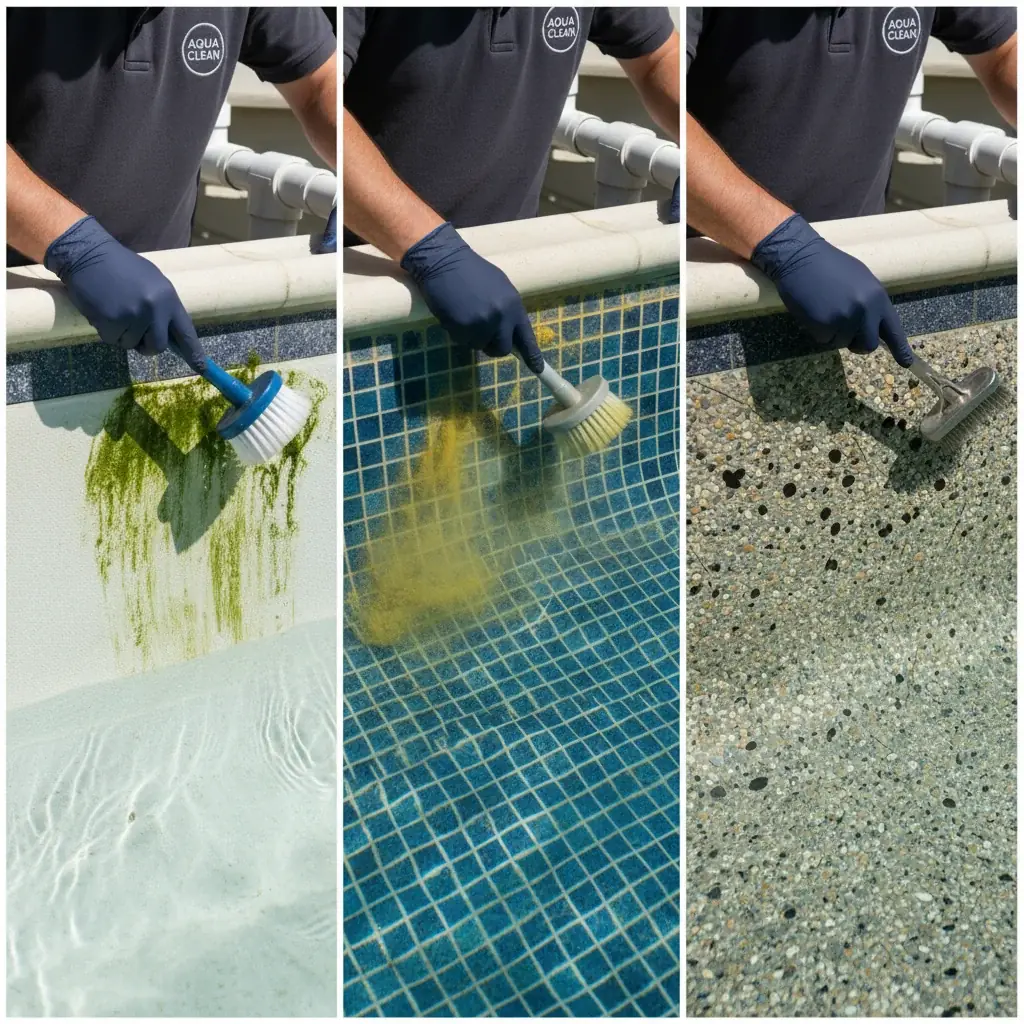
Three types of algae invade San Diego pools: green, yellow (also called mustard), and black. Each one looks different, behaves differently, and demands a different chemical approach. Treat the wrong type with the wrong product and you will stare at cloudy water for weeks. Here is how to tell them apart and what actually kills each one.
Green algae: the most common type
Green algae is what most people picture when they hear “algae bloom.” The water turns cloudy or pea-soup green. A slippery film coats the walls. The algae floats freely in the water column rather than clinging to surfaces.
A pool can go from clear to green in 48 hours. Heat and low chlorine are the usual triggers. You will often notice a smell before the color change becomes obvious.
Green algae is the least resistant type. It has no special cell-wall defenses. That makes it the easiest to kill, but only if you hit it hard enough on the first try.
Treatment for green algae:
- Shock the pool to 10 to 20 ppm free chlorine.
- Follow with a standard quat algaecide at label dosing.
- Run the filter continuously until the water clears, usually 24 to 72 hours.
If your pool has already turned green, our post on green pool cleaning in San Diego walks through the full recovery process. For step-by-step shock instructions, see how to shock a pool.
Yellow and mustard algae: the sneaky one
Mustard algae looks like dirt, sand, or pollen. It settles on the pool floor, shaded walls, and corners. When you brush it, the cloud disperses, then resettles within hours. The color ranges from yellowish-green to brownish-yellow.
Unlike green algae, mustard algae doesn’t cloud the water column. That makes it easy to mistake for debris. The giveaway is that it keeps coming back after you brush it away.
This type has real chlorine tolerance. A standard shock dose won’t finish it. It also hitchhikes on swimsuits, toys, and brushes, which is why reinfection is so common.
Treatment for yellow and mustard algae:
- Raise free chlorine to 30 ppm.
- Use polyquat 60, not a cheap quat algaecide. The polyquat molecule is larger and more persistent.
- Decontaminate all gear with diluted bleach: suits, floats, brushes, nets.
- Rinse cartridge filter elements with diluted bleach after treatment.
Skipping gear decontamination is the number one cause of recurrence. Spores survive inside filter media and reseed the pool within days. For a deeper look at this type, see our post on mustard algae in San Diego pools.
Black algae: the hardest to kill
Black algae appears as dark blue-green or black spots embedded in plaster, grout, or concrete. It doesn’t float. It resists brushing. A protective outer layer shields the cells underneath, and root-like rhizoids anchor deep into porous surfaces.
If the roots survive treatment, the spots regrow within days. This type almost never affects vinyl or fiberglass pools. Older plaster or exposed gunite carries the highest risk.
Treatment for black algae:
- Break the protective layer first with a stainless steel wire brush on plaster.
- Apply copper-based algaecide, which penetrates the outer layer.
- Shock at a high dose and repeat over 2 to 3 days.
- If rhizoids have penetrated deep into rough plaster, resurfacing may be the only permanent fix. Our guide on pool resurfacing options covers what is available.
Expect a week or longer for full clearance, and watch for returning spots.
Check your cyanuric acid first
San Diego pools often run high stabilizer levels. Above 80 ppm, chlorine power drops sharply. You can dump shock into the water and get almost no killing effect if your cyanuric acid is too high.
Test stabilizer before starting any algae treatment. If it reads above 80 ppm, dilute the pool first. We cover this in detail in our post on cyanuric acid too high.
Treatment sequence: order matters
The steps below apply to all three types. Adjust the specific product and dose based on which algae you identified above.
Step 1: brush first
Brushing breaks the protective layer so algaecide can reach the cells. Use a nylon brush for green algae. For mustard algae, brush all surfaces including steps, ledges, and behind ladders. For black algae, use a stainless steel wire brush on plaster.
Step 2: balance the water
Set pH to 7.2 to 7.4. That range maximizes chlorine effectiveness. Above 7.8, a large percentage of your chlorine is neutralized before it can kill anything. Adjust pH and alkalinity before you add shock.
Step 3: algaecide, then shock
Dose algaecide per the label first. Then shock at night, because UV burns off chlorine during the day. The baseline for green algae is 1 lb of cal hypo per 10,000 gallons. For yellow and black algae, double or triple that dose.
Step 4: run the filter continuously
Run the filter 24 hours straight until the water clears. Dead algae is removed through filtration. For a serious outbreak, set the multiport valve to “waste” and backwash first to remove the bulk of the debris.
Step 5: clean or backwash the filter
Clean or backwash at 24 hours after treatment. Do it again at 48 hours if the water is still cloudy. For mustard algae, rinse cartridge elements with diluted bleach. Spores survive inside filter media and cause reinfection if you skip this step.
San Diego summer prevention
Outdoor pools in San Diego County hit water temperatures of 82 to 88 degrees from June through September. High UV intensity and heavy use make this the peak window for algae blooms. Spores are always present. Chemistry is what prevents them from gaining a foothold.
- Maintain free chlorine at 2 to 4 ppm consistently.
- Run the pump at least 1 hour per 10 degrees of water temperature. At 80 degrees, that means 8 hours minimum. Short pump cycles create dead spots where algae takes hold.
- Brush walls and the waterline weekly.
- Keep cyanuric acid under 80 ppm. Check stabilizer monthly during summer.
- Clean cartridge filters every 4 to 6 weeks in summer.
- Backwash DE or sand filters when pressure rises 8 to 10 psi above the clean baseline.
Consistent maintenance is the strongest defense against all three types. If you want a deeper look at clearing a green pool on a timeline, see how long to clear a green pool.
When to call us
If you have shocked twice and the algae is still alive, something else is wrong: high stabilizer, poor circulation, or a failing filter. Black spots returning within a week mean the rhizoids survived. A licensed pool pro can diagnose the underlying issue and get the water clear without wasting more chemicals on guesswork. Call us at (858) 400-4404 and we’ll connect you with a licensed local pool specialist.
Frequently asked questions
Which type of pool algae is the hardest to kill?
Black algae is the toughest. Its protective outer layer shields the cells, and rhizoids anchor deep into porous plaster. You need a wire brush, copper-based algaecide, and repeated high-dose shock over several days. If the roots survive, it regrows within days.
Can I use the same algaecide for every type of algae?
No. Green algae responds to standard quat algaecide. Yellow and mustard algae need polyquat 60, which has a larger, more persistent molecule. Black algae requires copper-based algaecide that can penetrate its outer layer. Using the wrong type wastes time and chemicals.
How long does it take to clear a pool after algae treatment?
Green algae typically clears in 24 to 72 hours. Yellow and mustard algae takes 3 to 5 days and often needs multiple passes. Black algae can take a week or longer, and it may return if the roots were not fully destroyed.
Can mustard algae live on my pool equipment?
Yes. Mustard algae hitchhikes on swimsuits, floats, brushes, and filter media. If you skip decontaminating your gear with diluted bleach, reinfection is almost guaranteed. That is the number one cause of recurrence.
What is the best way to prevent algae in a San Diego pool during summer?
Keep free chlorine between 2 and 4 ppm, run the pump at least 8 hours daily, brush walls weekly, and hold cyanuric acid under 80 ppm. Consistent maintenance is the strongest defense against all three types.
Need professional help in San Diego County?
Splash Pool SD connects you with a licensed specialist for any service in this post.