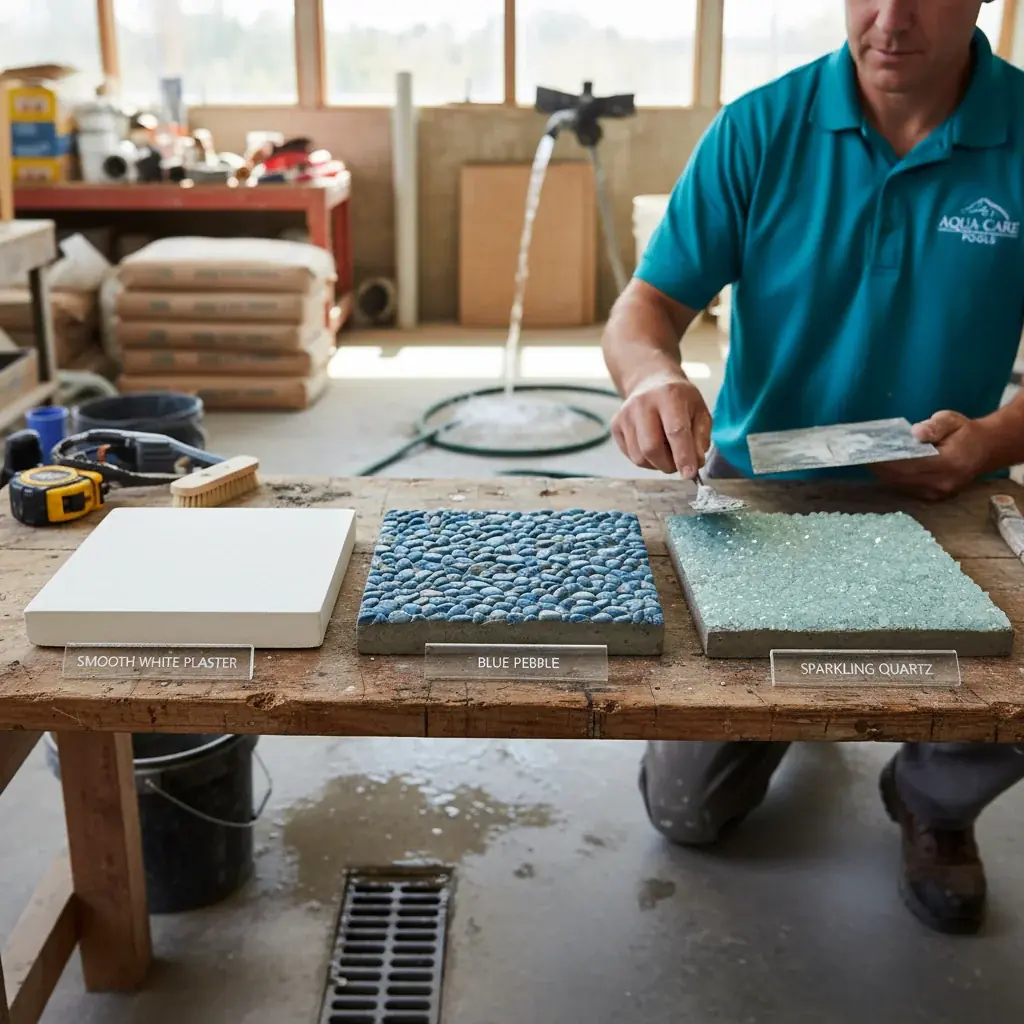
Choosing a pool finish in San Diego comes down to three options: white plaster, quartz, and pebble. Each one handles our hard water, intense sun, and evaporation differently. The right pick depends on your budget, how long you plan to stay, and whether your pool runs on salt or chlorine.
What each finish is made of
White plaster is Portland cement mixed with marble dust and water. It goes on smooth and looks clean on day one. The surface is inherently porous, though, which means calcium and minerals penetrate it over time.
Quartz finishes grind quartz aggregate into the same cement matrix. The crystals fill pores that plain plaster leaves open. That denser surface resists staining and scaling better than white plaster alone.
Pebble finishes embed river pebbles or glass beads in a cement base. During installation, the installer washes away the top layer of cement to expose the aggregate. What you see and touch is mostly stone or glass, with minimal cement showing. NovaBead and Pebble Tec are two well-known brands in this category.
Lifespan comparison
Manufacturer claims represent best-case scenarios. Real-world results depend on chemistry discipline. Here is what to expect in San Diego conditions:
- White plaster: 7 to 12 years
- Quartz: 12 to 18 years
- Pebble: 20 to 25 years
Chemistry drift shortens plaster life toward the 7-year mark. Pebble often looks good well past its warranty expiration. The difference between landing at the top or bottom of each range comes down to weekly water testing.
Why San Diego water is hard on finishes
San Diego County Water Authority delivers tap water with 300 to 400 ppm calcium carbonate. That is hard. Hardness varies by neighborhood depending on the source blend, but no part of the county gets soft water.
Evaporation makes it worse. Water leaves faster than dissolved minerals, so calcium concentration climbs. With 266 average sunny days per year, evaporation is constant. UV also degrades the cement binder in lesser finishes over time.
The chemistry ranges that protect your finish:
- Calcium hardness: 200 to 400 ppm
- pH: 7.4 to 7.6
- Total alkalinity: 80 to 120 ppm
Weekly testing keeps you in range. Let it slide and you will see scaling, etching, or roughness sooner than expected. For more on managing hard water specifically, see our guide on hard water and San Diego pools.
Scaling: the universal problem
White calcium deposits show up on all three finishes here. The difference is how each one handles removal.
Plaster is the most vulnerable. Acid-wash descaling can etch the surface underneath, thinning the finish each time you clean it. Quartz crystals resist mild acid better than plain cement, so light cleaning is safer. Pebble deposits are mostly cosmetic because the aggregate sits above the cement. A light acid wash is generally safe on pebble without damaging the surface.
Staining resistance
Stains come from metals like iron, copper, and manganese, or from organics like leaves and algae. San Diego’s hard water carries trace minerals that accumulate over years.
White plaster stains easily. Brown iron marks show up fast on a light surface. Quartz is more resistant because its denser surface limits mineral entry. Pebble is the most resistant. The aggregate itself hides discoloration that would be obvious on smooth plaster.
If your pool sits under trees or you are on well water with high iron content, staining risk goes up regardless of finish. Our post on pool stain removal in San Diego covers treatment options.
Fading and UV exposure
Fading primarily affects quartz and colored plaster. The pigments live in the cement binder, and UV bleaches them over time. Deep blue or green quartz can lighten noticeably after 8 to 10 years.
White plaster doesn’t fade, but it roughens. Pebble color lives in the stone itself, not in pigment, so it resists fading far better.
Sun exposure matters by location. Full south-facing pools in Chula Vista or Escondido get more direct UV than shaded pools tucked behind fences or structures. If your pool bakes all day, pebble’s fade advantage is greater.
Cost for a typical San Diego pool
Here is what you are looking at on a typical San Diego pool, roughly 450 square feet of surface area:
White plaster Material and labor run $5 to $8 per square foot, putting a typical total at $4,500 to $7,500. Color options are limited: white, off-white, light gray, and light blue tint.
Quartz finishes Material and labor run $8 to $14 per square foot, with a typical total of $8,000 to $14,000. The color range is wide, and the aggregate gives the water a sparkle that plain plaster can’t match.
Pebble finishes Material and labor run $13 to $22 per square foot, with a typical total of $12,000 to $22,000. Premium glass bead options push the top of that range higher. Color and texture options are extensive.
These numbers include basic prep, draining, and standard bead-blasting of the old surface. Structural cracks, delamination, or tile replacement cost extra. The matched pro quotes the full scope before work starts.
Pebble finishes run $6 to $10 per square foot more than plaster upfront but last 20 to 25 years with proper care, which often makes the per-year cost competitive. You skip one or two full resurfacing cycles over the life of the pool.
For a deeper breakdown of what moves the price, see our post on pool replastering cost in San Diego.
Saltwater considerations
Salt systems are harder on all three finishes. Salt tends to lower pH, which accelerates plaster degradation. Quartz and pebble hold up better than white plaster in a saltwater environment.
If you are running salt or planning a conversion, discuss finish compatibility with your contractor before committing. Our guide on chlorine vs. salt water pools in San Diego covers the tradeoffs.
Which finish fits your situation
Choose plaster when:
- Your budget is tight
- The pool is older and likely needs structural work within 10 years
- You plan to sell within five years and want a fresh, clean look for listing
Choose quartz when:
- You want a visual upgrade without the full pebble price
- Your pool runs on saltwater
- You live in a high-hardness area like Mira Mesa, Santee, or El Cajon
- You plan to stay 10 to 15 years
- You want more design flexibility than plaster offers
Choose pebble when:
- A full backyard renovation is underway
- You want a finish that outlasts two resurfacing cycles
- Heavy use from kids or guests is the norm
- Slip-resistant texture matters on steps and benches
- You want a premium aesthetic for high-end outdoor living
Warranties and what voids them
Quartz finishes typically carry a 10-year limited material warranty. Premium pebble brands offer 10 to 15 years. Requirements almost always include chemistry logs and installation by a licensed professional. Some manufacturers require quarterly service records.
No documentation means a denied claim. Sustained pH below 7.2 voids all warranties because acidic water dissolves cement-based finishes. A common mistake is over-acidifying to correct high pH, which damages the finish you are trying to protect.
Licensing matters
California requires a C-53 Swimming Pool Contractor license for resurfacing work. You can verify any contractor through the CSLB license lookup. Unlicensed work also voids manufacturer warranties on premium finishes. We cover this in detail in our post on checking a pool contractor’s license in California.
Signs it is time to resurface
Don’t wait until the surface is failing badly. Delay increases prep costs and can expose the shell to damage. Watch for:
- Delaminating or bubbling plaster
- Structural cracks visible to the eye
- Surface rough enough to scratch swimmers
If you are seeing any of these, our post on signs your pool needs resurfacing walks through what to look for. Curing conditions vary by season, and this isn’t a DIY job.
When to call us
Resurfacing is licensed trade work that requires a C-53 contractor, proper prep, and chemistry knowledge specific to San Diego’s hard water. If your finish is rough, stained, or showing its age, a professional assessment will tell you whether repair or full resurfacing makes sense. Call us at (858) 400-4404 and we’ll connect you with a licensed local pool specialist.
Frequently asked questions
How long does pool plaster last in San Diego?
White plaster typically lasts 7 to 12 years here. San Diego's hard water and intense UV exposure push it toward the lower end unless chemistry stays tight. Weekly testing of calcium hardness, pH, and alkalinity is what separates a 7-year finish from a 12-year one.
Is pebble worth the extra cost over plaster?
Pebble runs $6 to $10 more per square foot than plaster upfront but lasts 20 to 25 years with proper care. Over the life of the pool, the per-year cost is often competitive because you skip one or two full resurfacing cycles.
Does quartz pool plaster stain easily?
Quartz is more stain-resistant than standard plaster but less so than pebble. The ground quartz crystals fill pores in the cement matrix, which limits how deeply minerals and organics can penetrate. It is a solid middle ground for stain resistance.
Which pool finish is best for a saltwater system?
Salt systems are harder on all cement-based finishes because salt tends to lower pH, which accelerates degradation. Quartz and pebble hold up better than white plaster in saltwater pools. Discuss finish compatibility with your contractor before committing to a salt conversion.
What license does a pool resurfacing contractor need in California?
California requires a C-53 Swimming Pool Contractor license for resurfacing work. You can verify any contractor through the CSLB license lookup. Unlicensed work also voids most manufacturer warranties on premium finishes.
Need professional help in San Diego County?
Splash Pool SD connects you with a licensed specialist for any service in this post.