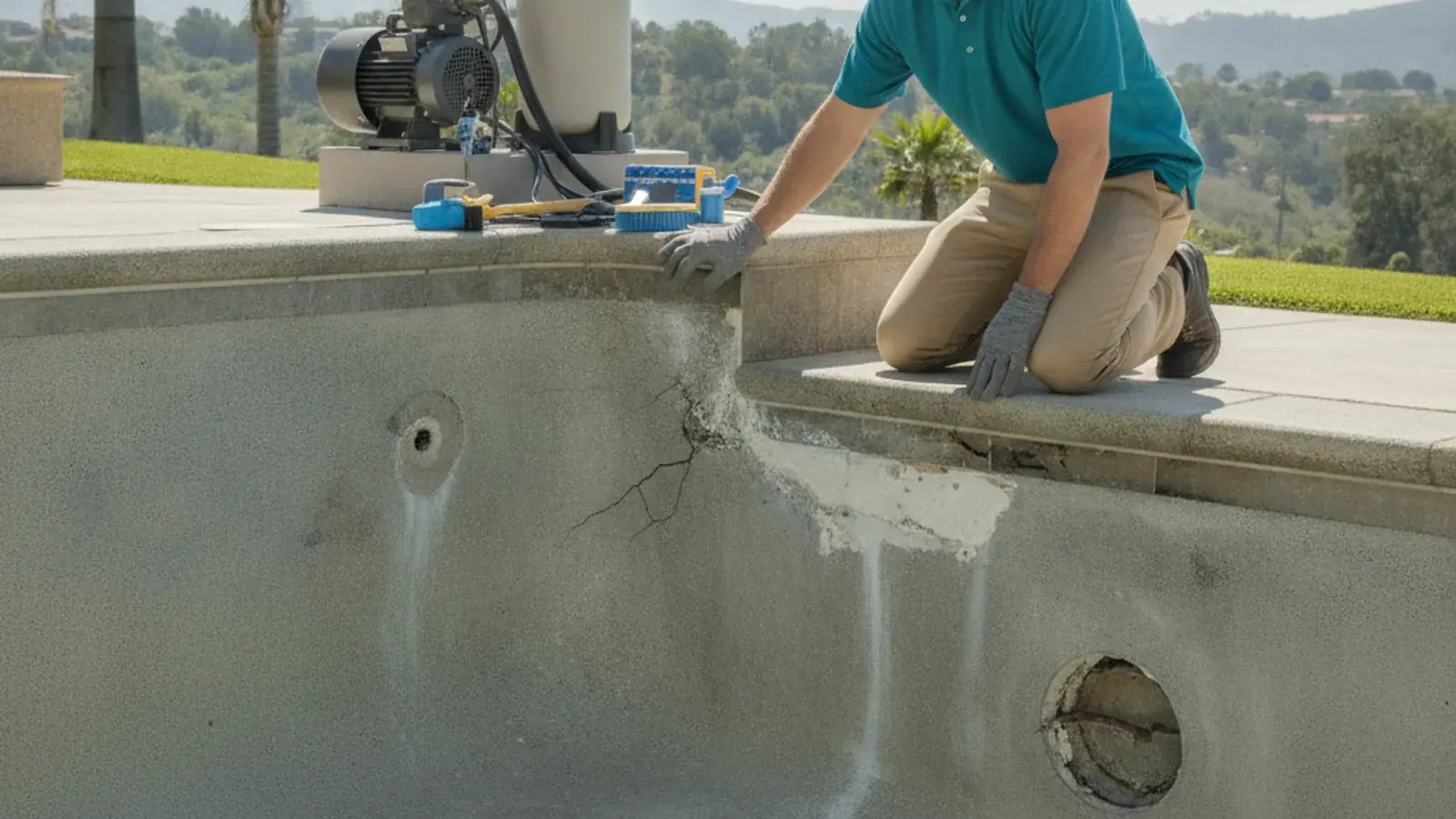
7 signs your pool needs resurfacing
San Diego’s long sun season, hard water, and occasional well-water supply all wear on pool plaster faster than pool owners expect. When the surface starts to fail, it doesn’t fix itself. Here are the seven signs that tell you it is time to resurface.
1. The surface feels rough or gritty
Run your hand along the pool floor or steps. If it feels like sandpaper or a cheese grater, the plaster is etching. Acidic or aggressive water eats away the top layer, leaving a coarse texture behind.
Kids and swimmers with sensitive skin usually notice this first. The roughness is worst on the floor and steps, where water chemistry fluctuations hit hardest.
Patching won’t help here. Etching spreads uniformly across the entire surface, so spot repairs just create uneven patches. The whole shell needs a new finish.
2. Dark or gray stains that won’t scrub out
Some stains sit on top of the plaster and respond to brushing or an acid wash. Others penetrate deep into the surface. If you have tried scrubbing and the stain stays, the plaster has become porous enough to absorb minerals from the water.
Older copper or iron plumbing makes this worse. Metal leaches into the water and darkens the plaster from the inside over multiple seasons. Once that happens, no amount of cleaning brings the original color back.
3. Visible cracks in the plaster
Not all cracks mean the same thing. Hairline spiderweb cracks are usually cosmetic, caused by shrinkage during the original cure. They are common and often harmless.
Wider cracks or straight-line cracks are different. They signal movement in the gunite or shotcrete shell underneath. Ground movement, freeze-thaw stress, and general aging all cause this kind of cracking.
Anything beyond hairline width deserves a look from a licensed professional. Structural cracks can develop into leaks if left alone. We cover this in more detail in our post on cracked pool plaster repair in San Diego.
4. Chalky water or white flakes despite balanced chemistry
If your water looks cloudy and you keep finding fine white flakes on the floor, the plaster is leaching calcium into the water. Those flakes are tiny pieces of degrading surface breaking off.
Many homeowners chase this problem with extra filter cleanings and chemical adjustments. It isn’t a filtration problem. High calcium hardness combined with a rough surface means the plaster itself is the source.
5. Exposed rebar or gunite
This is the most urgent sign. When the plaster wears through completely, the steel rebar or gunite shell underneath becomes visible. Exposed rebar corrodes in pool water, and rust stains bleed into the surrounding plaster.
Continued use at this stage risks weakening the structural shell. If you see bare metal or gray gunite showing through, stop using the pool and get a licensed specialist out as soon as possible.
6. Stains that survive an acid wash
An acid wash removes surface stains plus a thin layer of plaster. It works well for light discoloration when the surface underneath is still smooth.
If you have already had an acid wash and the stains came back, or if gray patches show through the finish afterward, the plaster is too far gone. The surface is too porous to hold a clean appearance. At that point, resurfacing is the only option that lasts. Our guide on pool acid washing in San Diego explains when an acid wash is enough and when it isn’t.
7. Unexplained water loss beyond normal evaporation
San Diego pools lose some water to evaporation, especially in summer. But if you are adding water more often than expected and the loss doesn’t match the weather, a crack may be letting water escape behind the plaster.
Resurfacing often exposes hidden hairline cracks that were sealed under the old surface. A pro pressure-tests the shell before applying a new finish, so any leak gets caught during the job rather than after. If you suspect a leak, our post on how pool leak detection works walks through the process.
Why San Diego pools wear faster
Several local factors shorten plaster life here compared to milder climates:
- Long sun season. UV exposure and heat accelerate surface breakdown year-round.
- Hard public water. San Diego’s municipal supply carries more dissolved minerals than many coastal cities elsewhere. Those minerals build up as scale and stress the plaster.
- Well water. Parts of the county still rely on well water, which often has higher mineral content and can degrade plaster faster than treated municipal supply.
- Uncovered pools. Pools without a cover or shade take the full brunt of sun and heat, which speeds up chemical consumption and surface wear.
Consistent water balancing and a good cover slow plaster wear significantly. If you want specifics on local water chemistry, our post on hard water and San Diego pools goes deeper.
What drives the cost of resurfacing
HomeGuide publishes general U.S. planning estimates: plaster resurfacing runs $6 to $8 per square foot, or about $6,000 to $8,000 for 1,000 square feet of surface. Pebble finishes run $7 to $15 per square foot, or about $7,000 to $15,000 for 1,000 square feet.
Your actual price depends on several factors: pool size, the finish you choose, how much prep work the shell needs, whether crack repair or tile work is included, and what equipment brands are already on the pad. The pro you are matched with will quote the full scope before any work starts.
For a breakdown of finish options, see our guide to pebble, plaster, and quartz resurfacing options. And if you are comparing bids, our post on comparing pool refinishing quotes in San Diego covers what to look for in a written scope.
What happens if you wait
Delaying a resurfacing job makes the problem worse, not better:
- Etching deepens and the surface gets rougher.
- Stains set further into the plaster and become harder to address.
- Hairline cracks widen with each temperature cycle.
- Water penetrates behind the plaster through unaddressed cracks.
- A job that started as a simple resurface escalates into a larger shell repair.
The longer you wait, the more expensive the fix becomes.
Resurfacing isn’t a DIY project
This job requires draining the pool, prepping the shell, and applying a new surface in a single continuous pour. An uneven pour causes streaking or premature cracking. Prep work often uncovers structural issues like rebar corrosion that need repair before the new finish goes on.
A licensed professional evaluation is required before any new surface is applied. Different finishes like plaster, quartz, and pebble also have different cure requirements, so the written scope should name the exact product and refill rules.
When to call us
If you are seeing two or more of these signs, the plaster is likely at the end of its life and a licensed resurfacing specialist should evaluate the shell. Call us at (858) 400-4404 and we’ll connect you with a licensed local pool specialist.
Frequently asked questions
How do I know if my pool needs resurfacing or just an acid wash?
An acid wash removes light surface stains and a thin layer of plaster. If the surface feels rough, shows gray patches through the finish, or has pitting, the plaster itself is breaking down and an acid wash will not fix it. A licensed specialist can tell the difference after inspecting the shell.
How long does pool plaster last in San Diego?
Lifespan depends on finish type, water chemistry history, sun exposure, and whether the pool is covered. San Diego's long sun season and hard water shorten surface life compared to milder climates. Well-water pools degrade faster. Track your last resurfacing date and ask a licensed contractor for written warranty terms on any new finish.
Can I resurface my pool myself?
No. Resurfacing requires draining, prepping, and a single continuous pour. An uneven pour causes streaking or premature cracking, and prep often uncovers structural issues like rebar corrosion. A licensed professional evaluation is required before any new surface goes on.
Does resurfacing fix a pool leak?
Resurfacing alone does not fix a structural leak. In fact, the process often exposes hidden hairline cracks under the old plaster. A pro pressure-tests the shell before applying a new finish. Sealing over an active leak traps the problem underneath.
Need professional help in San Diego County?
Splash Pool SD connects you with a licensed specialist for any service in this post.