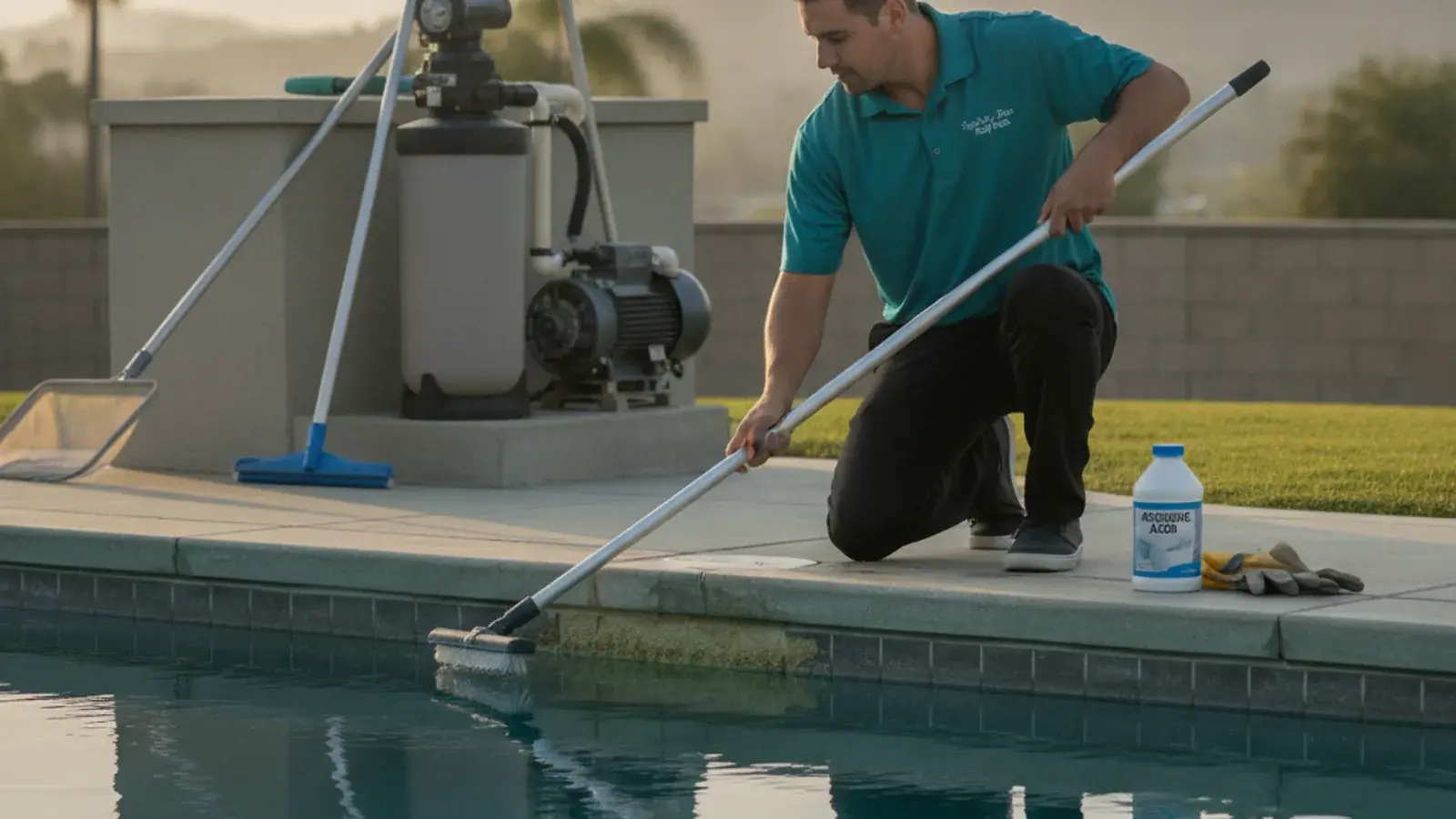
Pool stains in San Diego come from two sources: organic debris and dissolved metals in the tap water. The fix depends entirely on which one you have, and the wrong treatment makes things worse. This guide walks you through identifying the stain type, treating it, and keeping it from coming back.
How to identify the stain
Before you add anything to the water, run two quick tests.
The chlorine tablet test
Press a chlorine tablet directly on the stain and hold it for about 30 seconds. If the spot fades or lightens, the stain is organic. Leaves, berries, acorns, algae, and decaying plant matter all leave organic marks. They respond to oxidation.
If the spot doesn’t change at all, move to the next test.
The vitamin C test
Crush a plain vitamin C tablet and press the powder against the stain. If the discoloration lifts within a minute or two, you have a metal stain. Blue-green, gray, and rust-orange marks that ignore chlorine are the classic signs. The metals involved are usually iron, copper, or manganese dissolved in the water.
Treating organic stains
Organic stains respond to chlorine, so the approach is straightforward.
Balance the water first. Then shock the pool with a high dose of chlorine. Brush the stained area firmly right after dosing. Light organic stains often fade within hours.
For stubborn spots, keep the pump running continuously and brush the area twice a day for two to three days. The filter catches the material as it lifts off the surface. If you need a refresher on shocking properly, our post on how to shock a pool covers the steps.
If the same spots keep returning, overhead vegetation is likely outpacing your skimmer. A weekly service plus a mesh cover during heavy drop season solves that.
Treating metal stains
Metal stains need the opposite of chlorine. Ascorbic acid, which is plain vitamin C, is the treatment.
Lower the free chlorine level first. Chlorine fights the ascorbic acid and can push the metal deeper into the plaster. Once chlorine is low, broadcast ascorbic acid powder across the stain or apply it directly to a concentrated spot. The stain often lifts within minutes.
Here is the step most people skip: add a metal sequestrant immediately after the stain clears. Sequestrant binds the dissolved metal so the filter can carry it out of the water. Run the filter continuously and clean it afterward, because it holds the removed metal.
If you skip the sequestrant, the metal is still in the water. It redeposits on the plaster, and the stain returns. Metal stains aren’t permanent, but they need sequestrant to actually exit the pool.
Rust stains are metal stains with a source
Rust is a metal stain where you can often identify the cause. A bobby pin, a toy with a metal clip, or a stray screw sitting on the pool floor leaves a rust ring. Remove the object, treat with ascorbic acid and sequestrant, and the stain clears.
Recurring rust in one spot with no visible object is a different problem. It usually means rebar or a tie wire is pushing through thin or worn plaster. That is a structural issue, not a chemistry problem. Exposed steel under deteriorating plaster requires resurfacing to seal the steel back in.
San Diego factors that drive staining
The tap water in San Diego County runs roughly 250 to 400 ppm hard. Every time you top off the pool, dissolved minerals and metals enter with the fresh water. This is the same water that causes the white calcium line on tile, which we cover in our post on calcium on pool tile.
Inland and East County pools deal with oaks, sycamores, and eucalyptus dropping tannin-rich debris. Tannins are strong organic stainers. If your pool sits under these trees, organic staining is a constant battle without a cover and regular skimming.
Coastal pools see less leaf drop but more wind-blown grit and salt air. Salt air corrodes metal fittings over time, feeding metal staining slowly. Most pools in the county encounter both stain families at some point.
Staining here is rarely a one-time event. Year-round sequestrant dosing plus steady water chemistry is what keeps both types away. Our post on hard water and San Diego pools goes deeper into managing mineral-heavy fill water.
When chemistry isn’t enough
Surface stains lift with the treatments above. Embedded stains don’t. If you have run the correct treatment and the discoloration stays, it is inside the plaster itself.
For thick plaster finishes, a drain-and-acid-wash strips a thin top layer and can reveal clean surface underneath. There is a limit to how many times you can acid wash before the plaster becomes too thin. Our guide on pool acid wash in San Diego explains when that option makes sense.
If the plaster is already thin, etched, or stains return quickly after an acid wash, resurfacing is the real fix. You can compare finish options in our post on pebble, plaster, and quartz resurfacing.
Prevention: three habits that work
Most staining is preventable with a consistent routine.
Balance the water. Balanced water holds metals in solution and resists scale formation. Test regularly and adjust before levels drift.
Dose sequestrant on a schedule. Add extra sequestrant any time you add fresh tap water, because that is when new metals enter the pool. Most pool metal arrives through the garden hose.
Brush weekly. Brushing prevents debris and early stains from setting into the surface. Skim leaves before they sink and empty the skimmer basket often.
A weekly pool service handles all three habits automatically. If you are already on one, staining should be rare.
When to call us
If the correct treatment has failed, if rust keeps returning in one spot, or if the plaster looks thin and etched, the problem has moved beyond DIY chemistry. A licensed pro can assess whether you need targeted treatment, an acid wash, or a full resurface, and that assessment prevents spending money on the wrong fix.
Call us at (858) 400-4404 and we’ll connect you with a licensed local pool specialist.
Frequently asked questions
How do I tell if my pool stain is organic or metal?
Press a chlorine tablet on the stain for about 30 seconds. If the spot lightens, it is organic. If nothing changes, crush a vitamin C tablet and press it on the stain. If the stain lifts, it is metal.
Will chlorine make a metal stain worse?
Yes. Chlorine oxidizes dissolved metals and drives them deeper into the plaster surface. Use ascorbic acid and a metal sequestrant instead of adding more chlorine.
Do I need to drain my pool to remove stains?
Most stains clear without draining. Draining is a last resort for deeply embedded plaster stains, and in San Diego it carries a risk of shell cracking due to soil conditions.
Why do stains keep coming back in San Diego pools?
The tap water here runs 250 to 400 ppm hard and carries dissolved metals into the pool with every top-off. Local yards drop tannin-rich debris. Without regular sequestrant and brushing, both stain families return.
Does a saltwater pool stain differently than a chlorine pool?
Salt itself does not stain. However, salt systems can raise pH over time, which accelerates scale and metal staining. The same prevention rules apply regardless of sanitizer type: balance the water, dose sequestrant, and brush weekly.
Need professional help in San Diego County?
Splash Pool SD connects you with a licensed specialist for any service in this post.