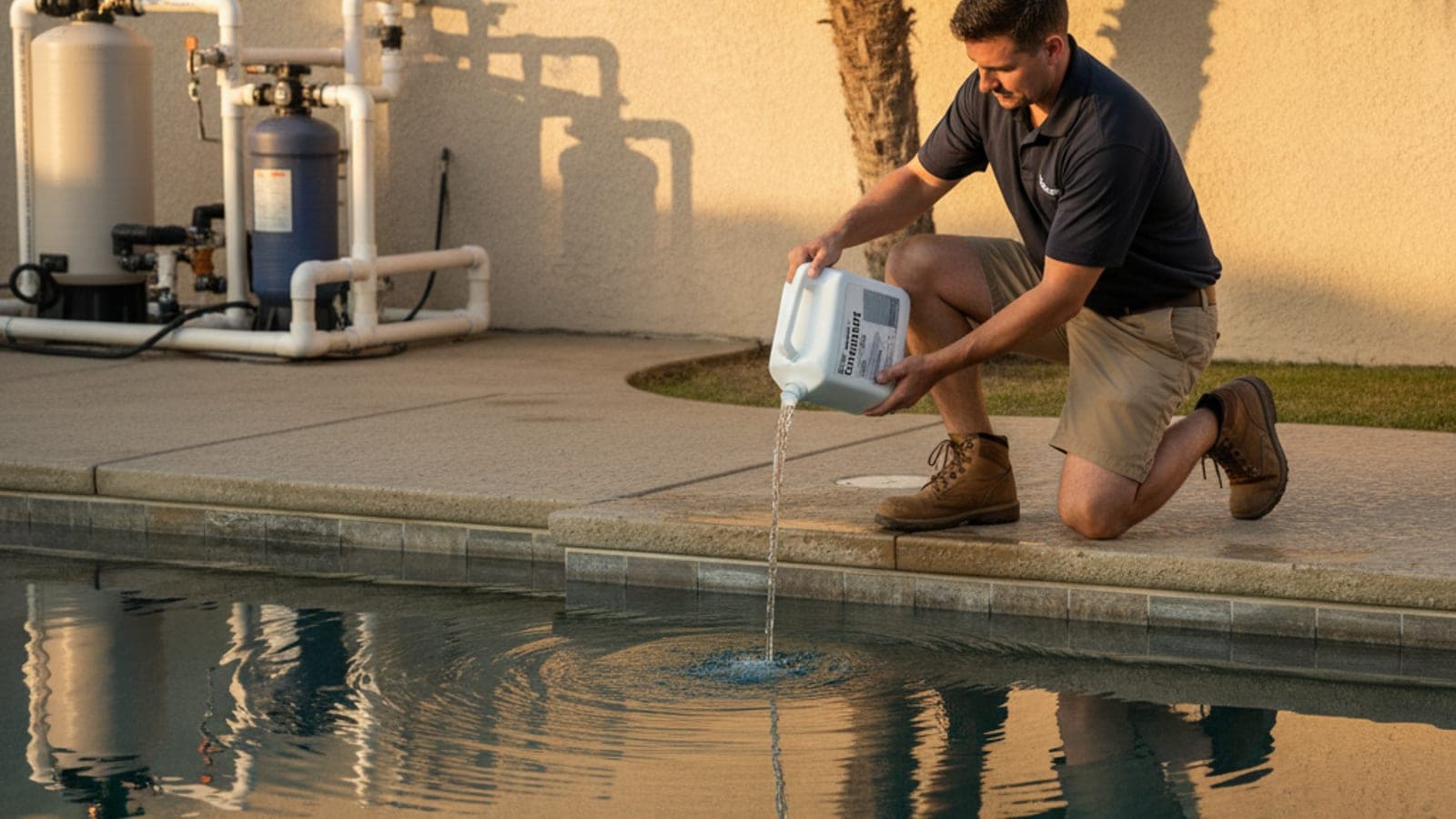
How to shock a pool: the right way to do it
Shocking a pool means raising free chlorine high enough to kill algae, bacteria, and organic contaminants in one concentrated dose. The single most important number is your cyanuric acid level, because it determines how much chlorine you actually need. Multiply your CYA by 0.4 and that is your target free chlorine. Skip that test and you are guessing, and guessing is the most common reason DIY shocks fail.
Why CYA controls everything
Cyanuric acid stabilizes chlorine against UV breakdown, which sounds helpful until it gets too high. At elevated levels, CYA binds so much chlorine that the remaining free chlorine can’t kill anything. The relationship is linear: CYA at 30 ppm means you need 12 ppm free chlorine. CYA at 50 ppm means 20 ppm. CYA at 70 ppm means 28 ppm.
Once CYA hits 90 ppm, your target jumps to 36 ppm free chlorine, which is impractical for most homeowners. Above 100 ppm, shock alone won’t work. You need to drain and dilute first. If your CYA reads over 80 ppm, no amount of chlorine will fix the problem until you lower that number. We wrote a full guide on what to do when cyanuric acid is too high.
When to shock in San Diego
San Diego’s year-round swim climate means algae never fully goes dormant. During July and August, weekly shocking is the standard. In cooler months, every other week keeps water clear.
Beyond the schedule, shock after these events:
- Pool parties or heavy bather load
- Heavy rain or Santa Ana wind events
- First sign of green tint, cloudiness, or algae on walls
- After refilling or a large top-up
- After raising or lowering your CYA level
- After wildfire smoke or ash fallout, because ash is organic matter that consumes chlorine aggressively
Santa Ana winds and post-wildfire conditions deserve special attention. If you see ash on your pool surface, shock immediately rather than waiting for your regular day.
Step-by-step process
- Test CYA, pH, free chlorine, and total alkalinity. If you are unsure what to test or how, our pool water testing guide covers the basics.
- Check your CYA. Under 60 ppm, proceed normally. Between 60 and 80, shock aggressively. Over 80, drain and dilute before adding any chlorine.
- Adjust pH to 7.2 to 7.4. If pH reads above 7.6, add muriatic acid and wait 30 minutes before continuing.
- Add your chlorine at sunset. UV light degrades free chlorine fast, and dosing in the evening gives it the full night to work.
- Run the pump continuously for 8 to 24 hours minimum.
- Brush walls and floor within one hour of dosing. Brushing breaks the biofilm that protects algae, letting chlorine penetrate. Skipping this step is one of the top reasons shocks fail.
- Retest the next morning. If algae persists, re-shock at the same target.
- The pool is safe to swim in once free chlorine drops to 5 ppm or below.
What product to use
Liquid chlorine, sodium hypochlorite, is the best default. Standard 8.25% household bleach works fine. Pool-store liquid chlorine comes in 10% or 12.5% concentration.
For a 20,000-gallon pool, here is what each gallon of 8.25% bleach does:
- 1 gallon raises free chlorine about 5 ppm
- 2 gallons raise it about 10 ppm
- 4 gallons raise it about 20 ppm
- 6 gallons raise it about 30 ppm
Dichlor is only appropriate when CYA is under 20 ppm. Never use it when CYA is above 30, because it adds more stabilizer to water that likely already has too much. Cal-hypo is only a fit for pools with low calcium hardness, which is rare in San Diego’s hard water. Trichlor tablets drop pH and add CYA, so avoid them for shocking.
Liquid chlorine also has a cost advantage. Shock bags cost 3 to 5 times more per effective dose, and they add either calcium or stabilizer that you probably don’t need.
Common mistakes that waste your time
- CYA too high. This is the number one reason shocks fail.
- pH above 7.5, which reduces chlorine’s kill power significantly.
- Underdosing. One bag isn’t enough for pools over 15,000 gallons.
- No brushing. Biofilm stays intact and chlorine can’t reach the algae underneath.
- Insufficient circulation time. The pump needs to run long enough to distribute the dose.
- Phosphates feeding algae faster than chlorine can kill it.
Salt water pools need a different approach
Salt cells produce low-level chlorine continuously, which handles day-to-day sanitation but not a true shock. Most systems have a “super chlorinate” or “boost” mode that runs the cell at maximum output for approximately 24 hours. That helps with mild cloudiness but isn’t enough for algae or heavy contamination.
If your salt pool turns green, run boost mode and add liquid chlorine on top of it. If your system throws an electrical fault code during boost, that points to a control board or wiring problem. In San Diego, salt cell wiring falls under electrical code, and a licensed electrician handles that work. Our post on salt cells that stop working covers the diagnostic steps.
For a broader comparison of salt versus traditional chlorine systems, see our chlorine vs. salt water pool guide.
San Diego-specific considerations
Hard-water cities like El Cajon and San Marcos present a particular problem with cal-hypo. The added calcium accelerates scale buildup on tile lines and equipment. If your pool already deals with scale, liquid chlorine avoids making it worse. Our hard water and San Diego pools post explains the full picture.
Coastal pools from Poway to Oceanside deal with salt air that corrodes metal components faster than inland pools. Keep your equipment pad clean and check for corrosion when you are out there brushing.
After the shock: what to expect
A routine shock should clear within 4 to 8 hours of circulation. Algae treatment takes longer: maintain the high free chlorine level for 24 to 48 hours.
If your pool turns green after shocking, the algae had a head start and the dose was likely insufficient for the CYA level. If the water turns hazy or milky, that usually points to a filtration issue or a chemistry imbalance rather than a chlorine problem. For a full green-pool recovery walkthrough, see our green pool cleaning guide.
When to call us
If your CYA is above 80 ppm, your water hasn’t cleared after two shock attempts, or your equipment is throwing error codes during the process, a licensed pool professional can diagnose the underlying issue and get your chemistry back on track. Call us at (858) 400-4404 and we’ll connect you with a licensed local pool specialist.
Frequently asked questions
How do I calculate the right shock dose for my pool?
Your dose depends on your cyanuric acid level, not just pool volume. Multiply your CYA reading by 0.4 to get your target free chlorine. For example, CYA at 50 ppm means you need 20 ppm free chlorine. The FC-to-CYA ratio should stay around 40%.
How long does it take for pool shock to work?
For routine maintenance, 4 to 8 hours of continuous circulation is enough. If you're killing algae, maintain the high chlorine level for 24 to 48 hours and retest before letting the level drop.
Is liquid chlorine better than shock bags?
Liquid chlorine adds no stabilizer or calcium to your water. Cal-hypo bags add calcium hardness, and dichlor bags add CYA, which is usually already too high. Bags also cost 3 to 5 times more per effective dose.
Why did my pool stay green after I shocked it?
The most common cause is CYA above 80 ppm, which makes chlorine ineffective regardless of dose. Other reasons include pH above 7.5, a clogged filter, or skipping the brushing step that breaks algae biofilm.
Can I shock a salt water pool the same way?
Salt cells produce low-level chlorine continuously, and boost mode runs the cell at maximum for about 24 hours. But boost mode alone is not enough for algae or heavy contamination. Add liquid chlorine on top of boost mode for a real shock.
Need professional help in San Diego County?
Splash Pool SD connects you with a licensed specialist for any service in this post.