Cyanuric acid too high means your chlorine is locked and your pool is at risk of going green. The only proven fix is a partial drain and refill: pump out a calculated portion of the water, replace it with fresh water, and rebalance. No chemical product reliably removes CYA without removing water. Here’s how to confirm the problem, size the fix, and keep it from coming back.
What cyanuric acid does in your pool
CYA is a stabilizer. It shields chlorine molecules from ultraviolet breakdown. Without it, San Diego sun destroys free chlorine in 2 to 4 hours. With proper CYA levels, chlorine persists through the full day.
Target ranges depend on your sanitation system:
- Chlorine pools: 30 to 50 ppm
- Saltwater generator pools: 60 to 80 ppm
Above 90 ppm, chlorine becomes increasingly bound and ineffective. At 150 ppm, even 5 ppm of free chlorine is nearly useless.
Why San Diego pools accumulate CYA fast
CYA never evaporates, degrades, or filters out on its own. Once it enters the water, it stays until you physically remove water.
San Diego’s hot dry climate makes this worse. Summer evaporation often exceeds 1 inch per week, sometimes reaching 2 inches. Evaporation concentrates every dissolved solid in the pool, including CYA. Topping off with fresh water replaces volume but doesn’t remove the accumulated stabilizer.
Trichlor pucks are the most common source of buildup. They contain roughly 57 percent CYA by weight. A pool maintained exclusively with trichlor can exceed 100 ppm in a single season, with no intentional stabilizer dose ever added.
Dichlor shock is another hidden source. It contains about 56 percent CYA by weight. A single heavy dichlor shock adds 10 to 15 ppm of stabilizer. If you’re shocking with dichlor regularly, CYA climbs fast.
For more on how San Diego’s water chemistry affects your pool, see our guide on hard water and San Diego pools.
Chlorine lock: what actually happens
CYA molecules weakly bond to chlorine molecules. Bound chlorine sanitizes far more slowly than free chlorine. Most test strips read bound chlorine as “free,” which is misleading.
At 30 ppm CYA, roughly 1 in 300 chlorine molecules is fully active at any moment. That’s workable. At 100 ppm CYA, you’d need over 10 ppm of free chlorine to match the sanitizing power of 3 ppm at proper CYA levels. Most pools never reach that.
The result: a pool that tests positive for chlorine but still grows algae. If your water is green despite a decent chlorine reading, high CYA is the likely culprit. Our post on green pool cleaning covers the full recovery process.
How to test CYA accurately
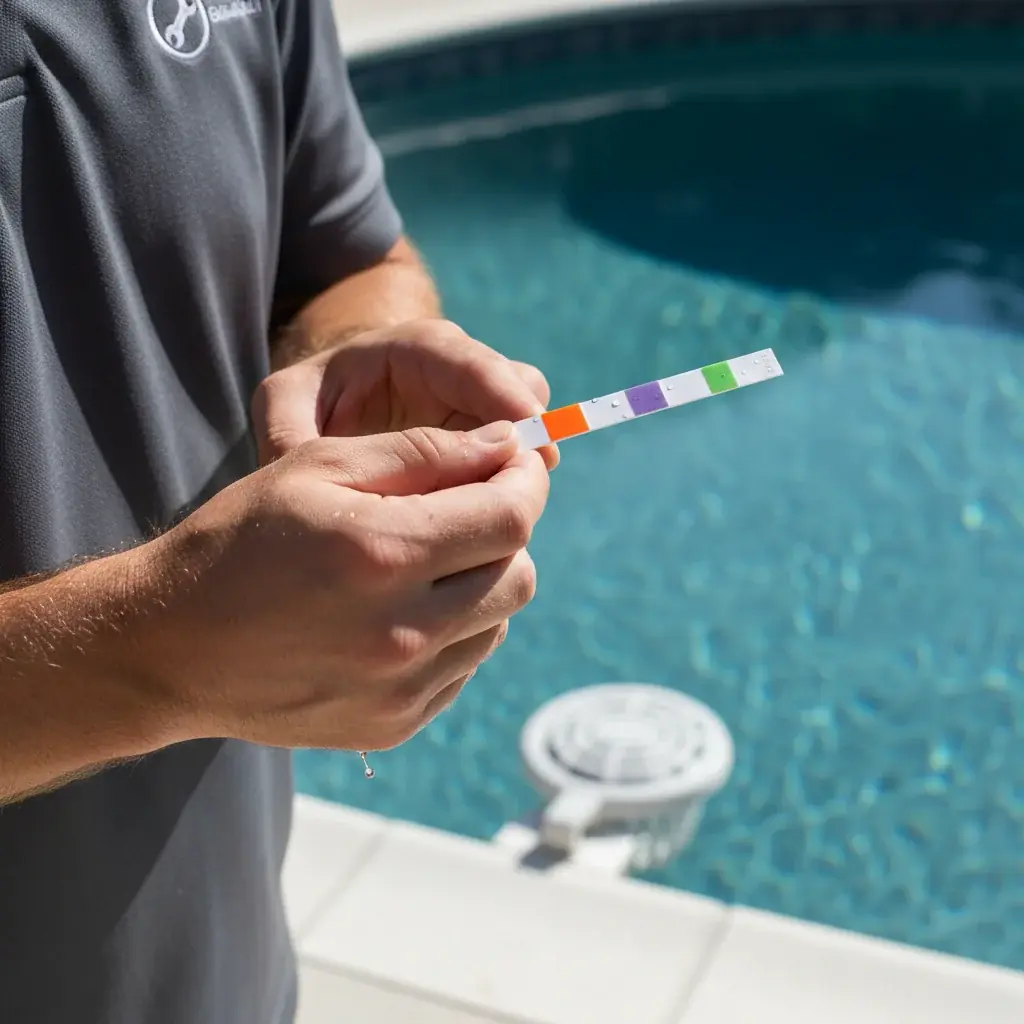
Test strips are too imprecise for drain decisions. Use a turbidity test instead.
The Taylor K-2006 is the standard liquid kit. It includes a comparator tube with a black dot on the bottom. Fill the tube with pool water, add the reagent, mix, then slowly pour the solution out while looking straight down at the dot. Stop pouring when the dot disappears. Read the level at the water line.
Two things to know about this test:
- The tube scale maxes out around 100 ppm. If the dot vanishes before you reach the 30 mark, your CYA is very high.
- Always test in shade. Direct sunlight skews the turbidity reading.
A pool supply store can also run a full water analysis if you’d rather not buy the kit. For a broader look at what to test and when, see pool water testing: what to test.
The fix: partial drain and refill
Partial drain and refill is the only proven method to lower CYA. You’ll need a submersible pump, a discharge hose, and a disposal plan.
In San Diego County, you can discharge pool water to a side yard or permeable area. Sanitary sewer discharge is also permitted. Storm drain discharge is prohibited. Check San Diego County stormwater guidelines at sdcwa.org before you start.
Lower the water level before beginning so you can refill immediately after. Don’t leave the pool low for an extended period. Fiberglass shells are vulnerable at low water levels, and vinyl liners can shift or wrinkle. Vinyl liners are rare in San Diego but present in some older installations.
Dilution math for a 20,000-gallon pool
The percentage you replace determines how far CYA drops:
- 100 ppm down to 50 ppm: replace 50 percent, or 10,000 gallons
- 150 ppm down to 50 ppm: replace 67 percent, or about 13,400 gallons
- 200 ppm down to 50 ppm: replace 75 percent, or 15,000 gallons
At 200 ppm, a full drain may be more practical. A full drain also lets you inspect the plaster and reset all chemistry from zero.
If you’re considering a full drain as an opportunity to inspect your finish, our post on signs your pool needs resurfacing can help you decide whether to address surface wear at the same time.
After the refill
Retest CYA before adding any stabilizer. San Diego tap water carries 300 to 400 ppm TDS and near-zero CYA, so your refill water won’t raise the reading.
Dilution resets all chemistry, not just CYA. Rebalance pH, alkalinity, and calcium hardness after the refill. Your matched pro can handle the full chemical reset in a single visit.
Prevention habits that keep CYA in range
Once you’ve fixed the problem, these habits keep it from returning:
- Switch your maintenance chlorine to unstabilized products. Liquid chlorine (sodium hypochlorite) adds zero CYA. Cal-hypo granules also add zero CYA.
- Reserve trichlor pucks for occasional supplementation only. Never use them as your primary chlorine source.
- Shock with cal-hypo or liquid chlorine instead of dichlor.
- Test CYA every 4 to 6 weeks during swim season. Most owners forget about stabilizer for months. Catching it at 70 ppm means a small adjustment, not a drain event.
If you’re weighing chlorine versus salt for your pool, our comparison of chlorine vs. salt water pools in San Diego breaks down how each system interacts with CYA targets.
Evaporation top-offs don’t add CYA, which is good news. They do dilute calcium, alkalinity, and pH buffers over time. San Diego water is moderately hard, so regular top-offs actually help manage TDS between drain events.
A professional service tracks chemistry patterns over time and catches CYA creep before it becomes a drain event. If you want ongoing monitoring, our guide on how to shock a pool covers the right products to use so you’re not adding stabilizer with every treatment.
When to call us
If your CYA reads above 150 ppm, or your water won’t clear after you’ve adjusted chemistry, a licensed pool pro should handle the drain and refill. Large-volume drains involve significant water movement and discharge rules where small mistakes get costly quickly. Call us at (858) 400-4404 and we’ll connect you with a licensed local pool specialist.
Frequently asked questions
What is the ideal cyanuric acid level for my pool?
Chlorine pools should stay between 30 and 50 ppm. Saltwater generator pools run higher, at 60 to 80 ppm. Once CYA climbs above 90 ppm, chlorine loses most of its sanitizing power and a partial drain becomes necessary.
Can I lower cyanuric acid without draining my pool?
No product on the market reliably removes CYA without removing water. So-called CYA reducers have not been validated by university or industry research. Partial drain and refill remains the only proven method.
How long does a partial drain and refill take?
A typical San Diego residential pool holds 15,000 to 20,000 gallons. The drain portion takes 4 to 8 hours with a submersible pump, depending on pump size and volume removed. Refill time depends on your household water pressure.
Why do San Diego pools build up cyanuric acid so fast?
The hot dry climate drives heavy evaporation year-round, often 1 to 2 inches per week in summer. Evaporation leaves CYA behind and concentrates it. Trichlor pucks compound the problem because they are roughly 57 percent CYA by weight.
Can high cyanuric acid cause my pool to turn green?
High CYA does not directly cause algae, but it locks chlorine so it cannot sanitize effectively. That chlorine lock allows algae blooms to develop, which is why fixing CYA is often the first step in clearing a green pool.
Need professional help in San Diego County?
Splash Pool SD connects you with a licensed specialist for any service in this post.