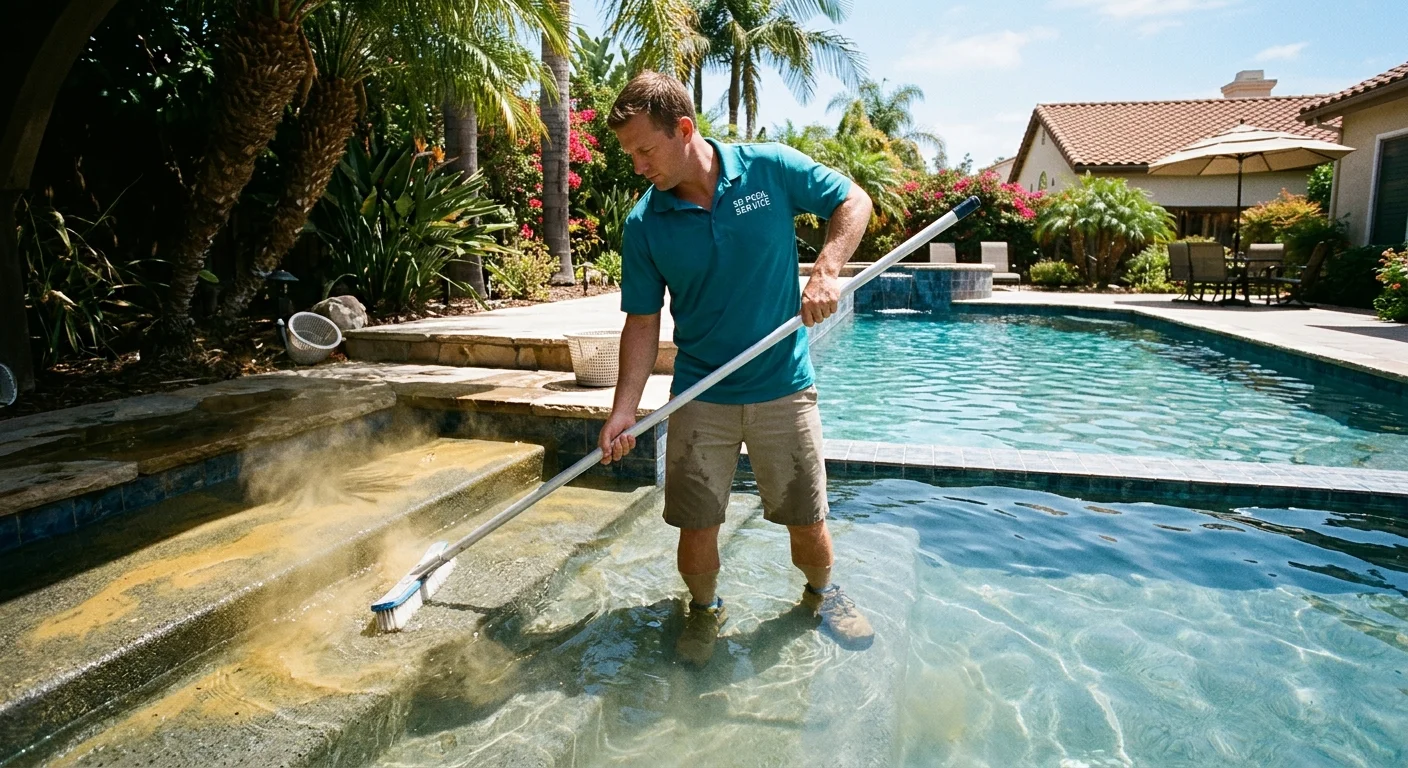
Mustard algae is a yellow-brown film that clings to shady pool surfaces while the water above stays clear. Green algae, by contrast, clouds the entire water column and can turn a pool opaque. If you see a dusty yellow patch on your steps or walls but the water still looks swimmable, you are likely dealing with mustard algae. This post explains how to tell them apart, why San Diego pools are prone to it, and what the full cleanup actually involves.
How mustard algae looks
Mustard algae colonizes plaster, pebble, and vinyl surfaces. It shows up as a fine, powdery film that resembles dust, pollen, or a smear of mustard. You will typically find it on shady steps, walls, ladder wells, and the house-side walls of salt pools. The water above often remains clear enough to swim in, which is why many owners miss it at first.
Brushing the patch lifts a faint cloud, but the growth reforms in the same footprint. It hides in skimmer throats, under step lips, and behind light niches. This is a surface problem first, not a water-column bloom.
How green algae looks
Green algae clouds the entire water column. It ranges from a light haze to opaque pea-soup. The shallow-end floor often becomes invisible. It is triggered by low sanitizer combined with warm weather. Unlike mustard algae, green algae isn’t localized. It affects the whole pool at once.
If your water is green or cloudy, address that problem first. Our post on green pool cleaning in San Diego covers that process.
The brush test
The simplest way to confirm what you are looking at is the brush test.
- Dirt and sand brush up, resettle elsewhere, and never rebuild the same patch.
- Pollen floats, films the surface, and collects in the skimmer basket.
- A true mineral stain won’t move under brush pressure.
- Mustard algae smears off lightly, then reforms in the identical shady location.
If the patch keeps coming back to the same spot after brushing, it is almost certainly mustard algae.
Why San Diego pools get it
Mustard algae lives on surfaces, not free-floating in the water. It thrives where shade prevents sunlight and sanitizer from reaching the film. Several common San Diego conditions create those pockets.
North-facing walls in neighborhoods like Kensington and South Park stay dim most of the day. Patio covers in Chula Vista and Eastlake shade the top steps permanently. Canyon lots in Tierrasanta, Poway, and La Jolla throw afternoon shade from the slopes. House walls in El Cajon, Santee, and Escondido form still, dim pockets where air circulation is limited.
Circulation problems make it worse. Treads sit outside the main return-jet flow. Ladders, rails, and toys trap film in place. Grout lines, pebble texture, and coping undersides harbor growth. A weak pump, a dirty filter, or a closed valve creates dead zones where chemicals never reach.
Salt pools deserve special attention. Salt generators produce chlorine in the cell only. They don’t scrub shaded plaster automatically. The house-side wall of a salt pool is a common hotspot.
Climate and seasonal factors
San Diego has no real algae off-season. The coastal marine layer cools mornings, but afternoon sun drives growth in shaded zones. From Encinitas to Imperial Beach, the long coastal swim season means pools stay warm for months. North County and East County get hotter from late spring through fall.
Pollen season, which runs from spring into early summer, confuses diagnosis. Eucalyptus, jacaranda, and street trees drop yellow-green dust that looks similar to mustard algae. The difference is that pollen rinses and skims out. Mustard grips walls.
Hard local tap water causes chemistry drift over the long season. Stabilizer accumulates when water isn’t replaced, and pH tends to climb under these conditions. Tab-only maintenance fails to address the film. Our post on hard water and San Diego pools explains how mineral buildup affects your chemistry.
What brushing alone misses
Brushing breaks the film so sanitizer can contact the underlying organisms. But brushing is only the first step. You must vacuum the loosened debris out of the pool afterward. The vacuum-to-waste setting is preferred because it avoids recirculating spores through the filter. If your system lacks a waste setting, the filter must be cleaned immediately after vacuuming.
A cartridge loaded with mustard film keeps reseeding the water. Sand, cartridge, and DE media all harbor organisms. Backwash or clean the filter per your equipment type, then retest.
Contaminated gear is another source of recurrence. Brushes, vacuum hoses, skimmer baskets, floats, goggles, and swimsuits all carry spores. Machine-wash soft goods. Soak hard goods per the product label. Sun-dry toys before returning them to the pool.
Test the water before dosing, not after. Test strips showing residual chlorine are insufficient for diagnosis. Mustard algae can persist on walls while mid-pool readings look normal. A licensed specialist interprets readings against actual pool conditions.
Routine weekly shock isn’t a mustard-algae treatment. Shock may be part of the cleanup, but it isn’t the sole fix. For more on shock technique, see our guide on how to shock a pool.
Salt systems and mustard algae
If you run a salt chlorinator, you might expect the pool to stay clean on its own. That assumption causes problems. The salt cell generates chlorine, but it doesn’t direct that chlorine to shaded walls or step treads. The film grows where water doesn’t circulate, regardless of how much chlorine the cell produces.
Our comparison of chlorine vs. salt water pools in San Diego covers the maintenance differences in more detail.
When to escalate to a professional
Call in a licensed specialist if any of these apply:
- The yellow patch returns after you brush, vacuum, clean the filter, and follow labeled shock instructions.
- You can’t distinguish a stain from algae visually.
- The filter clogs as fast as you clean it.
- The pump fails to move water into corners.
- Walls are yellowing and the water is simultaneously turning green.
A specialist tests the water, inspects circulation patterns, evaluates shade exposure, and checks whether your salt system or chlorine feeder is adequate. Contaminated tools get cleaned or isolated to prevent reseeding. Treatment follows the product label and test readings. The film must be confirmed gone before the job is closed.
No guaranteed timeline exists. Some pools clear after a surface attack plus filter service. Others persist because of a damp hose, a contaminated suit, or a dead corner that nobody noticed. The key is identifying the source of reseeding.
You can verify any contractor’s license through the CSLB lookup tool before hiring. For a broader guide, see our post on pool algae types and treatment.
When to call us
If mustard algae keeps returning despite your best brushing and cleaning, or if you can’t tell whether the film is algae, pollen, or a mineral stain, a licensed pool professional can diagnose the problem on site. Call us at (858) 400-4404 and we’ll connect you with a licensed local pool specialist.
Frequently asked questions
Is it safe to swim in a pool with mustard algae?
Visible algae means the water is not properly maintained. The CDC healthy-swimming guidance references treated water standards. Skip swimming until a specialist confirms your chemistry is back in range. No mustard-specific illness rule has been confirmed, so do not assume the water is safe.
How do I get rid of mustard algae for good?
Brushing is only the first step. You must vacuum loosened debris out of the pool, clean or backwash the filter, and wash all wet gear. Test the water before dosing any product, then follow the shock or algaecide label instructions. If the film keeps coming back, a licensed specialist should inspect circulation and shade patterns.
How long does it take to clear mustard algae?
No verified standard timeline exists. Some films resolve after a thorough brush, vacuum, and filter cleaning. Others recur because of a damp hose, a contaminated swimsuit, or a dead circulation corner. An on-site professional assesses your actual conditions before giving you a realistic expectation.
Will shocking the pool kill mustard algae?
Routine weekly shock is often insufficient on its own. Mustard algae persists on shady plaster even when mid-pool chlorine reads normal. Shock may be one component of a broader cleanup. Dose, product choice, and whether you need an algaecide should follow the product label and your test readings.
How do I tell mustard algae apart from pollen or dirt?
Dirt and sand brush up, resettle elsewhere, and never rebuild the same patch. Pollen floats, films the surface, and collects in the skimmer basket. A true mineral stain will not move under brush pressure. Mustard algae smears off lightly, then reforms in the identical shady spot.
Need professional help in San Diego County?
Splash Pool SD connects you with a licensed specialist for any service in this post.