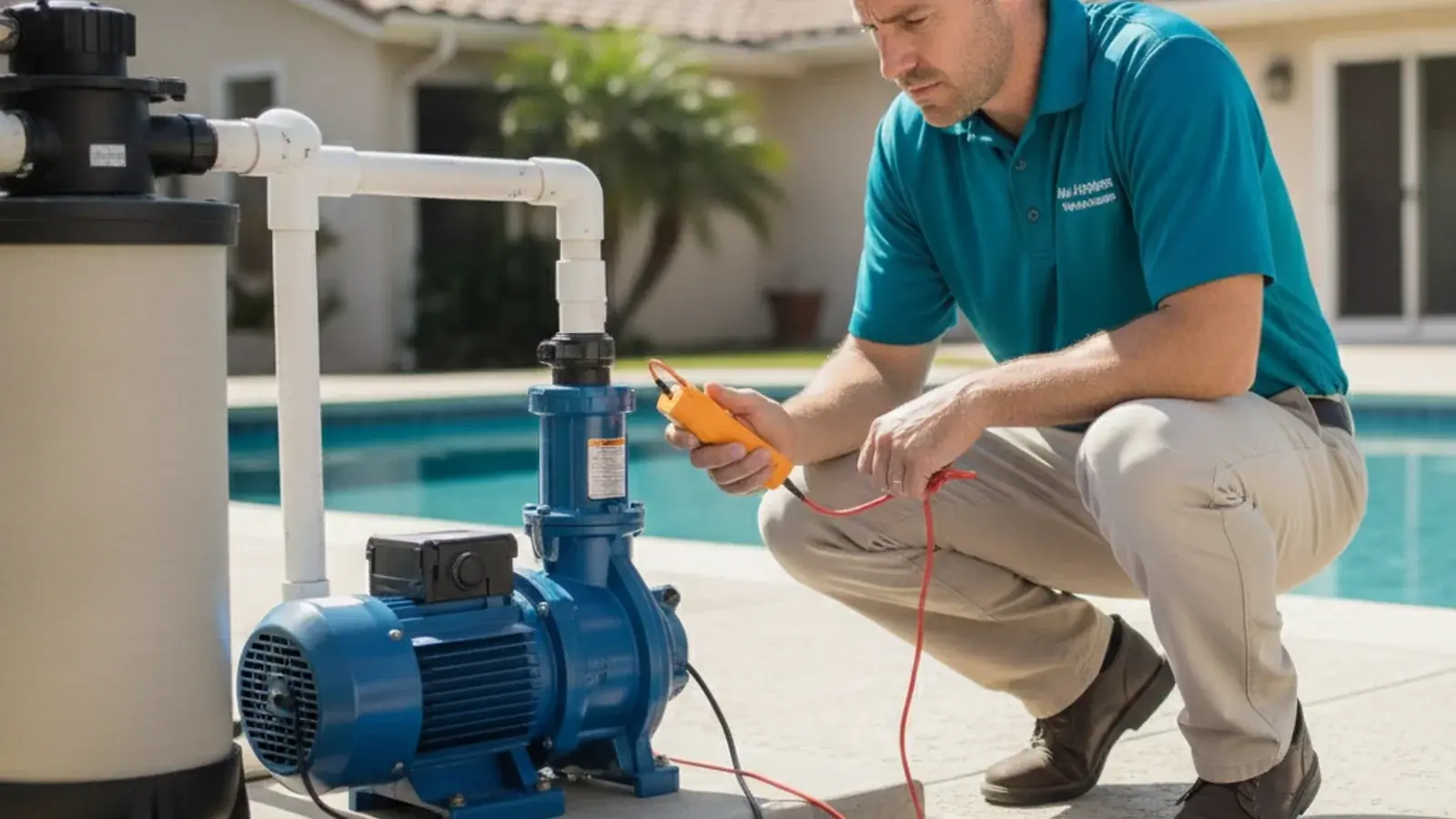
A Hayward pool pump that hums, leaks, or trips the breaker is one of the most common equipment calls we see across San Diego County. The five failures below cover the majority of those calls, and each one has a specific cause tied to how the pump runs and where it sits. If your Hayward is acting up, this guide walks through what is likely wrong, what a repair looks like, and when replacement makes more sense.
Five most common Hayward pump failures
Leaking shaft seal
Water pooling under the housing at the motor and wet-end junction is the telltale sign. This is the most common Hayward repair call in our network. A pro swaps the seal kit at the shaft once the pump is depressurized. In San Diego, hard water deposits scale on the seal plate, which can complicate the reseat and shorten the life of a new seal if the plate isn’t cleaned properly.
Blown run capacitor
The pump hums briefly, then shuts off or never starts. Homeowners often mistake this for a dead motor. A technician must rule out winding failure before replacing the capacitor, because the symptoms overlap. If the windings test clean, a new run capacitor brings the pump back.
Worn bearings
Grinding or squealing that worsens over days or weeks points to bearing wear. Grinding means metal on metal. Squealing is earlier-stage wear. If you ignore it, the bearings seize the shaft and destroy the motor. On older two-speed models, a slipping belt can produce a similar sound, so the pro checks both.
Tripped or nuisance-tripping breaker
A breaker that trips repeatedly usually indicates a short in the motor windings. The root cause is often moisture intrusion from a failed shaft seal. A good pro checks the seal and the electrical system together rather than just resetting the breaker.
Motor hums but won’t spin
Try turning the shaft by hand. If it turns freely, the start capacitor or start switch is the likely culprit. If the shaft won’t turn, the bearings have seized and replacement is probable. We cover this scenario in more detail in our guide to pool pumps that hum but won’t run.
San Diego factors that shorten pump life
The county’s water and climate affect Hayward pumps differently depending on where you live.
Inland areas like El Cajon, Santee, and Poway sit on hard water. Scale builds at the seal plate and accelerates wear on seals and bearings. Long summer run times make it worse. We break this down further in our post on hard water and San Diego pools.
Coastal areas from La Jolla to Carlsbad face a different problem. Salt air corrodes housings, unions, and connections over time. The corrosion is slow but steady, and it shortens the life of external fittings before the motor itself fails.
Both ends of the county shorten pump lifespan slightly compared to moderate-climate regions. Run hours, water chemistry, and exposure all factor in.
Repair vs. replace: how to decide
A licensed pro must inspect the pump before making this call. Here is how to prepare:
- Record the model number from the pump housing.
- Describe what you see: leaks, noise, priming issues, breaker trips.
- Note the pump’s age if you know it.
- Request a written quote that compares repair and replacement side by side.
- Ask that the quote include warranty terms and care instructions.
- If you own a single-speed pump, ask about a variable-speed upgrade in the same quote.
Actual electricity rates and daily run hours change the math between repair and replacement. A pro who knows your setup can walk you through it. Our post on variable-speed pool pumps in San Diego covers the efficiency side.
What to note before the repair visit
The more you can tell the pro upfront, the faster the diagnosis:
- Where water collects under or around the pump.
- How the pump starts: does it hum, click, or stay silent?
- Breaker behavior: has it tripped, and how often?
- Any new noises and when they started.
- Whether the pump holds prime or loses it.
- Pump age, if you have the paperwork.
If you see air in the lines, a dropping water level, or the pump losing prime repeatedly, mention it. Those symptoms can point to a suction-side plumbing leak rather than a pump fault. Chasing pump symptoms without checking the plumbing wastes money. Our post on pool leak vs. evaporation helps you sort that out.
Pump problems as a signal of something bigger
A Hayward pump that strains or loses prime may be telling you about a plumbing issue downstream. Watch for:
- Air bubbling from return jets.
- Water level dropping beyond normal evaporation.
- The pump cycling on and off as it struggles to maintain flow.
If the pump itself tests clean, ask the pro about leak detection before authorizing repeated pump repairs.
Cost of Hayward pump repair in San Diego
HomeGuide lists a general U.S. planning estimate of $50 to $650 for pool pump repair. That range isn’t Hayward-specific and doesn’t cover seal-only or full replacement scenarios. HomeGuide also lists $800 to $2,000 installed for a variable-speed pump as a general U.S. figure.
Your actual cost depends on the failed part, pump condition, access to the equipment pad, and whether additional components like the filter or heater need attention. The pro you are matched with quotes the price in writing before any work starts. For a broader look at what drives repair pricing, see our post on pool pump repair in San Diego.
Salt system conversion timing
If you are considering a salt water conversion, talk to your pro about sequencing it with pump repair. Salt cells and pump sizing interact, and handling both in one visit avoids duplicate service calls. Our post on salt water conversion costs in San Diego covers what to expect.
When to call us
If your Hayward pump is leaking, making new noise, tripping the breaker, or not circulating water at all, a licensed pool equipment specialist should inspect it before the problem spreads to the motor or plumbing. Call us at (858) 400-4404 and we’ll connect you with a licensed local pool specialist.
Frequently asked questions
What is the most common Hayward pump failure in San Diego?
A leaking shaft seal is the most frequent repair call in the network. Hard water and long run times degrade the seal over time, and water pools under the housing at the motor and wet-end junction.
How much does Hayward pool pump repair cost?
HomeGuide lists a general U.S. planning estimate of $50 to $650 for pool pump repair, not specific to Hayward or seal-only work. Your matched pro quotes the actual price after inspecting your pump.
Should I repair or replace my Hayward pump?
A licensed pro must inspect the pump before deciding. Ask for a written quote that compares repair and replacement side by side, including warranty terms and variable-speed upgrade options.
Does San Diego hard water affect Hayward pumps?
Yes. Inland areas see scale build up at the seal plate, which shortens seal life and complicates reseating. Coastal areas face salt air corrosion on housings and fittings instead.
Can a pump problem signal a plumbing leak?
Yes. Losing prime, air bubbling from return jets, or a water level dropping beyond evaporation can point to a suction-side plumbing leak rather than a pump fault alone.
Need professional help in San Diego County?
Splash Pool SD connects you with a licensed specialist for any service in this post.