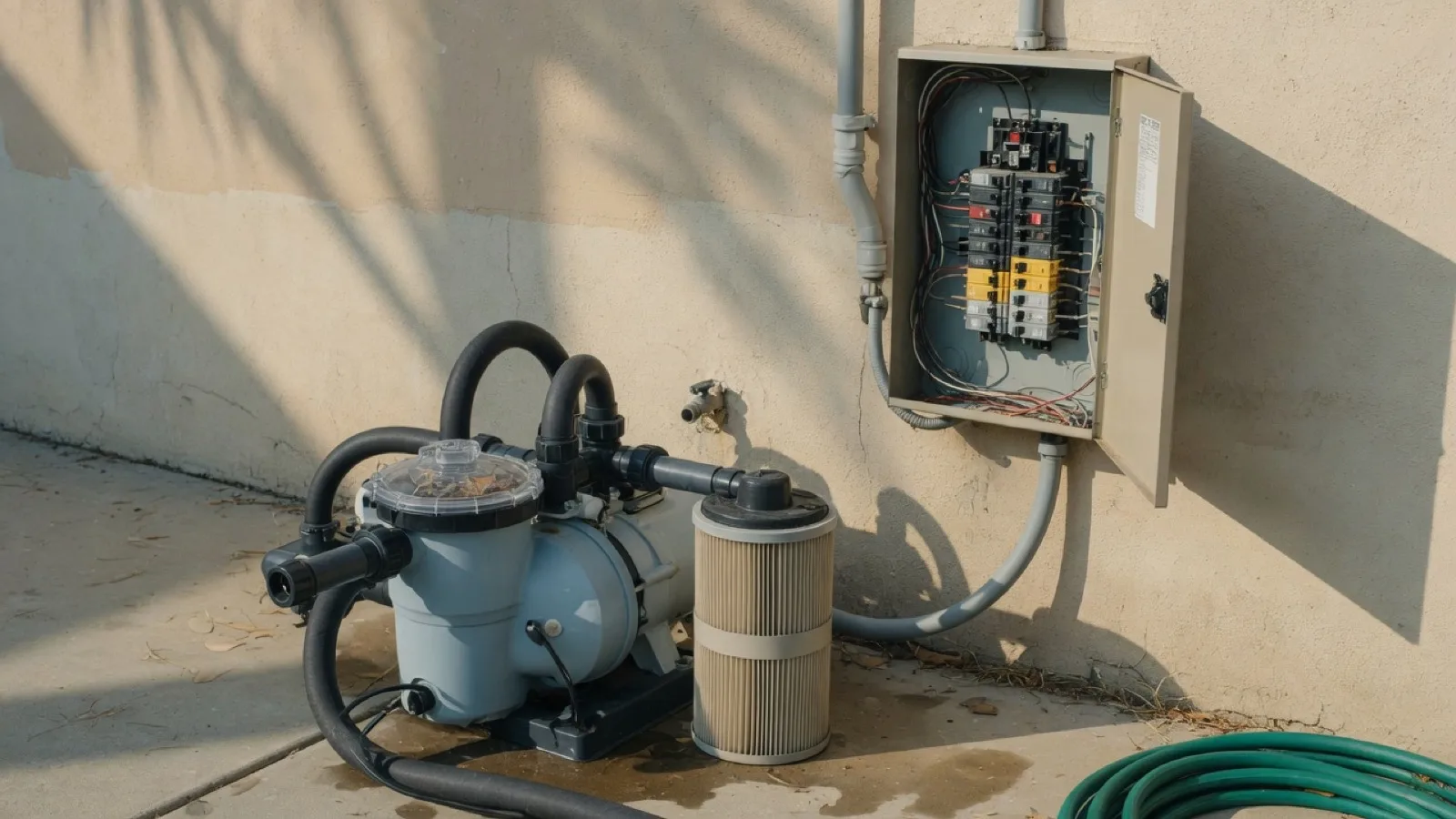
The pump starts, the yard goes quiet, and the breaker is off again. Resetting it is how a wet motor becomes a fire call. On a San Diego pad the usual villains are water in the motor, salt air in the conduit, a stalled impeller, or a ground-fault device doing its job.
This page is a filter pump that will not stay on. It is not a timer that lost time. It is not a pump that hums and never spins unless that hum ends in a trip. It is not a pump that will not prime. Electrical work on the circuit is licensed electrical work. Splash Pool SD matches you with licensed independent pros. We do not pull breakers.
Read the trip, then stop
Write down four facts before anyone touches the panel.
- Which device opened. GFCI/GFPE button, a branch breaker in the subpanel, the house main, or a disconnect at the pad.
- When. Instantly on start, after a few seconds, after a few minutes, after an hour, or only after rain.
- What you hear. Silence, a hum, a start-up then a click, or a normal run then a trip.
- What is wet. Motor can, junction box, conduit, or a puddle on the pad.
Then leave the breaker off. A ground fault that you keep feeding is a shock hazard at the water and at the pad. If anyone felt a tingle in the pool, get out, leave the pump off, and treat it as equipotential bonding plus this circuit, not as a nuisance trip.
Instant trip versus delayed trip
Instant, every start. That pattern is often a short: a failed winding, a chewed lead in the motor, a wet junction box, or a dead short in the whip. Coastal pads in Imperial Beach, Ocean Beach, and Point Loma eat those whips. Inland pads in Escondido cook the motor can until the insulation fails.
A few seconds. Locked rotor. The impeller is jammed, the shaft will not turn, or a capacitor (on motors that use one) cannot get the motor through start. The breaker sees a stall.
Minutes to an hour. The motor is running hot, the breaker is tired, or a failing winding only shorts once it is warm. Afternoon inland heat on a west-facing pad in El Cajon is a real setting for that. So is a pump that was already noisy.
Only after rain or a wash-down. Water in the motor, the GFCI, or the box. Dry it in the story you tell the pro. Do not blow a shop-vac into an open motor.
We do not publish trip-amp numbers, wire sizes, or a “this breaker is correct” chart. The nameplate on that motor and the inspection the local department requires decide those.
What is not the pump
A salt cell, a heater, a booster, and a control panel share pads in this county. A portable spa that dies on its own GFCI is hot tub GFCI trips, not this filter-pump circuit. A trip that only happens when the heater fires is not a filter-pump winding. A trip that only happens when the Polaris booster starts is that motor. Tell the pro which piece of equipment was called when the device opened.
A check valve does not trip a breaker. If the pump loses prime and then trips, you still have two problems: air and current. Do not assume one part.
What a licensed pro tests
A matched licensed pool contractor, and a licensed electrician when the circuit is the job, will:
- Confirm which device opened and whether it is a GFCI, GFPE, or standard breaker.
- Lock out the circuit, then inspect the motor, the whip, the box, and the wet end.
- Check whether the impeller turns by hand with power locked out.
- Test the motor as the electrician’s process requires. We will not invent megger numbers here.
- Name the failed part on a written estimate: motor, capacitor (if present), whip, device, or control.
If the motor is a replacement, California Title 20 rules for replacement dedicated-purpose pool pump motors manufactured on or after July 19, 2021 apply when the motor is 0.5 hp or greater: those replacement motors must be variable-speed. Cite the California Energy Commission FAQ. That is a motor-replacement rule, not a demand that you rip out a running single-speed pump today. The matched pro says whether this swap is in scope.
Look up the contractor on the CSLB license check. We do not hold the trade license, own the truck, or warranty the repair.
How to describe the fault when you request a match
Say “the filter pump trips the breaker,” and which device. Say instant, seconds, minutes, or after rain. Say whether there is a tingle in the water. Photograph the motor nameplate and the open panel only if you can do it with the door already open and your hands dry. Do not remove deadfronts.
Call (858) 400-4404 and we will match you with a licensed local specialist.
Frequently asked questions
Why does my pool pump keep tripping the breaker?
The pump is pulling more current than the breaker will hold, or a ground-fault device is seeing leakage to ground. Common causes: a wet motor, a shorted winding, a seized impeller that stalls the motor, a failing capacitor on some motors, damaged conduit at a coastal pad, or a breaker that is the wrong size or already tired. The sequence of the trip (instantly, after a few seconds, after an hour) is the clue. Do not keep resetting it.
Is a GFCI trip the same as a thermal breaker trip?
No. A GFCI or GFPE device trips on leakage to ground. A standard thermal-magnetic breaker trips on overload or a short. A pump that drowns a GFCI and holds on a regular breaker is still a ground-fault problem. A licensed electrician or a licensed pool pro who subcontracts that electrical work should name which device actually opened.
The pump hums, then the breaker trips. What is that?
A hum with no spin is often a seized wet end, a bad capacitor on motors that use one, or a locked rotor. The breaker then opens because the motor is stalled and drawing locked-rotor current. That overlaps [pool pump humming not running](/blog/pool-pump-humming-not-running/). Treat it as one visit, not two guesses.
Can I swap in a bigger breaker?
No. The breaker protects the wire and the motor according to the nameplate and the installation. A larger breaker is how you burn the motor or the wire. The matched licensed electrician sizes the device to the equipment and the code the local building department enforces. We do not publish amp charts.
The timer is fine. Why mention the timer?
A timer or automation relay can weld or leak and trip a breaker even when the pump itself is healthy. If trips happen only at start-up, the timer and the motor starter are in the test. The sweep already covers a timer that will not keep time. This page is the pump circuit that will not stay on.
Need professional help in San Diego County?
Splash Pool SD connects you with a licensed specialist for any service in this post.