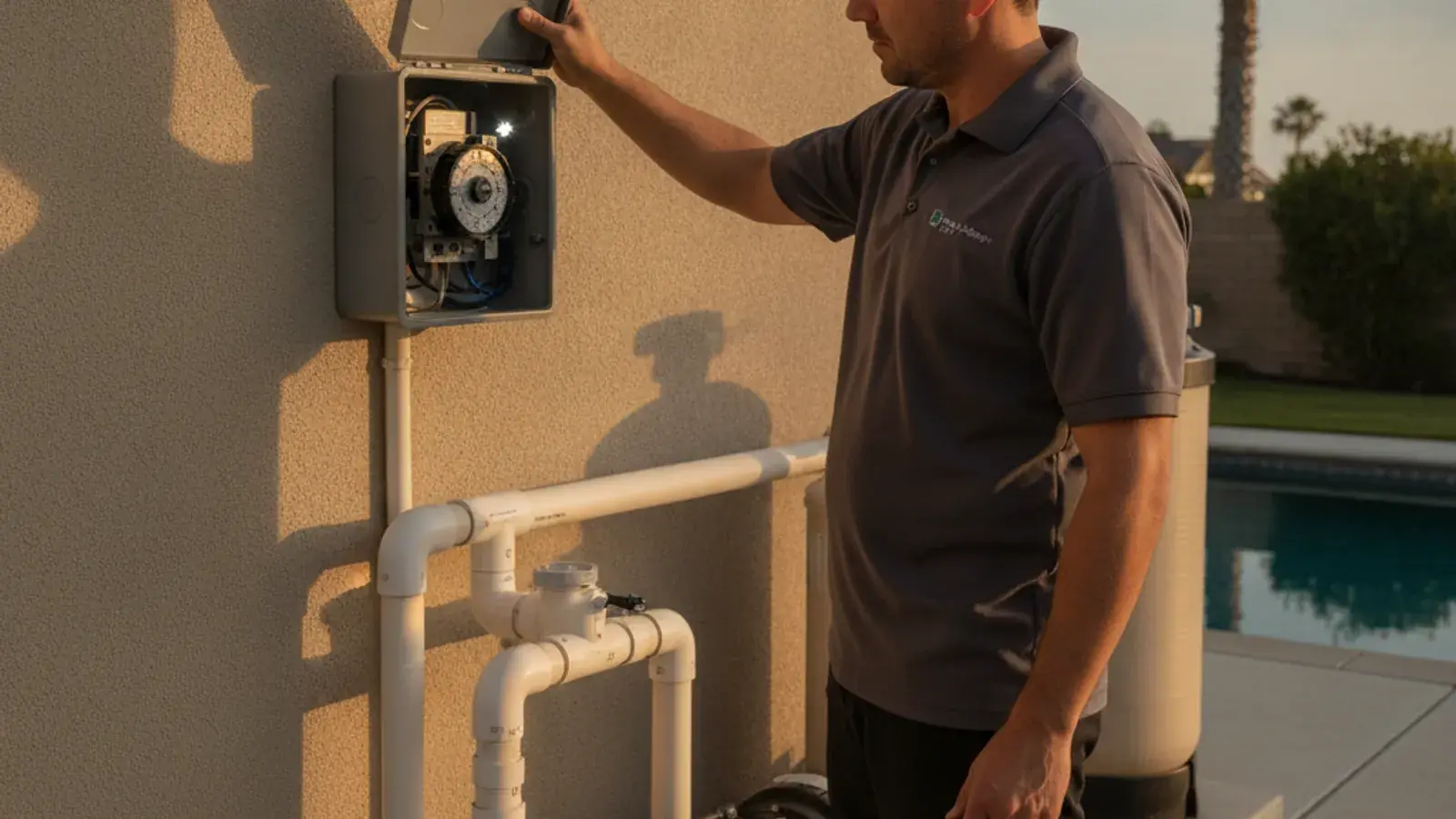
A pool timer that stops working almost always comes down to one of two things: a tripped breaker or GFCI that cut power, or a failed clock motor inside the timer itself. The breaker is the most common cause by far, and it is the first thing to check. Everything else, from displaced trippers to a digital controller that lost its program, is less likely but still worth ruling out. This guide walks through each cause in order of frequency so you can find the problem without guessing.
Start at the breaker panel, not the timer box
Most people walk straight to the timer when the pump doesn’t kick on. That is backwards. The breaker panel is where you start, because a tripped breaker looks almost identical to one that is on. A partially tripped breaker can sit in what appears to be the on position while delivering no power at all.
Find the dedicated breaker for your pool equipment. Flip it fully to the off position, then back to on. Don’t just push it forward. You need to feel it click into the off position before you reset it. That full cycle clears a partial trip.
Next, look for a GFCI button on the breaker or on a nearby outlet. Pool circuits require GFCI protection per code, and these devices trip from moisture, surges, and worn connections. Press the reset button firmly. If it pops back out immediately, don’t keep trying. That is a wiring fault, and pushing past it risks a fire.
If you have a non-contact voltage tester, use it at the timer enclosure to confirm power is reaching the box. If the tester shows no voltage and the breaker is on, the problem is upstream. Stop here and call a licensed professional.
Resetting a mechanical dial timer
Mechanical dial timers, the Intermatic style with a round face and two plastic trippers, are the most common type on older pools across San Diego County. They are simple and reliable, but the clock motor inside them does eventually fail.
Before you open the enclosure, turn off the dedicated breaker. These circuits carry 220 to 240 volts, and working on them live is dangerous. Once the power is confirmed off, remove the cover.
Look at the dial. It should show the current time at the fixed pointer. If the dial is hours off or hasn’t moved at all, the clock motor has stopped. That is the most common mechanical failure. The motor is a small, inexpensive part, but it requires opening the housing to replace.
Check the two trippers. One engages the on cycle and one engages the off cycle. Each tripper pushes a lever as it passes the pointer. Over time, vibration or cleaning can knock a tripper out of position. If one is loose or missing, the timer won’t switch the pump on or off at the right time. Press each tripper firmly back into its slot on the dial edge.
Rotate the dial by hand to the correct current time. You should feel a distinct click as each tripper passes the lever. That click confirms the tripper is engaging properly. If the dial won’t turn under power, the motor is seized. If it turns freely by hand but doesn’t move on its own when power is restored, the motor has failed.
Restore the breaker and watch the timer through a full cycle. The dial should rotate slowly and the pump should switch on and off at the times you set. If the dial moves but the pump doesn’t respond, the contacts inside may be worn. That is a separate issue covered below.
For more on how long your pump should run each day, see our guide on how long to run a pool pump in San Diego.
Resetting a digital or smart controller
Digital timers and smart controllers behave differently. When they lose power, they don’t just stop. They lose their program. You will see a flashing clock icon or an error code on the display.
To fix this, reprogram the controller using the manufacturer’s button sequence. You will need to re-enter your run times, duration, and any heater or feature cycles you had scheduled. The exact steps vary by brand, so check the manual or the manufacturer’s support page.
If your controller loses its schedule after every brief power blip, the backup power source is dead. Some units use a small battery. Others use a capacitor. Either way, the fix is replacing that component. It is a small part, but it requires opening the controller housing.
If you are considering upgrading to a WiFi-enabled controller that lets you adjust schedules from your phone, our pool equipment upgrade guide for San Diego covers what to look for.
Variable-speed pump scheduling conflict
This one catches people off guard. If you have a variable-speed pump, it likely has its own onboard controller that handles scheduling. An upstream mechanical timer can conflict with it, sending power at times the pump’s internal program doesn’t expect.
Before you troubleshoot, confirm which device is actually controlling the pump schedule. If the variable-speed pump’s onboard controller is set to run at certain times, but the mechanical timer is cutting power during those windows, the pump won’t start. You need to either sync the two or remove the upstream timer and let the pump manage its own schedule.
Worn contacts and salt-air corrosion
Sometimes the timer dial turns and the trippers click, but the pump never kicks on. You hear the click, but nothing happens. That points to pitted or worn contacts inside the timer.
Contacts degrade from repeatedly breaking a real electrical load. Every on and off cycle wears them a little more. Eventually they pit and stop conducting. At that point, replacement usually beats repair. Older mechanical timer parts are increasingly hard to source.
Along the San Diego coast, salt air adds another layer of trouble. It corrodes metal enclosures and the connections inside them. Corroded contacts behave the same way as worn ones: you get the click but no load switching. This happens even with perfectly balanced pool chemistry. It has nothing to do with hard water in San Diego pools, which affects surfaces and plumbing, not electrical components.
If you live within a few miles of the ocean, check your timer enclosure for rust, white or green corrosion on terminals, and any signs of moisture inside the box. If you see any of that, the timer likely needs replacement rather than repair.
What drives replacement cost
The cost of fixing or replacing a pool timer depends on several factors, and no two jobs are the same. Here is what moves the number.
A simple reset costs nothing in parts. If the breaker tripped and you reset it, you are done. A clock motor swap requires opening the housing and replacing a small part. A full mechanical timer replacement is the standard fix when contacts are worn or the housing is corroded. Upgrading to a smart WiFi controller adds app-based scheduling and remote control, which changes the scope.
The number of loads the timer switches matters. A timer that runs only the pump is simpler than one that also controls a heater, lights, and a cleaner booster. More loads mean more wiring and more complexity.
Equipment-pad accessibility affects labor time. A timer mounted in a tight corner behind landscaping takes longer to reach than one on an open wall. If you are planning changes to your pad, our post on pool equipment pad layout covers spacing and access considerations.
A matched pro will assess your specific setup and provide a quote before any work starts. If you want to understand what goes into an estimate, our breakdown of pool equipment repair estimates explains the variables.
Safe limits for DIY troubleshooting
You can safely check the breaker, reset a GFCI, inspect the dial and trippers, and reprogram a digital controller. Those are all low-risk tasks that require no tools beyond a screwdriver and possibly a non-contact voltage tester.
Anything beyond that on a 220 to 240 volt circuit belongs to a licensed professional. That includes replacing contacts, rewiring, or working inside the enclosure while power is present. If you are unsure whether the power is truly off, stop. The risk isn’t worth it.
If your pump hums but doesn’t spin, that is a different problem entirely. Our post on a pool pump that hums but won’t run covers that separately.
When to call us
If the breaker re-trips immediately after you reset it, if you see water or corrosion inside the timer box, if there is a burning smell or scorch marks near the panel, or if you need any work done on 220 to 240 volt wiring beyond basic checks, that is the point where a licensed pool professional needs to take over. Pushing past a tripped breaker or working on live circuits creates a real fire and shock risk.
Call us at (858) 400-4404 and we’ll connect you with a licensed local pool specialist.
Frequently asked questions
Why won't my pool pump start on schedule?
The most common cause is a tripped breaker or GFCI that cut power to the timer. If the breaker is fine, the clock motor inside a mechanical dial may have failed, or a digital controller may have lost its program after a power outage. Check the breaker panel first before opening the timer enclosure.
How do I reset a mechanical pool timer dial?
Turn off the dedicated breaker first. Open the enclosure and check whether the dial shows the correct current time. If it is hours off, the clock motor has likely stopped. Rotate the dial by hand to the correct time, make sure both trippers are seated, then restore power and watch a full cycle.
Why does my digital pool controller keep losing its schedule?
A digital controller that repeatedly loses its program after brief power blips usually has a dead backup battery or a failed capacitor. Every time power drops, the schedule wipes. Replacing the backup power source solves it. Check the manufacturer's manual for the specific battery or capacitor type.
Should I call an electrician or a pool technician?
If the problem is a tripped breaker that resets and holds, you likely do not need either. If the breaker re-trips immediately, you see corrosion or water inside the enclosure, or you smell burning, stop and call a licensed professional. Any work on 220 to 240 volt circuits beyond basic checks belongs to a pro.
What affects the cost of replacing a pool timer?
Cost depends on whether you need a simple clock motor swap, a full mechanical timer replacement, or an upgrade to a smart WiFi controller. The number of loads the timer switches, such as pump only versus pump plus heater and lights, also matters. Equipment-pad accessibility affects labor time. A matched pro quotes before any work starts.
Need professional help in San Diego County?
Splash Pool SD connects you with a licensed specialist for any service in this post.