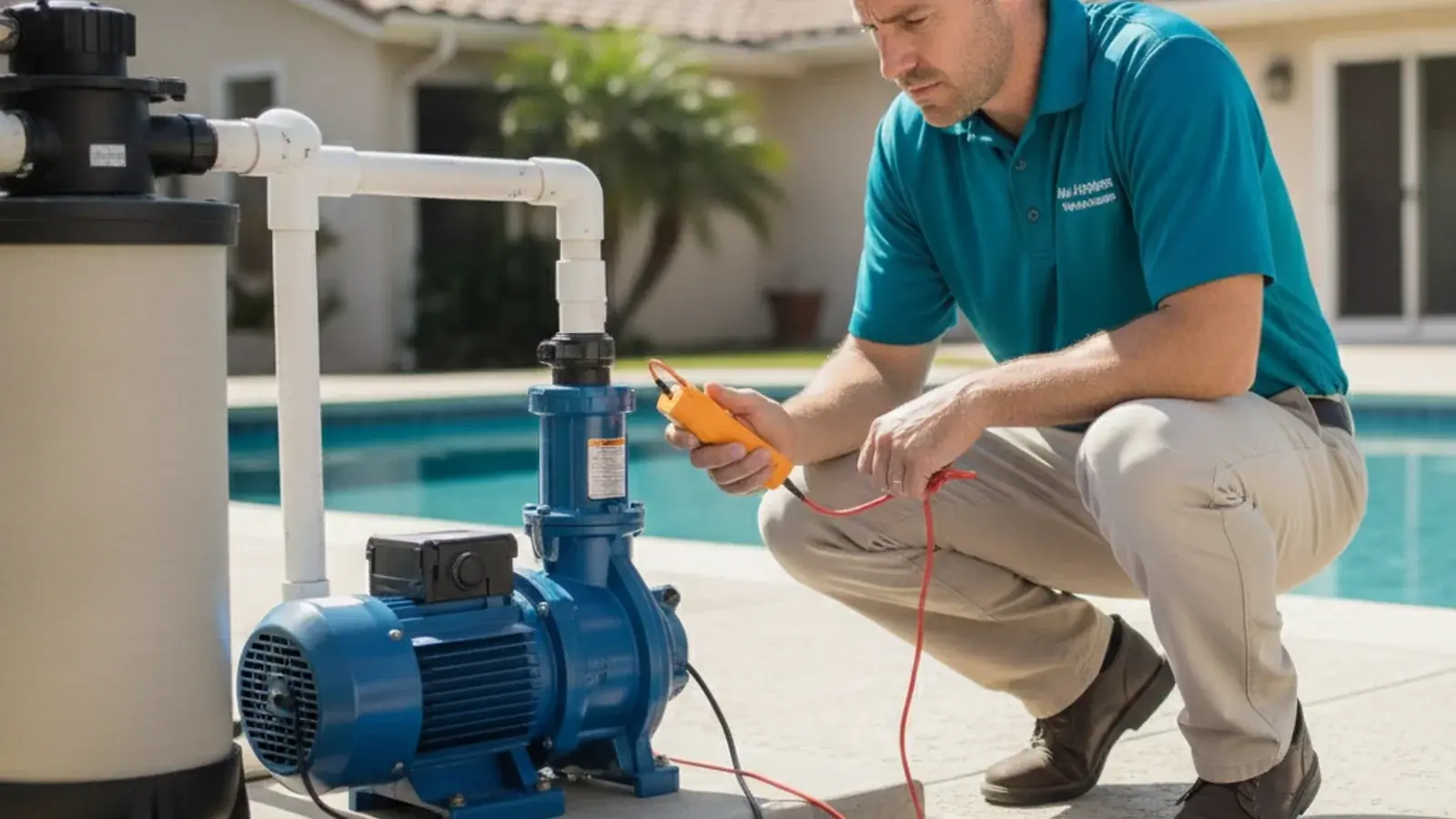
A pool pump that won’t prime almost always has air getting in on the suction side or a blockage preventing water from reaching the impeller. The pump needs water already inside the housing to create suction. When air enters faster than the pump can expel it, no vacuum forms and the basket stays empty. Before you call anyone, there are several checks you can do yourself in about fifteen minutes.
Symptoms of lost prime
You’ll notice one or more of these:
- The strainer basket is empty or only half full of water.
- The pump runs louder than usual.
- No water is reaching the filter.
If you see any of these, the pump has lost its prime. Work through the checks below in order.
Check the baskets first
Shut the pump off. Remove the pump lid and pull the strainer basket. Leaves, hair, and debris can fully block flow. Check the skimmer baskets too. A full skimmer basket starves the pump just as effectively as a clogged strainer.
Clean both baskets, refill the pump housing with water from a hose, replace the lid, and restart. If the pump primes and holds, the baskets were the cause.
Inspect the pump lid O-ring
The lid O-ring is the most frequent air-leak source on any pool pump. Over time it dries out, cracks, or collects debris that breaks the seal.
Pull the O-ring and inspect it for cracks or flattened spots. If it’s damaged, replace it. If it looks fine, lubricate it with silicone-based pool O-ring lube. Never use petroleum jelly. It degrades rubber and will make the problem worse.
Re-seat the lid squarely and hand-tighten. A crooked lid leaks even with a perfect O-ring.
Tighten suction-side valves and unions
Valves and unions sit between your skimmer, main drain, and pump. A loose union or a worn valve stem packing nut admits air into the line.
Hand-tighten any union that moves. If you see a water drip under pressure, that same joint is likely pulling air under suction.
This is especially common in Santee, Lakeside, and other East County areas where older plumbing is typical. PVC and threaded fittings from the 1990s and early 2000s loosen over decades of thermal cycling. San Diego’s temperature swings between day and night are enough to work these joints apart slowly.
Look for a cracked pump housing
Hairline cracks in the housing open under suction and close under pressure, which makes them hard to spot. Look for a white mineral trace or a damp spot on the housing while the pump is running.
If the housing is cracked, it needs full pump replacement. A seal repair won’t hold.
Check the impeller
Pebbles, broken basket fragments, and debris can jam the impeller vanes. With the pump off and the breaker off, reach through the basket opening and try to spin the impeller by hand. It should turn freely.
If it’s stuck or grinding, debris is lodged in the vanes. Removal requires disassembling the housing, and the shaft seal typically needs replacement at the same time. This is a job for a licensed professional.
When to stop troubleshooting
Some symptoms mean the problem isn’t priming at all. Stop and shut the pump off if you notice any of these:
- The motor hums but doesn’t turn.
- The breaker trips.
- You smell burning electrical insulation.
- Water leaks between the motor and the wet end.
These point to motor or electrical failure. Continued running risks destroying the pump entirely. In coastal areas of San Diego County, salt air accelerates motor corrosion. Motors exposed to the ocean breeze fail sooner than those set back inland.
If you’re in a coastal zone and your pump is more than a few years old, corrosion may already be inside the motor housing. A pro can test the capacitor and windings before the motor burns out completely.
Record this before calling a pro
Having details ready speeds up diagnosis and helps the pro bring the right parts on the first visit:
- Pump brand, model, and horsepower.
- Speed type: single, dual, or variable.
- The exact symptom: never catches, loses prime overnight, hums, or loses prime after a few minutes.
- Whether the basket fills when you add water manually.
Repair or replace
If you’ve replaced the O-ring, cleaned the baskets, and tightened every union but the pump still loses prime, you likely have a deeper suction-side leak or a failing housing. At that point a licensed pro should pressure-test the system.
If the motor is old, noisy, and single-speed, a variable-speed replacement may make more financial sense than another repair. The pro you’re matched with will walk through scope, warranty terms, and parts availability before any work starts.
When to call us
If your pump hums without turning, trips the breaker, smells like burning insulation, or keeps losing prime after you’ve checked every seal and basket, you need a licensed pool professional. Call us at (858) 400-4404 and we’ll connect you with a licensed local pool specialist.
Frequently asked questions
Why does my pool pump lose prime overnight?
Air seeps into the suction line once the pump stops. The usual culprits are a bad lid seal, a worn O-ring, a hairline housing crack, or a loose union. Replace the lid O-ring first since it is the cheapest fix. If prime still drops, a deeper suction leak likely needs pressure testing.
Can I run my pool pump without water to try priming it?
Never run it dry more than two or three attempts. Dry running destroys the shaft seal and turns a simple seal swap into a full pump replacement.
How do I prime the pump after replacing the O-ring?
Fill the basket housing with hose water, replace the lid, and open the filter air relief valve. Turn the pump on and let air bleed out. Close the relief valve once water sprays from it. The pump should catch prime within about a minute if the seal is good.
My pump hums but will not start. Is that a priming problem?
No. A humming pump that will not turn points to a failed capacitor, seized bearings, or a stuck impeller. Shut it off immediately. A pro needs to test the capacitor and motor before the windings burn out.
Should I repair or replace a pump that keeps losing prime?
If the issue is a seal or O-ring, repair makes sense. If the motor is failing and the wet end is aged, replacement is likely cheaper long term. An on-site assessment from a licensed pro determines the actual scope and quote.
Need professional help in San Diego County?
Splash Pool SD connects you with a licensed specialist for any service in this post.