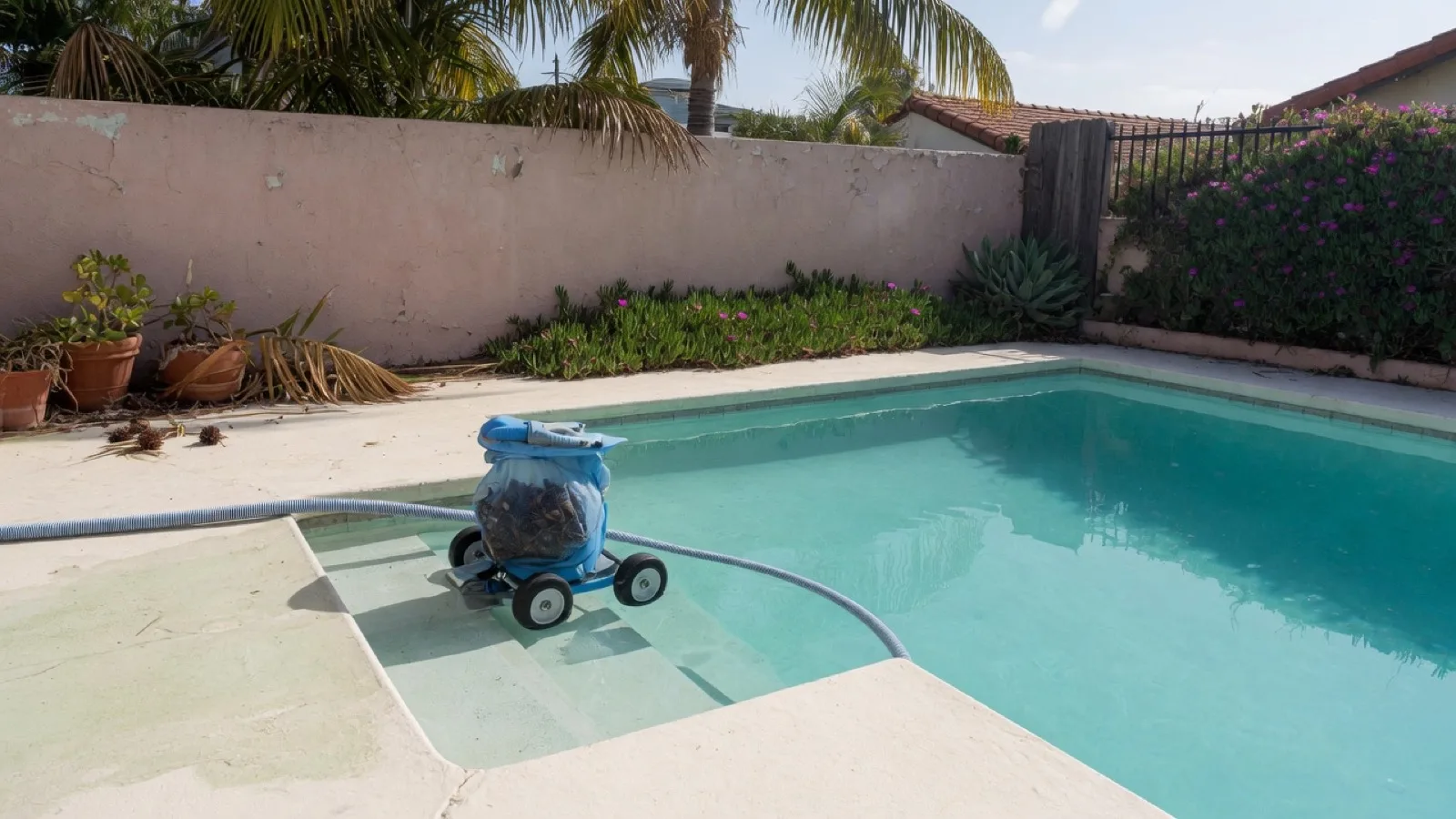
The Polaris Vac-Sweep 280 is a pressure-side cleaner. It does not live on a skimmer hose. If the three wheels are not turning, the job is flow, not a suction leak at the Hayward plate. San Diego yards still run a lot of 280s on older gunite pools in Clairemont, El Cajon, and Oceanside. Leaves, palm fiber, and hard-water scale all starve the same path.
This page is only for the 280-class pressure cleaner: wheels, bag, backup valve, feed hose, wall fitting, booster. If your cleaner is a suction vac that sits on a skimmer, go to pool vacuum not moving. That is a different machine.
Count the wheels before you order parts
Polaris’s published first check is wheel speed. With the cleaner in the water and the booster running, mark one wheel and count full turns for a minute. The Vac-Sweep 280 range they publish is 28 to 32 RPM.
That number is the whole diagnosis, written down.
- Wheels dead, hose stiff with pressure. Flow is reaching the wall fitting and dying in the head. Polaris tells you to clean the in-line filter in the quick disconnect, then check the water-management system for clogs.
- RPM a little under 28. Their next step is to remove the restrictor disc from the wall fitting.
- Wheels too fast. They tell you to install the red restrictor disc.
- Hose limp, no push at the wall. The booster never came up, a valve is closed, or the feed hose is split. That is pad work, not a new wheel kit.
Do not keep running a dry booster. A booster that screams with an empty basket cooks the seal the same way a filter pump does. Confirm any part and labor line on the written estimate. We publish no price list, and no figure on this page is a quote.
Backup valve, thrust jet, and a cleaner that parks
Wheels that turn while the 280 camps in one corner are a different complaint. Polaris’s Vac-Sweep 280 stuck article (March 1, 2022) lists three factory checks:
- Wheel RPM still in the 28 to 32 band.
- The backup valve cycling on and off about every three minutes.
- Thrust-jet aim. Factory is straight back. They note the 11 o’clock position for random turning on other Polaris pressure models.
Then they add the screen in the quick disconnect, the skimmer and pump baskets, the pool filter, and hose leaks that bleed pressure. Hose length that does not reach within six inches of the farthest wall shows up on their broader pressure-cleaner stuck guide.
A 280 that hangs on the spa spillover in a La Jolla hillside pool is often hose geometry, not a dead turbine. A 280 that never leaves the deep end in a Ramona wind yard is often a backup valve that never dumps. Photograph the valve cycling (or not) before the visit. The matched licensed pro should see that clip.
San Diego debris that kills a 280
Pressure-side cleaners drink whatever the booster sends. In this county that is usually:
- Eucalyptus buttons and palm fiber in Carlsbad, Encinitas, and Point Loma. They pack the in-line screen and the bag.
- Plaster grit after a resurface. Grit scores the turbine. Wait until the finish crew says the pool is ready for a cleaner. For a new pebble finish, that wait sits inside the PebbleTec startup window, not a guess.
- Scale from hard inland fill. Escondido, Santee, and El Cajon water leaves crust in the wall fitting. A crusted orifice looks like a weak booster.
- A booster on a salt pad. Salt air at Imperial Beach rusts the motor can. A booster that trips the breaker belongs on pool pump trips breaker, not a cleaner rebuild.
Empty the bag when it is heavy. A packed bag makes the head wander and can fake a backup-valve fault. Rinse the quick-disconnect screen with the booster off. Do not pull the cleaner body apart if you cannot put the turbine back on the same stack. That is the licensed pro’s work.
What a licensed pool pro tests on the visit
A matched licensed pool contractor does not start with a new 280. They test the feed.
Power and the booster first. Voltage at the motor, prime in the wet end, and actual pressure at the wall fitting. A booster that never starts is a capacitor, a relay, or a failed motor. A booster that runs and still delivers a limp hose is a closed valve, a clogged filter, or a split feed line.
Then the cleaner circuit. Screen, backup valve cycle, wheel RPM, thrust jet, hose leaks, and the bag. They should name the part they want to replace and why. Ask for that on the written estimate. If a figure is not on that paper, it is not confirmed.
Look up the contractor on the CSLB license check before you approve the work. Splash Pool SD matches you with licensed independent pros. We do not hold the trade license, own the truck, or warranty the repair. The pro who does the work carries those.
How to describe the fault when you request a match
Say it is a Polaris 280 or a three-wheel pressure cleaner with a bag, not a suction vac. Name the city and the yard: coastal deck, inland pad, or hillside equipment below the pool. Say whether the wheels are dead or the head is spinning in place. Say whether you counted RPM, and the number. Say whether the backup valve dumps every few minutes. Say whether the booster is silent, humming, or running hard.
Call (858) 400-4404 and we will match you with a licensed local pool specialist.
Frequently asked questions
Why is my Polaris 280 not spinning?
A Vac-Sweep 280 that sits still is almost always short of pressure or clogged inside the water path. Polaris's own troubleshooting asks you to count wheel revolutions: the published range is 28 to 32 RPM. Low RPM points at the in-line filter, a clogged water-management system, a restrictor disc still in the wall fitting, or a booster that never came up to speed.
How do I count Polaris 280 wheel RPM?
With the cleaner in the pool and the booster running, mark one wheel and count full turns for 60 seconds. Polaris publishes 28 to 32 RPM for the 280. Below 28, they tell you to clean the in-line filter, then check for clogs, then remove the restrictor disc from the wall fitting if RPM is only slightly low. Above the range, they tell you to install the red restrictor disc.
My Polaris 280 is stuck in one spot. Is that the same as not spinning?
No. Wheels turning while the head parks in a corner is a travel problem: backup valve, thrust jet, or hose length. Polaris's Vac-Sweep 280 stuck guide says the backup valve should cycle on and off about every three minutes, and the factory thrust-jet position is straight back. A head that does not spin at all is a flow problem first.
Does a Polaris 280 use the same pump as a Hayward suction vacuum?
No. The 280 is a pressure-side cleaner. It needs a dedicated booster (or a high-pressure feed) and a wall fitting. A Hayward-style suction cleaner lives on a skimmer or suction line. If the suction cleaner is the one sitting still, that is a different page and a different diagnosis.
When should I stop and request a match?
Stop if the booster hums with no flow, the wall fitting leaks under pressure, the backup valve never cycles after you have cleaned the screen, or you would have to open the cleaner body. Splash Pool SD matches you with a licensed independent pro. We do not hold the trade license or warranty the repair.
Need professional help in San Diego County?
Splash Pool SD connects you with a licensed specialist for any service in this post.