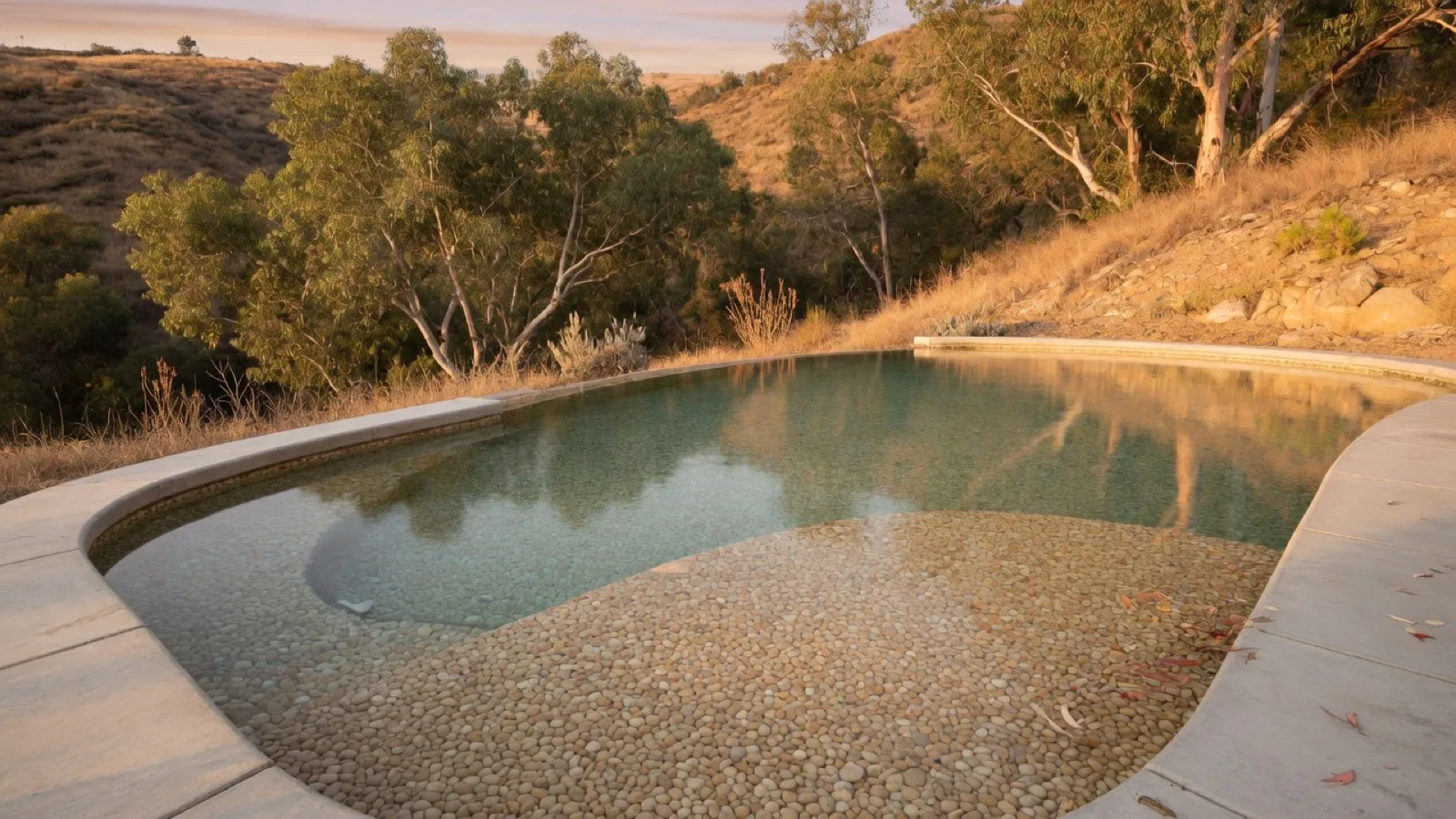
The crew leaves. The pool is full. You are now the person holding the test kit. Pebble Technology International (PTI) is blunt about that handoff: “During the first twenty-eight (28) days, the product develops most of its durability characteristics. Therefore, it is critical to adhere to the start-up instructions to prevent harm to the surface.” That sentence is from PTI’s Recommended Start-Up & Maintenance procedures.
This page is the owner checklist for a PTI pebble finish (PebbleTec, PebbleSheen, PebbleFina, PebbleQuartz) in San Diego County. It is not a lifespan promise, not a plaster startup, and not a quote. For how long a surface lasts in this climate, see how long pool resurfacing lasts. For the job that put the pebble in, see pool resurfacing.
Primary sources, pulled for this site: PTI pool care instructions and the PTI start-up PDF linked from the brand ledger.
PTI DOs and DON’Ts you actually run
From PTI’s published pool-care page:
DO NOT fill with soft water. If an outside hose bib is on a softener, tell the applicator. Soft water may be used after curing.
DO NOT enter the pool, including pets, until it is filled and balanced.
DO NOT chlorinate until pH and carbonate alkalinity are in the acceptable range. PTI warns that chlorine is highly reactive and high concentrations can precipitate metals or minerals.
DO wait about 28 days before judging final water and finish color.
DO brush with a nylon brush: three times a day for the first three days, two times a day for the next ten days, walls and floor toward the main drain. After that, about once a week depending on dust.
DO expect pebbles or glass beads to come loose in the first weeks. PTI calls a small loss normal.
DO wait at least 14 days before heating, then watch chemistry more closely.
DO wait at least 28 days before adding salt on a salt system. “Salt left on the finish surface may scale, stain or discolor the finish and is not covered by the warranty.”
The 28-day chemistry PTI publishes
Quote the ranges. Do not paraphrase them into a different band.
From PTI’s start-up procedures, first 28 days:
- pH 7.0 – 7.4
- Total alkalinity 80 – 90 PPM
- Calcium hardness 200 – 250 PPM
- Total dissolved solids 400 – 600 PPM
- Free chlorine 1 – 3 PPM
- CYA 20 – 80 PPM
- Langelier Saturation Index between -0.3 and +0.3
PTI’s own qualifier: “PTI Recommended Acceptable Start-Up Range is designed for high-performance finishes and not recommended for traditional pool plaster.”
Acid demand surprises owners. PTI: “Frequent additions of muriatic/hydrochloric acid (HCl) are normal during this time to maintain pH within the recommended acceptable range. It is not uncommon to add acid (HCl) to the water daily for the first two (2) weeks, and two (2) to three (3) times per week during the remainder of the twenty-eight (28) days.”
Salt, again, from the same sheet: “Important: NO SALT SHOULD BE ADDED FOR THE FIRST TWENTY-EIGHT (28) DAYS.”
Fill water can force a change. PTI says filling with water that has extremely high or low calcium hardness, pH, or total alkalinity may necessitate changes to these procedures. San Diego County fill is a mix of imported and local supply and it is not the same in La Jolla and Ramona. Test the fill. Do not assume a number from a forum.
Keep printed test reports. PTI’s care page asks you to, in case you need a warranty request. Register the finish on PTI product registration.
What San Diego owners get wrong in week one
Turning the salt cell back on. Salt systems are common here. The cell going live on day four is the exact thing PTI forbids. If you converted at the same time as the resurface, the cell stays off until day 28 unless the applicator gives you PTI’s salt-system start-up packet and it says otherwise in writing.
A metal brush. Nylon only. A wire brush chews the cement around the stone.
Heating on day three because the coastal marine layer made the water cold. PTI’s wait is at least 14 days.
Judging color on day two. Inland sun in Escondido and coastal overcast in Point Loma both lie. PTI wants about 28 days before you assess color.
Filling from a soft-water bib on a house that softened the outdoor lines. That is a DON’T.
If you also drained for the job, the empty-shell risk is on pool drain and refill and the hydrostatic valve. Do not drain a new pebble finish to “see the color.”
What the matched licensed pro is for
Daily brushing and testing are owner work PTI assigned to you. What is not owner work: acid in bulk if you are not trained, heater start before day 14, salt start before day 28, a finish that is dusting in sheets, hollow spots, or a drain filling with aggregate.
Splash Pool SD matches you with licensed independent pool contractors. We do not apply the finish, hold the trade license, or warranty PTI’s product. The applicator and PTI carry those. Verify the contractor on the CSLB license check.
How to describe the problem when you request a match
Say it is a PTI pebble finish in startup, not old plaster. Name the day you are on (day 4, day 12). Say whether salt is still off, whether you have been brushing nylon, and what the last test showed for pH and alkalinity. Photograph the surface and the test strip or printout.
Call (858) 400-4404 and we will match you with a licensed local pool specialist.
Frequently asked questions
How long is PebbleTec startup?
Pebble Technology International states that during the first 28 days the product develops most of its durability characteristics, and that it is critical to follow the start-up instructions. Their pool-care page also says to wait about 28 days before judging final water and finish color, and at least 28 days before adding salt.
When can I add salt after a PebbleTec resurface?
PTI's published rule is: no salt should be added for the first 28 days. Their pool-care DOs also say to wait at least 28 days before adding salt if you use a saltwater chlorination generator. Salt left on the finish may scale, stain, or discolor, and they say that is not covered by the warranty.
How often should I brush a new PebbleTec pool?
PTI's pool-care page: brush three times a day for the first three days and two times a day for the next ten days, with a standard nylon-bristle pool brush, walls and floor toward the main drain. Their start-up PDF also says brushing continues for a minimum of seven days, or until plaster dust is gone, whichever is longer.
Is loose pebble in the first weeks a defect?
PTI says pebbles and glass beads will come loose during curing, usually in the first few weeks, and that a small loss is normal. A sudden dump of aggregate, hollow spots, or a drain full of stone is not that sentence. Call the applicator and request a match if the loss looks like a slide, not a few beads in the skimmer.
Does this checklist apply to regular white plaster?
No. PTI states that its recommended start-up range is designed for high-performance finishes and is not recommended for traditional pool plaster. Use the plaster manufacturer's sheet for a plaster pool.
Need professional help in San Diego County?
Splash Pool SD connects you with a licensed specialist for any service in this post.