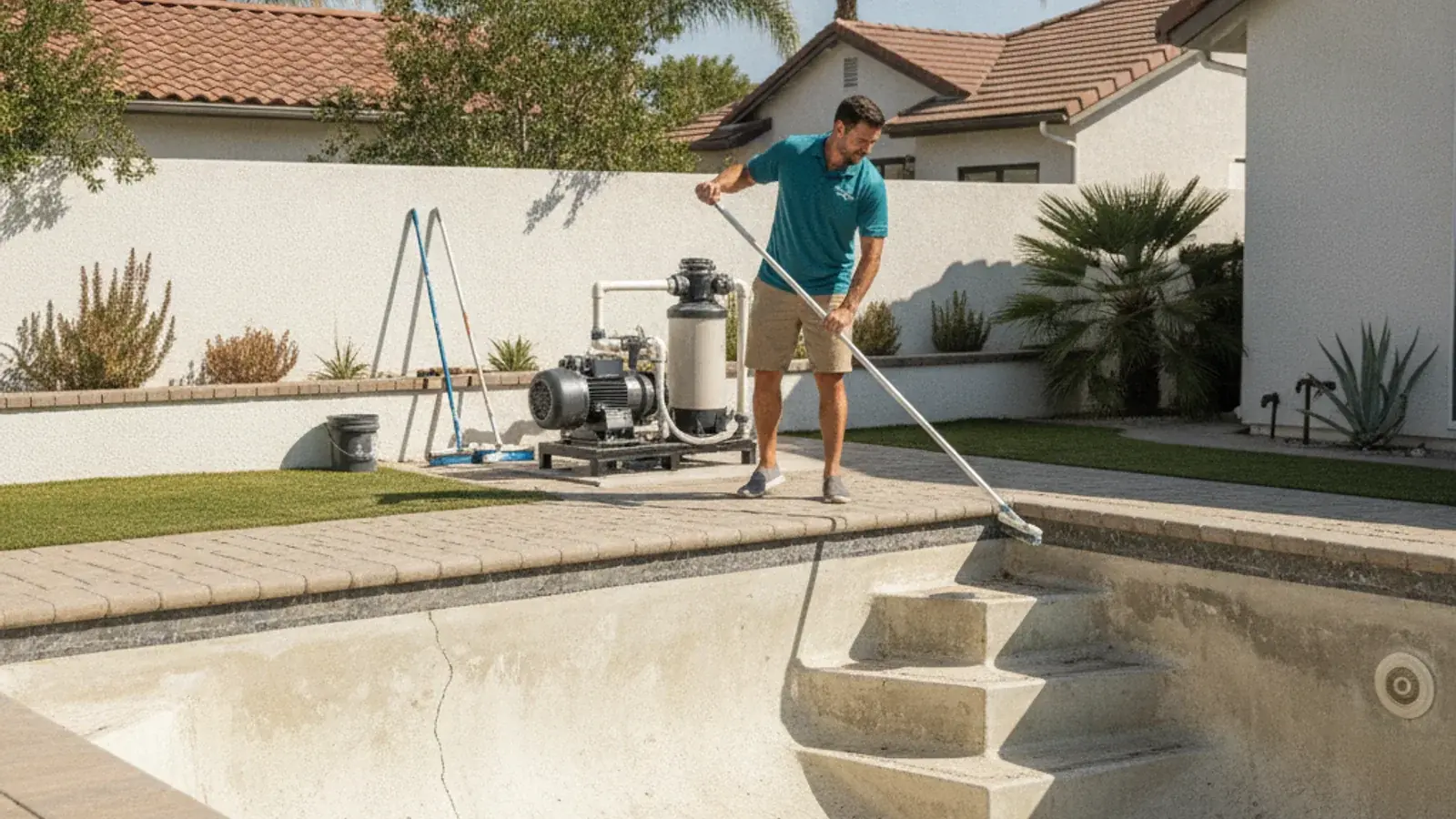
Pool resurfacing doesn’t come with a fixed expiration date. How long it lasts depends on the finish material, your water chemistry history, mineral content in your supply, bather load, and how consistently the pool has been maintained. In San Diego County, hard water and intense sun are the two biggest local factors that shorten a surface’s life. A well-maintained pebble finish in a coastal zone will outlast a neglected plaster job in East County by a wide margin.
Finish types and relative durability
The three common interior finishes rank clearly by hardness. White plaster is the softest and most widely used option. Quartz-aggregate sits in the middle, harder than plain plaster. Pebble is the most durable of the three.
Harder finishes resist etching and scale buildup longer, but no finish is immune to poor chemistry. Regardless of material, inspect for etching, scale, and roughness during routine maintenance. When you get a quote, ask which specific product the contractor specifies and request the written warranty terms.
For a deeper comparison of materials, see our guide on pebble, plaster, and quartz options.
San Diego factors that shorten lifespan
Hard water and mineral load
San Diego County water comes from the imported Colorado River supply. It carries moderate to hard mineral content. That mineral load speeds scaling and chalky buildup on pool surfaces. Scaling roughens plaster and dulls color earlier than expected.
East County and inland North County zones tend to run harder than coastal areas. Coastal zones benefit from softer supply water, which means slower aging. Homes on well water see even faster wear. If you want more detail on how local water affects your pool, read our post on hard water and San Diego pools.
Sun and thermal cycling
Sun exposure is the second major local factor. Uncovered pools absorb more UV radiation and go through daily heat cycling. That thermal stress causes hairline cracking over time. Shaded pools last longer because they avoid the worst of that cycling.
Bather load
Frequent parties or daily swimming increase wear. More bodies mean more oils, more chemical demand, and more physical abrasion on the surface. A pool that hosts swimmers six days a week ages faster than one used on weekends.
Signs you need a full resurface, not a patch
Some problems look fixable with a spot repair but actually signal the entire surface is failing. Watch for these:
- Sandpaper-like texture on the floor or steps. Roughness means the plaster has etched and aggregate is exposed.
- Gray, brown, or black staining that resists brushing and shock. That indicates deep mineral or organic absorption.
- Algae returning within days despite correct chlorine levels. A porous surface holds spores. A smooth finish sheds them.
- Spreading or multiplying cracks. These signal shell movement and need professional evaluation before any resurfacing work begins.
If you see cracking combined with water loss, get leak detection done first. Resurfacing over an active leak wastes the new finish.
Cost considerations
HomeGuide provides U.S. planning estimates of $6 to $8 per square foot for plaster and $7 to $15 per square foot for pebble, excluding refill. For a pool with roughly 1,000 square feet of surface area, that translates to about $6,000 to $8,000 for plaster and $7,000 to $15,000 for pebble.
These are planning figures only. Your final price moves based on pool size, current surface condition, hidden structural issues, access difficulty, equipment brand, and permit requirements. The pro you are matched with will quote the exact number before any work starts. Ask for an itemized breakdown that separates prep, material, and labor.
For more on what drives the final number, see our post on pool resurfacing cost.
What to ask before you accept a quote
Before you sign anything, gather a few things:
- Photograph the visible surface condition so you have a baseline.
- Record your current finish type if you know it.
- Ask which specific product the quote specifies.
- Request the product’s written water-care sheet. Check the specified pH and alkalinity ranges, the testing method, and whether a cover or brushing schedule is required.
- Get the written warranty and care terms in hand.
None of this guarantees extra lifespan, but it gives you a clear standard to maintain against. It also lets you compare quotes on equal footing. Our post on comparing pool refinishing quotes walks through that process.
Timing equipment work with a resurface
A drained pool is the easiest time to handle equipment upgrades. If you are considering a salt conversion, ask about timing. Salt systems interact differently with fresh plaster during the curing period. Coastal homeowners and those in San Diego proper often combine equipment upgrades with a resurface to save on mobilization.
When to call us
Rough texture, spreading stains, and repeat algae all warrant a professional inspection. A licensed specialist can run a plaster thickness check and confirm whether you need a full resurface or a smaller repair. Call us at (858) 400-4404 and we’ll connect you with a licensed local pool specialist.
Frequently asked questions
How long does pool resurfacing typically last?
There is no single number. Lifespan depends on finish type, water chemistry, mineral content, bather load, and how consistently the pool is maintained. Pebble outlasts plaster, and coastal San Diego pools age slower than East County pools due to softer water.
Does San Diego's water hardness affect resurfacing lifespan?
Yes. San Diego County water comes from the imported Colorado River supply and carries moderate to hard mineral content. That mineral load accelerates scaling and etching if chemistry is not monitored. East County and inland North County zones tend to have harder water than coastal areas.
What are the signs my pool needs resurfacing rather than a patch?
Sandpaper-like texture on the floor or steps, staining that resists brushing and shock, algae returning within days despite correct chlorine, and spreading cracks all point to a full resurface. A specialist can measure remaining plaster thickness to confirm.
Can I delay resurfacing if the surface still looks okay?
Surface appearance can be misleading. Plaster may thin beneath a layer that still looks intact. Once thinning reaches the gunite or rebar underneath, the project escalates from resurfacing into structural repair. A probe test measures remaining thickness.
How much does pool resurfacing cost in San Diego?
HomeGuide provides U.S. planning estimates of $6 to $8 per square foot for plaster and $7 to $15 per square foot for pebble, excluding refill. For 1,000 square feet of surface, that works out to roughly $6,000 to $8,000 for plaster and $7,000 to $15,000 for pebble. Your matched pro quotes the exact figure before work starts.
Need professional help in San Diego County?
Splash Pool SD connects you with a licensed specialist for any service in this post.