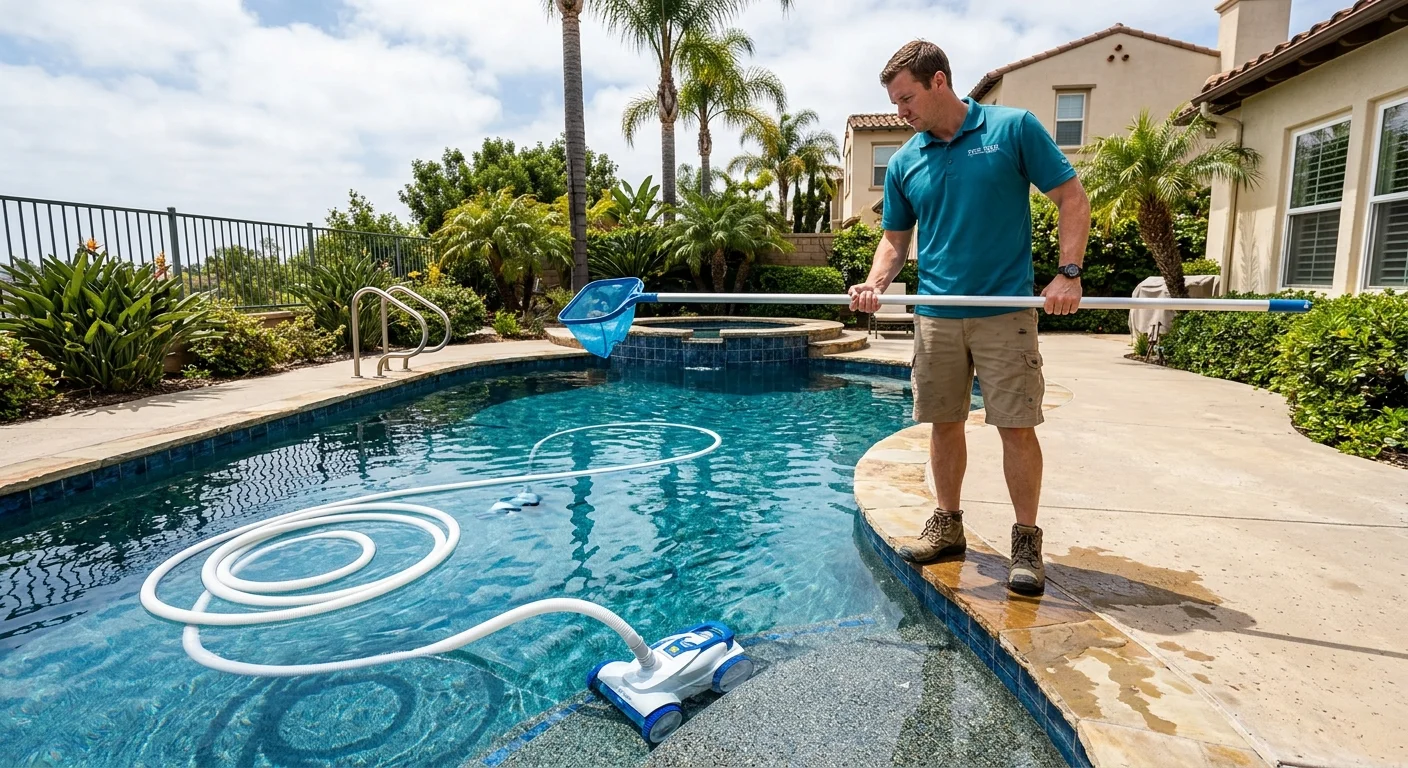
A pool vacuum that sits still on the floor usually has a flow problem, a hose problem, or a mechanical jam. Before you replace anything, identify which type of cleaner you have, then work through the checks below in order. Most of the time the fix is something you can spot in ten minutes.
Identify your cleaner type first
The diagnostic path depends entirely on what is sitting on your pool floor.
Suction-side cleaners connect to the skimmer or a dedicated wall port and ride on pump suction. They are common on older San Diego gunite pools built before dedicated cleaner lines became standard. Hayward makes several suction-side models still in service across the county.
Pressure-side cleaners run on return pressure. Many require a booster pump on the equipment pad. If the booster is off, the unit won’t move even though the main pump is running.
Robotic cleaners have their own motor, cable, tracks, and on-board basket. They are independent of your filter pump entirely. A dirty pool filter usually doesn’t cause a robot to stop.
Suction-side checks
If your cleaner feeds off the skimmer or a wall port, work through this sequence.
Hose integrity
Walk the hose in the water. Look for kinks, sun-split sections, and fittings that suck air. A cracked cuff at the skimmer is a classic San Diego failure. UV exposure on west-facing equipment pads in Mission Valley and Escondido cooks rubber cuffs over time. When the cuff cracks, the pump runs but the cleaner gets foam instead of pull.
Hose length matters too. On freeform coastal pools in La Jolla, Encinitas, and Pacific Beach, a hose that is too short can’t reach the deep end. One that is too long knots around the ladder. Match the hose to your pool shape.
Skimmer and basket
Pull the skimmer basket and look inside. Palm fronds, jacaranda blooms, and eucalyptus caps form hidden plugs that block flow before it ever reaches the cleaner. A cracked or missing basket lets debris pass through and lock the turbine inside the cleaner head.
If the skimmer body itself is cracked, the weir is jammed, or the equalizer line is pulling air, that is a skimmer problem, not a vacuum problem. Don’t force hose adapters into a broken throat.
Valves and water level
Two skimmers on one line can steal flow from the cleaner. Adjust valves deliberately so the cleaner port gets adequate suction. Also confirm the cleaner line valve is fully open. It is common for that valve to get closed during weekend maintenance and forgotten.
Water level below the skimmer mouth kills suction in minutes. Inland yards in El Cajon, Santee, and Escondido lose water faster to sun and wind. Top off the pool and recheck.
Pump prime
If the pump is humming but not moving water, or the lid is full of bubbles, the cleaner is starving. A packed pump basket or a pump that won’t hold prime produces the same result. Fix the pump first. The cleaner can’t work without flow.
Pressure-side checks
Pressure cleaners need return pressure to move. Start here.
Booster pump. Confirm it is running. If it is off or has tripped, the cleaner sits still while the main returns still ripple. That is normal and doesn’t mean the system is fine.
Debris bag. A packed bag creates back-pressure that stalls the unit. Empty it and recheck.
Belt. A slipped or worn belt stops wheel drive. Open the unit and inspect.
Wall fitting. A clogged wall fitting starves the cleaner of pressure. Remove and clear it.
Backup valve. If the unit crawls in circles only, the backup valve is likely stuck. It should reverse the unit periodically. A worn wheel can also cause circling, so check both.
Robotic checks
Robots are self-contained, so the checklist is different.
Power. Confirm the outlet is live. Test with another device if you are unsure.
Cable. A tangled or cut cord stops the unit. Unspool it fully and look for damage.
Tracks and brushes. Worn tracks reduce grip. The robot may power on but fail to climb walls or move at all.
Impeller housing. Sand from coastal bottom can pack the impeller housing and jam the drive. If the robot powers on but stays immobile, stop cycling it. Repeated attempts against a jam can destroy parts that are still salvageable.
Pump and filter as root cause
Sometimes the cleaner is fine and the problem is upstream.
A dirty cartridge or sand filter cuts flow to every suction and pressure cleaner on the system. If your pressure gauge reads high or oddly low after a backwash or cartridge swap, a valve may be left partway closed. Filter repair or replacement may be needed if the media is worn out.
Weak return jets are a sign the whole system is restricted, not that the cleaner head has failed. Check the filter, the valves, and the pump before you blame the vacuum.
San Diego factors that make this worse
Local conditions add failure modes you won’t see in pool-care guides written for other regions.
Coastal sand. Fine sand packs into cleaner throats and impeller housings. Pools near the beach in Pacific Beach and Encinitas see this regularly.
Hard water scale. Inland areas like El Cajon, Santee, and Escondido have hard water that leaves mineral scale on axles and turbines. Scale seizes moving parts over time.
Santa Ana winds. Wind events load South Bay and East County pools with oak leaves and palm fronds. Baskets plug faster than usual during these stretches.
Eucalyptus caps. East County eucalyptus trees drop small round caps that wedge into baskets and throats. They are a common hidden blockage.
Decomposed granite. Slopes in East County wash fine granite into pools during rain. It packs into turbine housings like cement.
Shaded, screened yards in neighborhoods like North Park tend to cause less wheel wear because less debris reaches the pool floor.
Repair or replace
There is no single lifespan number that applies to every cleaner. Run hours, debris load, and pump pull all affect how long a unit lasts.
Repair when the rest of the system is healthy and one part failed. A split hose, a worn belt, a packed throat, a failed backup valve, or a bad skimmer adapter are all fixable. Bring the model tag or a clear photo when you get parts. Don’t guess part numbers.
Replace when the drive is worn through, the shell is cracked, or a robot has both motor and track failure at the same time. Also replace if the pump can’t hold prime. A new vacuum on a starving system will still sit on the floor.
One more point: a new cleaner won’t climb walls that the old one couldn’t. It needs the right type, good tracks or brushes, and adequate flow for your pool. If your Hayward pump needs repair, fix that before shopping for a new cleaner.
Never keep running a jammed head. It can destroy parts that are still salvageable.
When to call us
If the pump is running, the hose is attached, baskets and valves are checked, and the cleaner still won’t walk, the problem is likely internal. A licensed pool pro can diagnose the drive assembly, test flow at the port, and tell you whether repair or replacement makes sense for your setup. Call us at (858) 400-4404 and we’ll connect you with a licensed local pool specialist.
Frequently asked questions
Why does my pool cleaner stay stuck in one spot?
Too much suction is the most common cause. The head seals against the pool floor and cannot break free. Check your suction-side valve or bypass regulator and reduce flow to the cleaner line. A kinked hose can also pin the unit in place.
Why won't the wheels on my pool vacuum turn?
Debris packed in the throat, a seized turbine or gear, a slipped belt, or scale buildup on the axle are the usual culprits. In San Diego, hard water scale on axles is a frequent cause inland. Pull the unit out and inspect the drive assembly.
My Hayward suction cleaner is not moving. What should I check?
Start with flow and hose integrity. Confirm the pump is primed, the skimmer basket is clear, and the hose has no splits or air leaks. Hayward suction units depend entirely on adequate water pull. If flow checks out, the diaphragm or flapper inside the head may have failed.
Can a dirty pool filter stop my vacuum from moving?
Yes. A clogged cartridge or sand filter restricts flow to every suction and pressure cleaner on the system. If your pressure gauge reads high after a backwash or cartridge swap, a valve may be partially closed. Clean or replace the filter media and recheck.
Should I repair or replace my pool cleaner?
Repair when the rest of the system is healthy and one part failed: a split hose, worn belt, packed throat, or bad backup valve. Replace when the drive is worn through, the shell is cracked, or multiple major components are failing at once. A pro can assess on site.
Need professional help in San Diego County?
Splash Pool SD connects you with a licensed specialist for any service in this post.