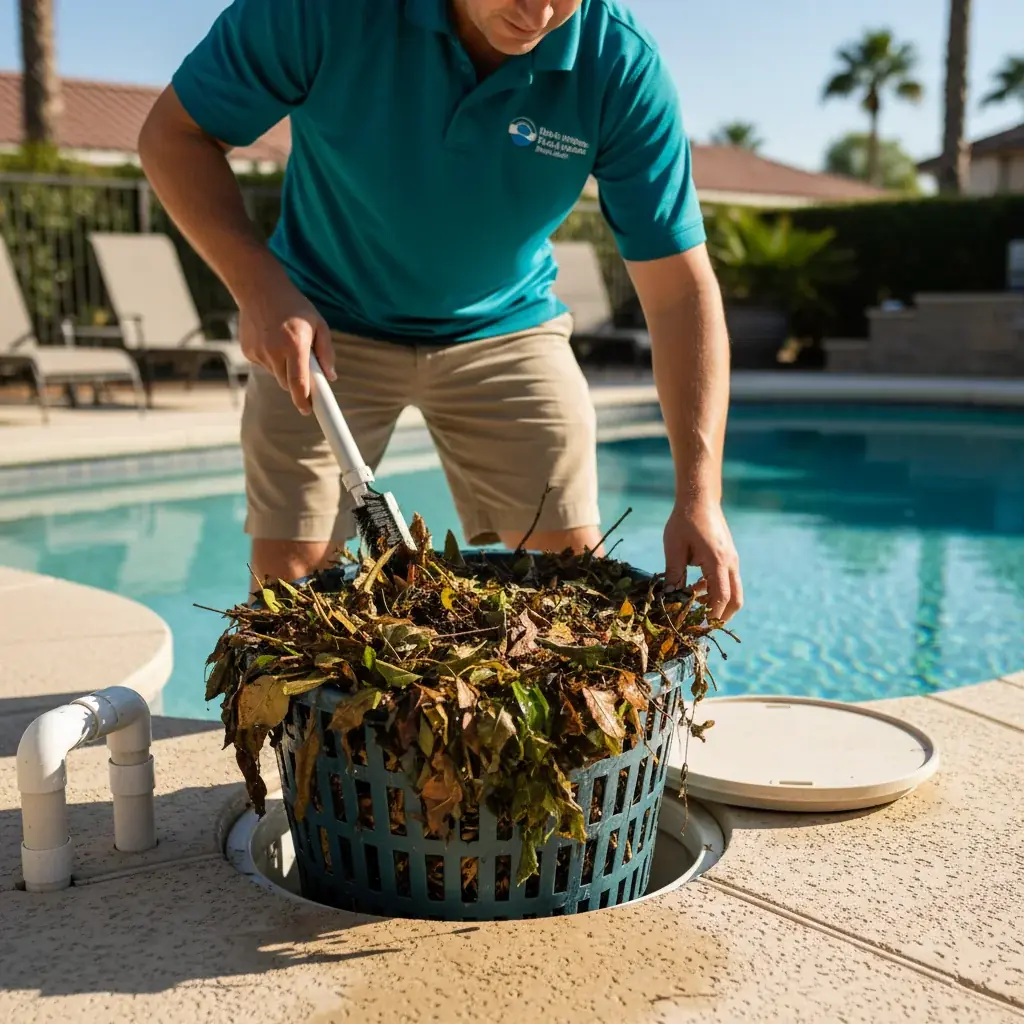
A pool skimmer that stops pulling water is almost always dealing with a clog, an air leak, or a mechanical issue with the weir door. The fix depends on which one you have, and most homeowners can narrow it down in under an hour with a few checks at the pool wall and the equipment pad. This guide walks through each cause in order, from the simplest to the ones that need a licensed pro.
What the skimmer actually does
The skimmer is the entry point to your entire filtration system. It pulls surface water, capturing leaves, pollen, and bugs before they sink and decay on the pool floor. That keeps the pump and filter from working harder than they need to. When the skimmer stops doing its job, debris accumulates fast, and the rest of your equipment feels the strain.
The key parts are the skimmer mouth (the opening in the pool wall), the weir door (a floating flap inside the mouth), the skimmer basket (a removable catcher for large debris), and the suction line (the pipe running from the bottom of the housing to the pump).
Weak suction: the most common problem
If water still moves through the skimmer but too slowly to grab floating debris, you have weak suction. That almost always comes down to a clog or an air leak.
Check the baskets first
An overflowing skimmer basket chokes flow. Pull it out, dump the debris, and rinse it. Then check the pump basket inside the pump housing at the equipment pad. Debris that gets past the skimmer basket collects there, and a full pump basket restricts suction across all lines.
Cleaning these two baskets is the single most important maintenance step for skimmer performance. If you haven’t done it in a week or more, start here.
Test for a line clog
Both baskets are clean and suction is still weak? That points to a plumbing clog between the skimmer and the pump. Go to the equipment pad and test the diverter valves. Close the main drain valve to isolate the skimmer line. If the pump struggles to prime or you hear it laboring, the clog is confirmed.
A plumbing bladder or jet tool can sometimes clear the blockage. Be careful, though. Incorrect tool use risks damaging the pipe, and a cracked suction line is a much bigger repair than a clog. If you aren’t comfortable doing this, stop and call a pro. The matched pros on our network handle skimmer repairs across San Diego County every week.
Look for an air leak
Air entering the suction side of the system drastically cuts efficiency. The telltale sign is tiny bubbles streaming from the return jets. You might also hear grinding or gurgling from the pump.
Common air leak locations:
- The pump lid O-ring. Check for cracks, dryness, or a missing ring entirely. The lid must screw on tightly.
- The threaded fitting at the front of the pump. This is a frequent leak source.
- Diverter valve O-rings. These wear over time and let air seep in.
If you can’t locate the air leak after checking these spots, a pro with pressure-testing equipment can find it without guesswork.
No suction at all
Zero suction is more serious than weak suction. It means either the skimmer line is completely blocked or the pump isn’t moving water.
Check the water level
San Diego’s dry climate and year-round swimming season mean evaporation drops pool levels fast. If the water falls below the skimmer mouth, the pump sucks air instead of water and loses prime. The correct level is halfway up the skimmer mouth opening. Top off the pool and see if suction returns.
If your pump keeps losing prime, we have a full guide on why that happens and how to fix it.
Verify the pump is running
Check the breaker and the timer. A tripped breaker or a timer set wrong will leave the pump idle. If the pump is running but the clear lid isn’t full of water, it has lost prime. That usually traces back to low water or a major air leak.
Check the diverter valve position
Someone may have accidentally shut off the skimmer line at the pad. Confirm the valve handle is positioned to allow skimmer flow. This sounds obvious, but it happens more often than you would think, especially after equipment service or winterizing. Our post on equipment pad layout can help you identify each valve.
Weir door problems
The weir door is that floating flap inside the skimmer mouth. During pump operation it angles to create a waterfall effect that speeds surface water into the skimmer. When the pump shuts off, it swings vertical and traps debris in the basket so it doesn’t float back out.
If the weir is stuck in the closed position, it completely blocks water entry. A stick, a pool toy, or a clump of leaves can wedge it shut. Reach in and make sure it swings freely.
If the weir is broken or missing, the skimmer still pulls water, but debris escapes back into the pool every time the pump cycles off. Replacement weirs are inexpensive and easy to install. Match the model to your skimmer brand.
Cracked skimmer body
Plastic skimmer housings crack from ground shift, UV exposure, and pressure changes over years. A crack means a leak, and even a small one can cause major water loss or damage the surrounding pool structure.
Inspect the corners and the throat, which is the junction where the skimmer meets the pool wall. Look for damp ground near the skimmer outside the pool. That signals a hidden crack leaking underground.
If you suspect a crack but can’t see it clearly, leak detection can pinpoint the location without excavation.
Repair or replace
A hairline crack above the waterline can sometimes be sealed temporarily with epoxy or pool putty. That buys time, but it isn’t a permanent fix.
Cracks below the waterline or running through the body of the skimmer are a different story. Water pressure eventually defeats any patch. A licensed pro can assess whether plastic welding or injection techniques will hold, but in many cases full replacement is the most durable solution.
Replacement involves cutting a section of concrete deck around the skimmer, excavating, cutting and redoing the plumbing, setting the new unit level, and pouring fresh concrete. It is a complex job and not suitable for DIY. The pros we connect you with handle this kind of pool repair regularly and will quote the full scope before any work starts.
San Diego specifics worth knowing
The county’s hard water leaves mineral deposits that can build up around the skimmer throat and weir hinge over time, making parts stick or seize. If you notice white or gray crust around the skimmer mouth, that is calcium. It is the same issue that shows up on tile, and we cover it in our post on hard water and San Diego pools.
Coastal areas from La Jolla to Encinitas also deal with salt air accelerating wear on metal components near the equipment pad. Diverter valve stems and clamp bands corrode faster within a few miles of the ocean. If your valves feel stiff or show rust, that is likely why.
Inland areas like El Cajon and Santee see more temperature swing, which expands and contracts plumbing joints. That makes air leaks on the suction side more common in East County than on the coast.
When to call us
If you have a deep plumbing clog you can’t clear, an air leak you can’t locate, or any crack in the skimmer body, it is time for a licensed pool professional. Attempting these repairs without the right tools and experience risks turning a small problem into an expensive one. Call us at (858) 400-4404 and we’ll connect you with a licensed local pool specialist.
Frequently asked questions
Why is my pool skimmer not collecting debris?
The most common causes are weak or absent suction. That usually traces back to a full skimmer basket, a clogged suction line, an air leak on the suction side, or a stuck or missing weir door. Start by checking the basket and water level before moving to plumbing.
How do I know if my skimmer line is clogged?
Clean both the skimmer basket and the pump basket first. If suction at the skimmer is still weak, close the other suction lines at the equipment pad to isolate the skimmer. If the pump struggles to prime or suction does not improve, a clog in the line is likely.
Can I fix a cracked skimmer myself?
A hairline crack above the waterline can sometimes be sealed temporarily with epoxy or putty. Anything below the waterline or running through the body of the skimmer needs professional attention. Water pressure will eventually defeat a patch, and the crack can worsen into a structural leak.
What does the weir door do?
The weir is the floating flap inside the skimmer mouth. It speeds surface water into the skimmer while the pump runs and swings vertical when the pump shuts off to trap debris in the basket. If it is stuck, broken, or missing, debris floats back into the pool.
Need professional help in San Diego County?
Splash Pool SD connects you with a licensed specialist for any service in this post.