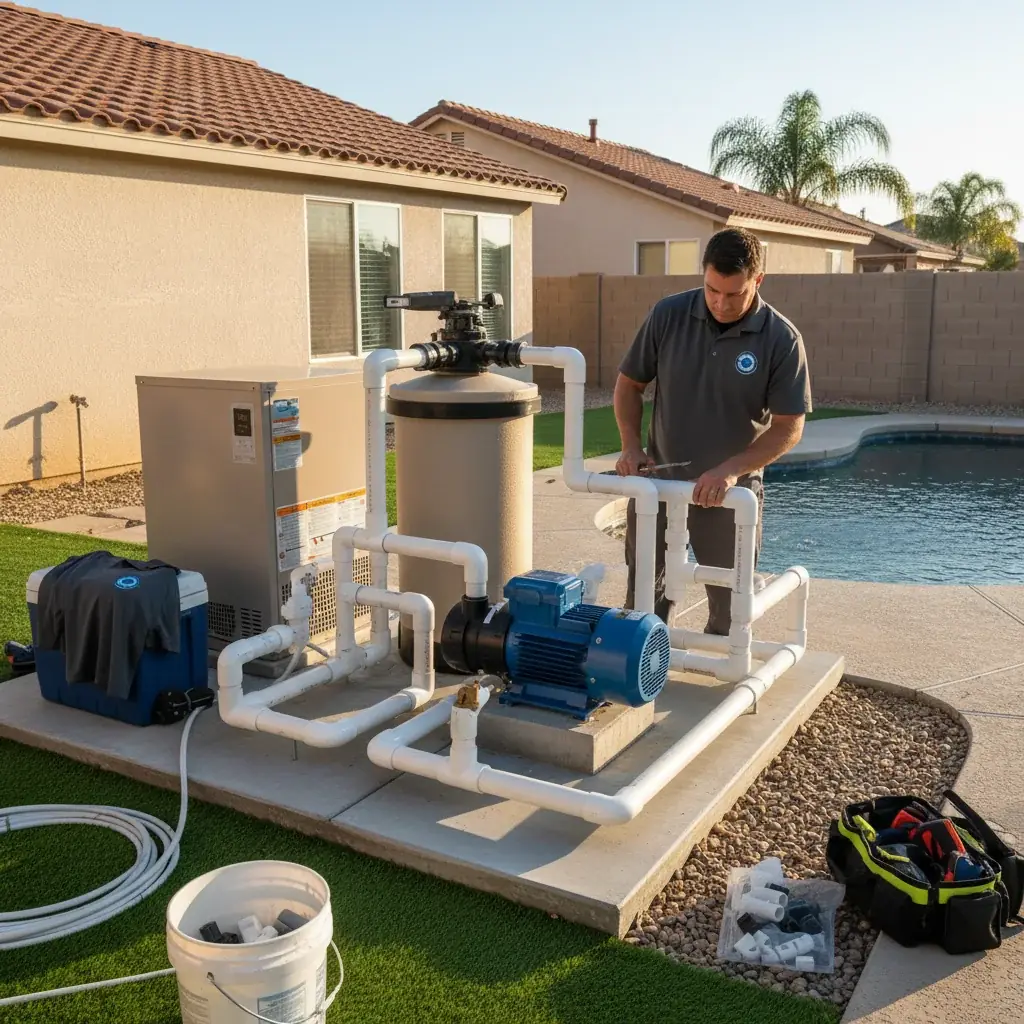
Standing water at your pool equipment pad means a specific seal, fitting, or connection is failing. It isn’t evaporation, splash-out, or a mystery. The pad sits outside the pool’s direct spray zone, so the water has a mechanical source. The good news: a pad leak is far easier to trace than a buried plumbing leak because every suspect is above ground and visible. Splash Pool SD connects San Diego County homeowners with licensed specialists who can identify the source and fix it.
Why water shows up at the pad
Every component on your equipment pad is held together by mechanical connections. Seals, o-rings, and threaded fittings keep the system watertight. When any single one of those fails, water escapes onto the concrete slab. The list of suspects is short compared to an underground leak, and you can usually narrow it down by watching the pad while the system runs.
The most common sources
Pump shaft seal
The shaft seal sits where the motor shaft meets the wet end of the pump. It is the most common source of standing water at a pad. The seal wears with normal use over time and begins to weep small amounts at the base of the pump housing. You will see a drip only while the pump is running, and the water pools directly beneath the motor.
A failing shaft seal isn’t just a nuisance. Water that escapes here can reach electrical components inside the motor. What starts as a cheap seal replacement becomes a motor repair if you ignore it. If you notice dampness under the pump while it runs, this is the first place to look. We have a full guide on pool pump leaks in San Diego that covers this in more detail.
Filter tank o-ring and clamp band
Sand filters and cartridge filters seal at the lid or where the two halves meet. A large o-ring and a clamp band hold everything together. When that o-ring dries out, gets pinched, or seats incorrectly, pressurized water sprays or weeps during the filtration cycle. The water tracks down the outside of the filter housing and collects at the base.
DE filters have a similar seal at the grid assembly. In most cases the fix is straightforward: replace the o-ring and reseat the clamp. If you aren’t sure how your filter is laid out relative to the rest of the pad, our post on pool equipment pad layout walks through the typical arrangement.
Valve diverter seals
Multiport valves, two-way valves, and three-way valves all use internal rubber seals to direct water between the pump, filter, heater, and returns. When those seals wear, water bypasses its intended path and a puddle forms at the valve base.
Valves that stay stuck in one position tend to fail first. If you rarely switch between filter and backwash modes, the seal inside that valve gets less exercise and degrades faster. A puddle that appears at the base of a specific valve is a strong clue.
Unions and threaded fittings
Unions and threaded connections are sealed by a rubber gasket or Teflon tape. Over time, heat and exposure break those materials down. In San Diego’s coastal areas, salt air accelerates the corrosion of metal unions, clamps, and fittings. Homes in La Jolla, Coronado, and Pacific Beach see this problem more often than inland yards in El Cajon or Santee.
A slow weep at a union can look like general dampness rather than a clear leak. It is easy to miss until corrosion spreads and the fitting deteriorates further. Coastal homeowners should inspect their unions and clamps more frequently than inland owners.
Backwash lines and drain plugs
If water appears only after you backwash a sand filter, the problem is likely a loose or cracked fitting at the backwash connection. That joint only sees pressure during the backwash cycle, so it stays dry the rest of the time.
Drain plugs on the pump and filter are another source. They are used for winterizing or servicing and can leak if the o-ring dries out or the plug isn’t reseated properly. DE and sand filters also have internal laterals. A cracked lateral leaks sediment-tinted water, and that tint is a useful clue pointing to filter internals rather than a simple seal.
How to trace the leak yourself
You can narrow the source before a specialist arrives. Here is the method:
- Dry the entire pad with towels or a shop vac.
- Run the pump through a normal filtration cycle.
- Watch each component in sequence: pump housing and shaft seal area, filter tank seams and o-ring, each valve base, and every visible union.
- Note where water reappears. That spot is your source.
If the pad stays dry while the system runs but gets wet afterward, the culprit is likely a drain plug or a backwash connection. Those only leak under specific cycle pressure, not during standard filtration.
Why even a small pad leak matters
A slow drip feels harmless, but the consequences build over time. Water seeps into the soil beneath the slab continuously. Over months, that moisture erodes the supporting ground. The result is a cracked or settling pad. Once the slab shifts, equipment on top of it is at risk too.
Corrosion also works its way into the equipment sitting on the wet surface. A small seal replacement today avoids a slab repair and equipment replacement down the road. If you want to understand what a repair quote might cover, our post on pool equipment repair estimates explains what drives the scope.
Pad leak vs. pool leak
These are different problems with different solutions. A pad leak comes from an equipment seal, o-ring, or fitting. Once you identify the specific part, the fix is contained and above ground.
A pool leak involves the shell, a skimmer, or buried plumbing lines. It requires professional detection equipment to locate. If you are unsure which one you have, our guide on pool leak vs. evaporation helps you tell the difference. For a deeper look at the detection process itself, see how pool leak detection works.
Both problems can coexist. If your water level is dropping and you also see standing water at the pad, a specialist should check both.
What the fix involves
The cost and scope depend on two factors: which component failed and how reachable it is. A shaft seal, o-ring, or union reseal is above ground and needs no concrete breaking. Those are the most common pad repairs and the least invasive.
If the leak has gone unaddressed long enough to damage the slab, the repair grows in scope. Buried line leaks also mean concrete work. A licensed specialist will inspect the pad, identify the failed part, and quote the repair before any work starts. You can also read more about what drives costs in our post on pool equipment replacement.
When to call us
If you see standing water at your equipment pad and can’t identify the source, or if the leak involves a cracked lateral, a corroded union, or damage to the slab, you need a licensed pool professional. Call us at (858) 400-4404 and we’ll connect you with a licensed local pool specialist.
Frequently asked questions
What does standing water at the equipment pad usually mean?
It almost always means a fitting, seal, or connection is escaping water. The pad sits outside the pool's direct spray zone, so evaporation and splash-out are not the cause. The specific source depends on where the water collects and when it appears.
How do I figure out which part is leaking?
Dry the entire pad, run the pump through a full filtration cycle, and watch each component in sequence. Check the pump housing, filter seams, valve bases, and every visible union. Water reappearing at one spot narrows the source. If the pad stays dry while the system runs, check drain plugs and backwash connections.
Is a pad leak the same thing as a pool leak?
No. A pad leak comes from equipment seals, o-rings, or fittings above ground. A pool leak involves the shell, a skimmer, or buried plumbing and requires professional detection to locate. Both can happen at the same time, so a specialist should check both if you suspect either.
What drives the cost of fixing a pad leak?
Two things matter most: which component failed and how reachable it is. A shaft seal, o-ring, or union reseal is above ground and needs no concrete work. Delayed repairs can lead to slab damage, which adds scope. A specialist quotes after inspecting the pad in person.
Does coastal salt air make pad leaks worse?
Yes. Salt air corrodes metal unions, clamps, and fittings faster than inland conditions. Homes in La Jolla, Coronado, and Pacific Beach see accelerated corrosion compared to inland areas like El Cajon and Santee. Coastal owners should inspect their fittings more often.
Need professional help in San Diego County?
Splash Pool SD connects you with a licensed specialist for any service in this post.