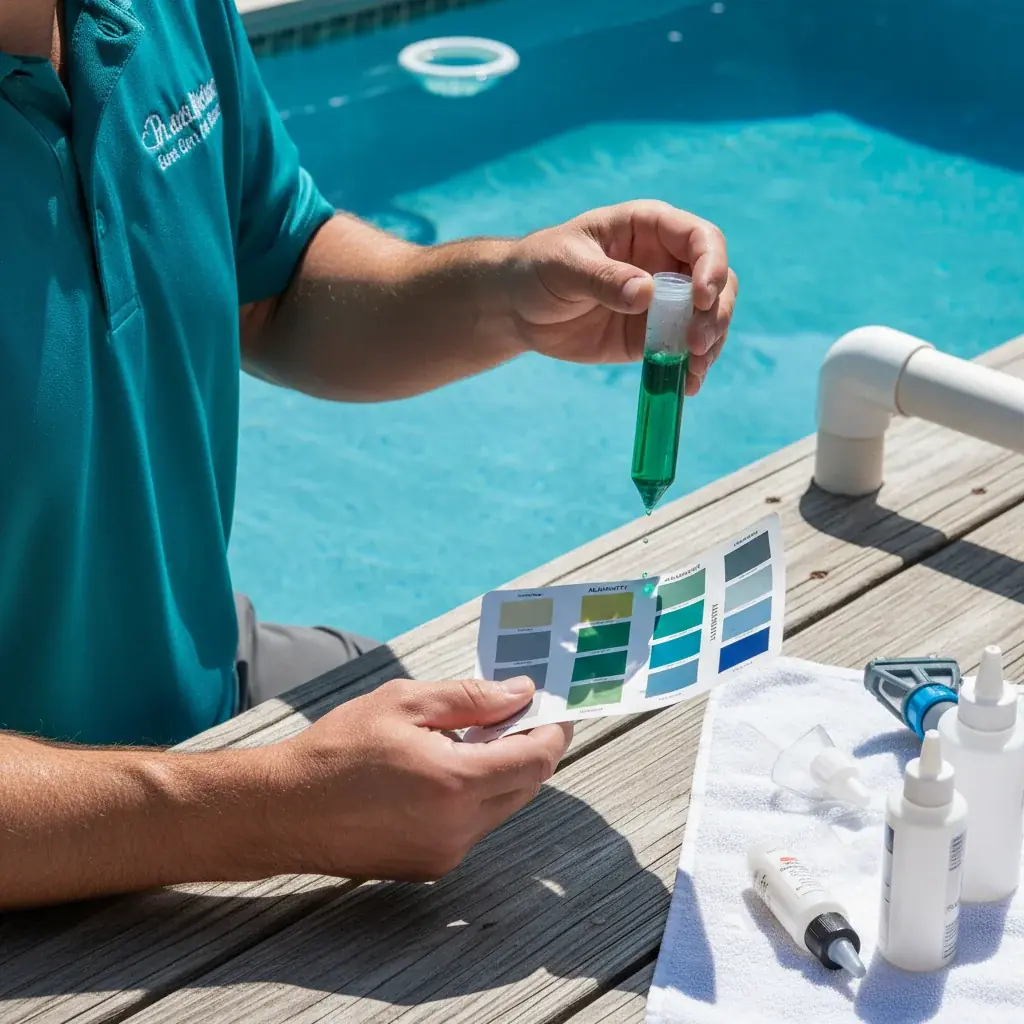
Total alkalinity measures the dissolved carbonates and bicarbonates in your pool water. When it drifts outside the target range, everything else follows. pH bounces, chlorine loses its punch, scale forms on equipment, and the water turns cloudy. The fix depends on which direction the number moved, and in San Diego County the fill water and climate make the problem more common than most owners expect.
What total alkalinity does
TA acts as a buffer. It anchors your pH and resists the swings that sanitizer, bather waste, and rain try to impose. Think of it as one of three balance pillars: pH, total alkalinity, and cyanuric acid. When TA sits in the correct range, your sanitizer stays effective and the water stays clear.
The target range
The general target is 80 to 120 ppm. If your pool has a salt chlorine generator or a plaster finish, aim for the lower end of that window, around 80 to 100 ppm. Salt cells and plaster surfaces are more sensitive to scale, so a tighter range protects them.
Symptoms of low alkalinity
When TA drops below 80 ppm, the buffer is gone. Here is what happens:
- pH bounce. The reading swings wildly from sanitizer additions, bather waste, or even a light rain.
- Corrosion. Low TA etches plaster, attacks metal ladders, heater coils, and pump seals.
- Staining. Dissolved metals in the water settle on surfaces and leave marks.
- Unstable chlorine. The sanitizer breaks down faster and becomes less effective.
- Swimmer discomfort. Skin rashes and eye irritation become common.
If you are seeing these signs, our post on what to test in your pool water walks through the full panel.
Symptoms of high alkalinity
When TA climbs above 120 ppm, the opposite problem appears:
- pH lock. You add acid, but the pH barely moves.
- Persistent cloudiness. The filter runs, but the water stays hazy.
- Scale formation. White or gray deposits build on the tile line, inside the salt cell, and on heater internals.
- Restricted flow. Scale narrows pipes and causes equipment failure over time.
- Reduced sanitizing power. High pH makes chlorine less effective, which raises algae risk.
Scale on a salt cell is one of the most common equipment complaints we hear about. If yours is already showing buildup, this guide on salt cell problems covers what to check.
How TA and pH interact
This is the part that trips up most owners. Acid lowers both TA and pH at the same time. Soda ash raises both. Sodium bicarbonate mainly raises TA with only a minor pH lift.
The common mistake: you see high pH, add acid to fix it, and crash your TA in the process. Then the pH bounces back up, you add more acid, and the cycle repeats.
The rule is simple. Correct total alkalinity first. Then fine-tune pH. If you need a deeper look at the pH side, our post on fixing high or low pH covers that separately.
How to lower high alkalinity
The method is acid plus aeration, done in stages. Never dump a large dose of acid at once. That can crash pH into the low 6s and damage your pool surface.
Work in cycles that drop TA by 10 to 20 ppm each round.
Step 1: Test. Use a reliable kit. You need accurate TA and pH readings before you add anything.
Step 2: Calculate the acid dose. For a 15,000 gallon pool, roughly 24 fluid ounces of muriatic acid at 31.45 percent concentration will lower TA by about 10 ppm. Scale the dose to your actual volume.
Step 3: Add the acid safely. Shut off the pump. Pour the acid in one spot near the deep end. Don’t broadcast it across the surface. Let it sit for 30 to 60 minutes, then restart the pump. Wear gloves and eye protection.
Step 4: Circulate and retest. Run the pump for 6 to 8 hours, then test again.
Step 5: Aerate to raise pH without raising TA. Use waterfalls, fountains, spa spillovers, or aim your return jets upward. Aeration expels CO2, which lifts pH without touching alkalinity. Target a pH of 7.4 to 7.6 after aeration.
Step 6: Repeat if needed. If TA is still above target, run another cycle. Full correction can take one to two days.
How to raise low alkalinity
Use sodium bicarbonate, which is purified granular baking soda. For a 15,000 gallon pool, about 2.1 pounds raises TA by 10 ppm.
Make sure the pump is running before you add it. You can pre-dissolve the powder in a bucket of pool water or broadcast it slowly across the surface. Avoid dumping it in one clump. If any settles on the pool floor, brush it up.
Circulate for 6 to 8 hours, then retest. Expect a slight pH increase. If pH creeps above 7.6, add a small amount of acid to bring it back.
Why San Diego makes this harder
The fill water in San Diego County arrives through the San Diego County Water Authority. Its source is the Colorado River, which is naturally hard and high in mineral content. That means your tap water starts with elevated alkalinity before you even fill the pool.
The arid climate adds another layer. High evaporation rates concentrate TA, calcium hardness, and total dissolved solids over time. The water that stays behind gets progressively harder.
Then there is the trichlor problem. Many owners use stabilized chlorine pucks, which push pH down continuously. To counter that, they add soda ash, which raises both pH and TA. Over weeks, TA creeps higher and higher while the owner chases a low pH reading.
The fix is to switch to liquid chlorine, which is sodium hypochlorite. It has a high pH on its own, so it reduces the need for soda ash. That breaks the cycle. Our comparison of chlorine versus salt water pools covers the tradeoffs if you are considering a switch.
A partial drain and refill every 2 to 3 years resets the chemistry and dilutes the accumulated minerals. If your water has been topping off for years without a drain, that is likely part of the problem. Our post on hard water and San Diego pools goes deeper into the local water profile.
Preventing the cycle from restarting
Once you have corrected TA, a few habits keep it stable:
- Test weekly with a reliable kit. Don’t rely on test strips alone for TA.
- Track your sanitizer type. If you use trichlor pucks, monitor TA monthly at minimum.
- Top off with fresh water after heavy evaporation periods to dilute concentrated minerals.
- Keep cyanuric acid in check. High CYA compounds the problem by reducing chlorine efficiency further. Our post on cyanuric acid too high explains that relationship.
When to call us
If your water stays cloudy despite correct TA, if you see visible scale on tile or equipment, or if your test readings keep jumping and won’t stabilize, the problem may involve calcium hardness, TDS, or a combination that needs commercial-grade testing to sort out. A licensed pool pro can run a full panel and build a correction plan that accounts for your specific finish, equipment, and fill water.
Call us at (858) 400-4404 and we’ll connect you with a licensed local pool specialist.
Frequently asked questions
What is the ideal total alkalinity range for a pool?
The general target is 80 to 120 ppm. If you have a salt system or a plaster finish, aim for the lower end, around 80 to 100 ppm.
Is it safe to swim when pool alkalinity is too high?
It is not immediately dangerous, but high alkalinity reduces chlorine effectiveness, promotes cloudiness, and encourages scale buildup. It is better to correct the level before swimming.
How long does it take to lower pool alkalinity?
The process is gradual. After adding acid, wait 6 to 8 hours before retesting. Full correction can take one to two days depending on how far off the reading is.
Does baking soda raise pH or alkalinity?
Sodium bicarbonate primarily raises total alkalinity. It also lifts pH slightly, so you may need a small acid adjustment afterward.
Need professional help in San Diego County?
Splash Pool SD connects you with a licensed specialist for any service in this post.