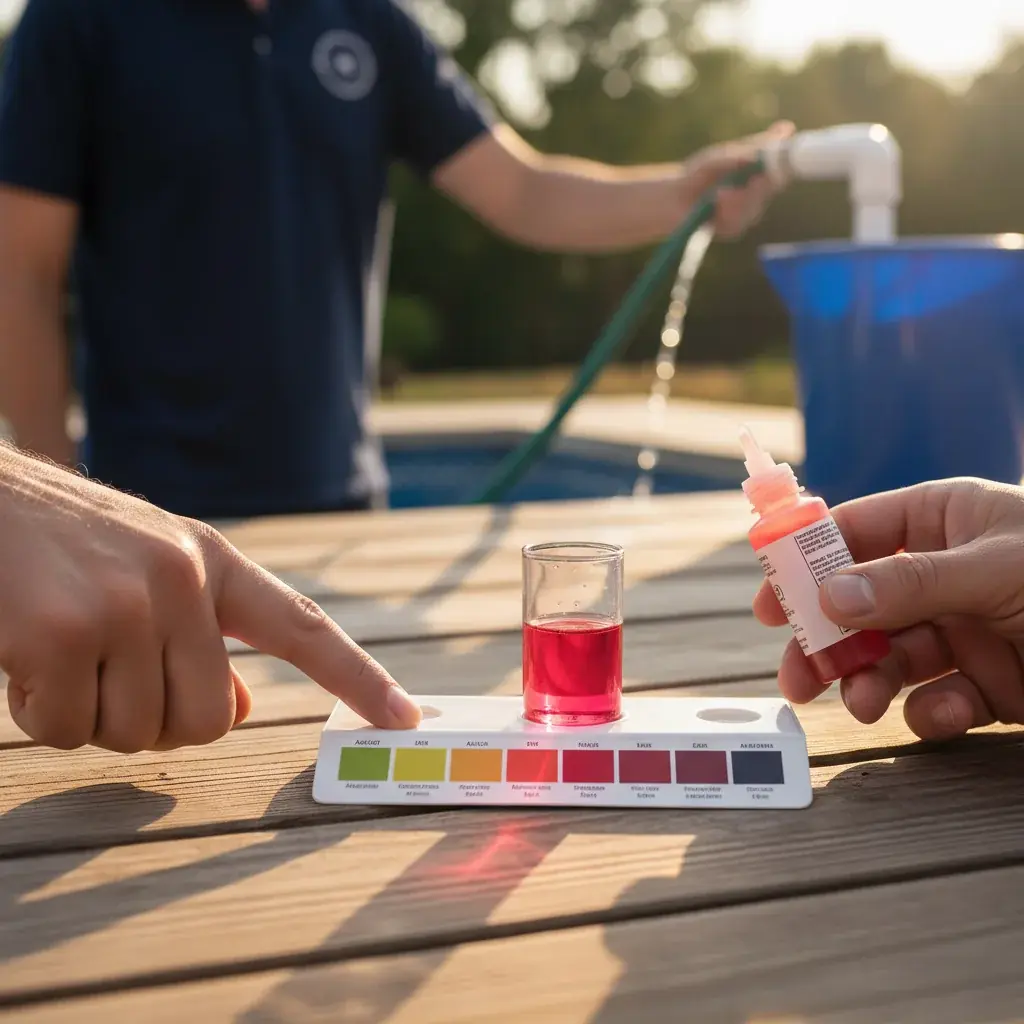
Your pool pH should sit between 7.4 and 7.6. That range matches the pH of human tears, so it is comfortable on eyes and skin. It also keeps chlorine working at full strength. When pH drifts outside that window, problems follow fast: corroded plaster, stinging eyes, cloudy water, or chlorine that barely sanitizes. In San Diego County, high pH is the more common headache because our fill water starts alkaline. Here is how to bring it back and keep it there.
Why pH controls everything else
The pH scale runs from 0 to 14. At 7.5, roughly 50% of your free chlorine exists as hypochlorous acid, the form that actually kills bacteria and algae. Push pH to 8.0 and that active fraction drops to about 21%. Nearly 80% of your chlorine sits inert. You would need to almost double your dose to get the same sanitizing power you had at 7.5.
On the low end, pH below 7.2 turns water corrosive. It eats plaster, grout, and metal fittings. Rubber seals on pumps and heaters soften and fail early. Swimmers get stinging eyes and dry skin.
Test at least twice a week during summer. A quick strip test catches drift before it causes damage.
Why San Diego pools drift high
San Diego County Water Authority blends Colorado River water and State Project Water. Both sources carry high mineral content, and the tap water arrives at a pH between 7.8 and 8.2. Every time you top off your pool, you are adding water that is already above target.
Aeration pushes pH even higher. When water agitates, it off-gasses dissolved CO2, and that raises pH. Waterfalls, spillways, and spa jets all accelerate this. A sheer-descent waterfall running eight hours a day will drift your pH up noticeably faster than a still pool.
High total alkalinity is the third driver. When alkalinity sits above 120 ppm, it buffers the pH upward. You add acid, pH drops, and within two to three days it rebounds. That rebound pattern is the signature of an alkalinity problem, not a pH problem. This is common in San Diego fill water. For more on how alkalinity and pH interact, see our guide on pool alkalinity too high or too low.
Why pH sometimes drops too low
Low pH is less common here but still happens. Heavy rain dilutes the pool with freshwater and can pull pH down. Over-adding acid is another cause: you overshoot the target and the water turns acidic. High bather load also consumes alkalinity over time, which lets pH fall.
How to raise pH
Use sodium carbonate, sold as soda ash or pH Up. Don’t use sodium bicarbonate, which is baking soda. Baking soda raises alkalinity more than pH, so it solves the wrong problem.
The rule: 6 oz of soda ash raises pH about 0.2 points per 10,000 gallons. A typical San Diego backyard pool holds 15,000 to 20,000 gallons, so measure your exact volume before dosing.
Application steps
- Test pH and total alkalinity first.
- Pre-dissolve the soda ash in a bucket of pool water. Dry powder tossed directly on plaster causes white cloudy spots.
- Pour slowly near a return jet with the pump running.
- Wait four hours, then retest before adding a second dose.
If your alkalinity is already above 100 ppm, try aeration before reaching for chemicals. Run the pump, turn on water features, and leave the pool uncovered overnight. Aeration raises pH without touching alkalinity.
How to lower pH
The standard product is muriatic acid at 31.45% concentration. Dry acid, sodium bisulfate, also works but needs about 1.6 times the dose for the same effect. Dry acid is safer to handle if you are uncomfortable with liquid.
Baseline: 10 oz of 31.45% muriatic acid lowers pH about 0.2 points in a 15,000-gallon pool. Never exceed 16 oz in a single addition per 15,000 gallons. Large single dumps create a low-pH dead zone on the floor that etches plaster.
Application steps
- Wear chemical-resistant gloves and eye protection. Muriatic acid fumes are harsh and the liquid burns skin on contact.
- Run the pump. Pour slowly along the deep-end edge while walking. Never dump in one spot.
- Keep people and pets out for at least four hours.
- Retest before adding a second dose.
The alkalinity fix that stops the rebound cycle
If your pH keeps bouncing back above 7.8 within days of adding acid, your alkalinity is almost certainly above 120 ppm. Lowering alkalinity is the real fix.
The targeted method: add muriatic acid in a single spot with the pump off. Let it sit for one hour. Brush the area, then turn the pump on. This preferentially drops alkalinity before pH. It takes multiple rounds, but it breaks the cycle of constant acid additions.
Once alkalinity is between 80 and 100 ppm, pH will hold steady with much less effort.
High cyanuric acid and pH problems often show up together in San Diego pools. If you are fighting both, read our post on cyanuric acid too high for the full picture.
Prevention
Consistent weekly testing and adjustment is the most reliable approach. A weekly maintenance service includes chemistry checks and balancing, which catches drift before it becomes a problem. San Diego’s hard water and warm climate mean pH drift is a constant force, not a one-time event. Our post on hard water and San Diego pools covers how mineral content affects your water long term.
If you aren’t sure what to test or how often, our guide on what to test in pool water walks through each parameter.
When to call us
If your pH won’t hold for more than two or three days despite correct additions, or you see scale forming on tile and equipment, the problem likely involves multiple numbers out of range at once. A licensed pro can test the full water profile and correct the underlying cause before scale or algae sets in. Call us at (858) 400-4404 and we’ll connect you with a licensed local pool specialist.
Frequently asked questions
What is the ideal pH range for a pool?
The target is 7.4 to 7.6. Below 7.2 the water turns corrosive and stings eyes. Above 7.8 chlorine stops working well, and at 8.0 only about 21% of your free chlorine is actually sanitizing.
How much muriatic acid do I need for a 15,000-gallon pool?
To drop pH from 7.8 to 7.5, you typically need 10 to 12 oz of 31.45% muriatic acid. Always retest after four hours before adding more. Never exceed 16 oz in a single addition per 15,000 gallons.
Why does my pool pH keep rising after I add acid?
The most common cause is high total alkalinity. When alkalinity sits above 120 ppm it buffers the pH back up within a few days. Bring alkalinity down to 80 to 100 ppm first, then the pH will hold.
Can I use baking soda to raise pool pH?
Baking soda is sodium bicarbonate, and it mainly raises alkalinity rather than pH. Use sodium carbonate, also called soda ash or pH Up, instead. Six ounces per 10,000 gallons raises pH about 0.2 points.
Is it safe to swim when pool pH is high?
Above 7.8 it will not immediately harm swimmers, but your chlorine becomes nearly inactive. At pH 8.0 only about 21% of free chlorine is sanitizing, so the water is undertreated even if your chlorine reading looks normal.
Need professional help in San Diego County?
Splash Pool SD connects you with a licensed specialist for any service in this post.