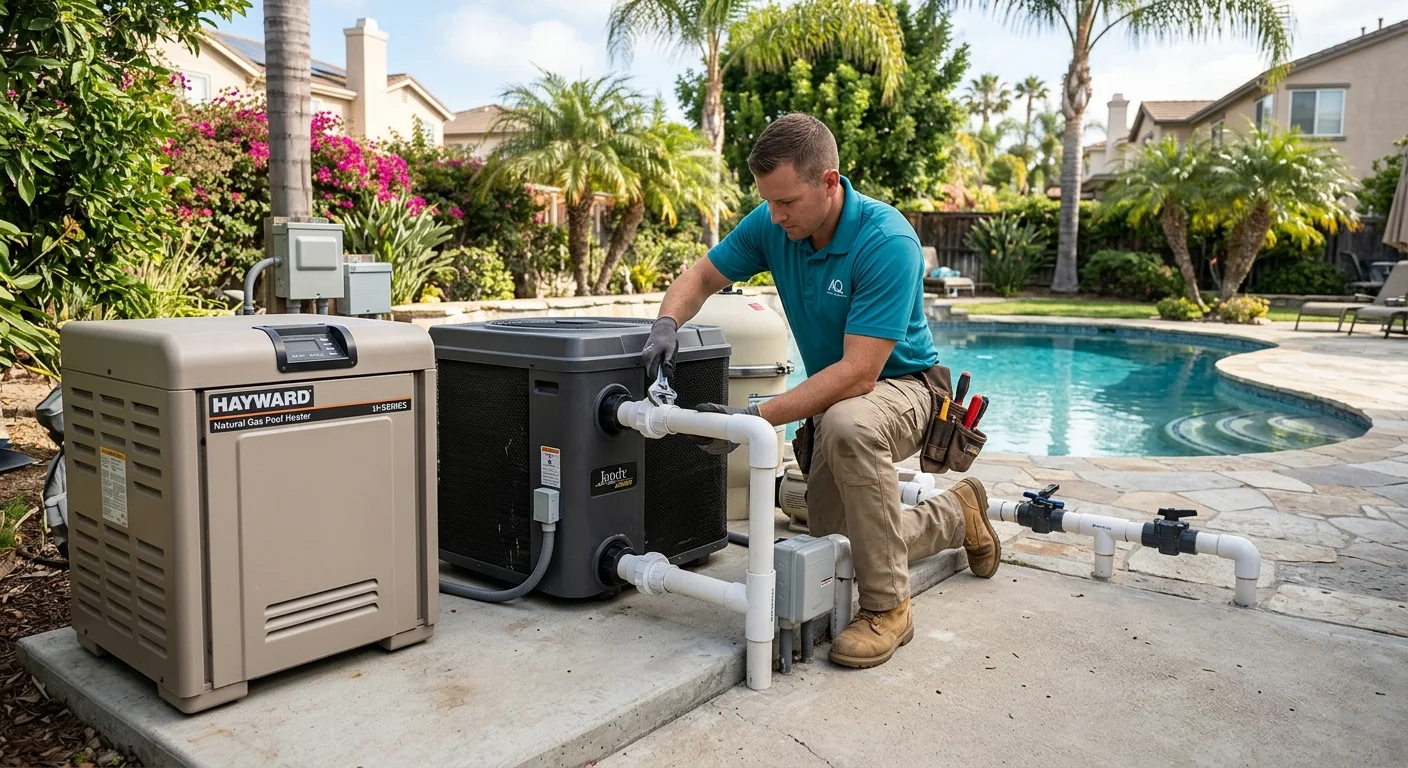
San Diego’s fall and spring shoulder seasons push pool owners into a real decision: gas or heat pump. The right answer depends on where you live in the county, how often you swim, and what your equipment pad can physically hold. Gas heaters deliver fast heat regardless of air temperature. Heat pumps maintain a set temperature over days at lower operating cost, but they need warm ambient air and more space. Neither is universally better. The match depends on your yard, your habits, and your panel.
How each type works
A gas heater burns natural gas or propane. Water passes through a heat exchanger and returns warm to the pool. Outdoor air temperature doesn’t matter. The unit fires on demand and raises water temperature quickly. That makes gas a strong fit for burst swimming schedules, spa-side setups that need a fast temperature jump, and East County late-season swims where nights drop hard.
A heat pump extracts warmth from the surrounding air and transfers it to the water. It runs on electricity only. It isn’t the same thing as an electric resistance heater, which uses a heating element and draws heavy power. Salespeople sometimes conflate the two, so clarify before you compare. A heat pump maintains a set temperature over days. It ramps up slowly. It suits pools kept in the swim zone most of the season.
Solar can complement either type. It requires adequate roof space and sun exposure. It can’t provide on-demand heat after dark.
San Diego climate zones change the math
The county spans multiple climate bands. The coastal strip, from Imperial Beach through Coronado, Pacific Beach, La Jolla, Encinitas, and up to Oceanside, sits under the marine layer. That layer moderates nighttime temperatures. A heat pump has more usable hours on the coast because the air stays warmer after sunset.
Inland north county, including Escondido, San Marcos, Poway, Santee, El Cajon, Lakeside, and Alpine, swings between hot days and cold nights. Uncovered water loses heat faster inland than under the coastal layer. East County November swims favor gas or a gas backup because overnight temperatures drop below the rated range of many heat pump models.
The South Bay, covering Chula Vista, National City, and San Ysidro, sits in an intermediate zone. Nights are milder than inland but cooler than the immediate coast.
No universal degree-day chart or outdoor cutoff applies across the county. Manufacturers rate heat pumps for specific air-temperature ranges. Your matched pro should pull the spec sheet for the model under consideration and compare it to your yard’s actual conditions.
Pad and installation realities
San Diego backyard pads are often tight. Heat pumps are bulky. They need clear airflow around the coil and fan. Crowding a heat pump against stucco, a fence, or a second unit starves it of air and kills efficiency.
Gas heaters need combustion air and exhaust clearance. Clearances follow the unit manual and must pass city inspector acceptance. The gas line must be properly sized for the unit’s BTU rating. Older lines may be undersized for larger heaters. Some pads never had gas at all. A new line requires a permit.
Propane is a workaround where natural gas is unavailable. It requires a tank and a refill schedule.
Heat pumps need a dedicated circuit sized to the unit. A standard 120-volt outlet isn’t sufficient. Older homes in Clairemont, Allied Gardens, and East County may lack panel space for an additional breaker. An electrician and a pool specialist should confirm load, breaker size, and wire gauge before you order.
A swap between types involves unions, flow adjustments, drains, and pad drainage. Verify your contractor’s license through the CSLB online lookup before ordering equipment. You can read more about that process in our guide to checking a pool contractor license in California.
Common failures by type
Gas heaters fail through no ignition, weak flame, or the unit attempting to fire then shutting down. Scale and bad chemistry damage the heat exchanger. A blocked vent or a bad pressure switch prevents safe start. If the cabinet is dark and silent, check the troubleshooting guide first. Don’t repeatedly reset the unit. Our post on pool heater repair in San Diego covers these scenarios in more detail.
Heat pumps fail when fans seize, coils cake with lint or salt or mulch, compressors weaken over time, or refrigerant leaks develop. Water-flow switches false-trip when the filter is dirty. Coastal pads see coil corrosion sooner than inland pads. A fan spinning with no heat gain indicates a repair need, not a chemistry issue. See our heat pump repair guide for more.
Both types are sensitive to low flow. An undersized pump, a clogged filter, or a half-closed valve trips safeties on either unit. A dirty filter can mimic a dead heater. Fix flow before condemning the unit. San Diego’s hard water accelerates scale buildup in heat exchangers, which makes regular chemistry maintenance even more important. Our post on hard water and San Diego pools explains the local water chemistry.
Equipment lifespan
No fixed year count is published for either type. Lifespan depends on chemistry, rinse habits, salt air exposure, and service history. Any source quoting a guaranteed lifespan number is guessing.
Pre-switch checklist
Before you decide between gas and heat pump, work through these items:
- Count your actual swim days per week in fall and spring.
- Note whether your spa needs short-notice heating.
- Confirm gas reaches your pad and verify line sizing.
- Check your electrical panel for a spare slot.
- Measure the clear air space around your current unit.
- Decide whether you will use a cover nightly.
- Clarify whether you are replacing a dead unit or adding heat for the first time.
- Request sizing based on gallons, surface area, and wind exposure.
- Get the heat pump’s rated air-temperature range in writing from the spec sheet.
- Ask about hybrid setup feasibility: pump for the daily hold, gas for fast jumps.
- Confirm who pulls the permit if one is required.
- Get the contractor’s license number and verify it independently.
- If your current heater still runs, repair may beat replacement. If it is down, get a diagnosis before switching fuel type.
- Quotes should separate unit cost from pad, gas, and electrical work.
Your utility sets the therm and kilowatt-hour rates that drive operating cost. Those rates vary by provider and plan. Ask your matched pro for a runtime estimate based on your specific pool and current rates.
Sizing and quotes
No single price applies to a given gallon count. What moves the quote is pool size, finish, pad access, equipment brand, and whether a permit is needed. The pro you are matched with will quote before work starts. If you want to understand what drives equipment replacement pricing more broadly, our post on pool heater replacement cost in San Diego breaks down the variables.
For pad layout questions, our guide to pool equipment pad layout covers spacing and airflow requirements.
When to call us
Choosing between a heat pump and a gas heater involves site-specific factors that a licensed specialist should evaluate in person: pad clearance, gas line sizing, panel capacity, and local air temperatures. If your unit won’t fire, or your pad can’t accommodate the next size up, get a professional diagnosis before ordering equipment. Call us at (858) 400-4404 and we’ll connect you with a licensed local pool specialist.
Frequently asked questions
What are the downsides of a pool heat pump?
Heat pumps ramp up slowly, need adequate outdoor air temperature, and take up more pad space than gas units. They also require a dedicated electrical circuit. Coastal salt air corrodes coils faster than inland conditions. For weekend-only or short-session heating, a heat pump is a poor fit.
Which is cheaper to run, a gas pool heater or a heat pump?
A heat pump costs less per hour when it holds a set temperature for days at a time. Gas costs more per hour but runs in shorter bursts. Your actual bill depends on utility rates, cover use, set point, and daily runtime. No single dollar figure applies to every pool. Ask your matched pro for a runtime estimate based on your specific setup and current utility rates.
How long does each type take to heat a pool?
There is no universal heat-up time for any pool size. Variables include starting temperature, target temperature, pad air temperature, wind, cover use, and unit sizing. Gas heaters are typically faster. A licensed specialist sizes the unit to your water volume and swimming habits.
Will a heat pump work on cold nights in San Diego?
It depends on the model and the actual air temperature at your pad. Coastal nights stay milder under the marine layer. Inland and East County nights drop harder. Manufacturers publish a rated air-temperature range for each model. Your pro should match that spec sheet to your yard conditions. Gas heaters fire regardless of outdoor air temperature.
Should I keep my gas heater, switch to a heat pump, or run both?
If you swim most weeks and want to hold temperature, a heat pump fits. If you need fast heat for weekend bursts or spa use, gas fits better. A hybrid setup is possible when your pad, gas line, and electrical panel support both units. The pump handles the daily hold while gas handles fast jumps. A site inspection is required before ordering anything.
Need professional help in San Diego County?
Splash Pool SD connects you with a licensed specialist for any service in this post.