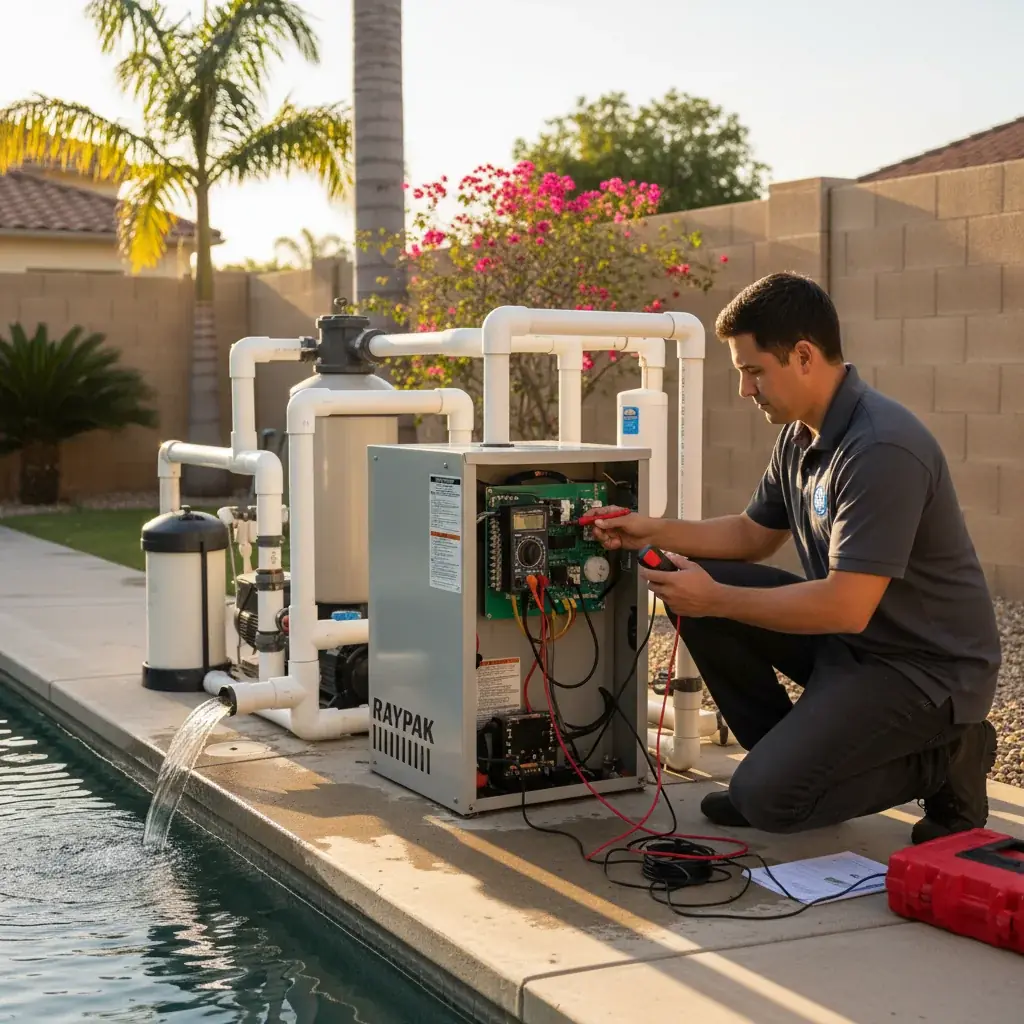
Most pool heater failures in San Diego surface in April or May. Owners flip the switch after a mild off-season and find the heater dead. The good news is that most failures are diagnosable and fixable. The bad news is that San Diego’s hard water, salt air, and marine layer humidity shorten heater life compared to drier inland climates. This guide covers the five most common failures, what they cost to fix, and when replacement makes more sense than repair.
The five most common heater failures
Ignition problems
Ignition failure is the most common service call for pool heaters in San Diego. You hear a click but no flame, or the flame lights briefly and then goes out. The usual causes are a worn igniter, a dirty or cracked flame sensor, or low gas pressure. Igniters are consumable parts and wear out over time. A dirty flame sensor can often be cleaned. A cracked one needs replacement.
Pressure switch failure
The pressure switch confirms water is flowing through the heater before it allows ignition. If the switch fails, or if water flow is genuinely low, the heater won’t start. Before assuming the switch is bad, check your filter. A clogged filter is the actual root cause more often than the switch itself. Clean or backwash the filter first, then test again.
High-limit switch tripping
The high-limit switch is a safety device. It shuts the heater down when internal water temperature gets too high. Scale buildup inside the heat exchanger restricts flow and causes the switch to trip. A single trip is worth monitoring. Repeated trips mean an underlying cause is present: scale, low flow, or a failing thermostat.
Control board failure
Control boards are sensitive to moisture, salt air, and power surges. Symptoms include a blank display, random error codes, or total unresponsiveness. Pentair, Raypak, and Hayward boards are all affected. Replacement boards for Pentair, Raypak, and Hayward units run $250-$500 for the part alone, according to current supplier pricing. On units older than 10 years, replacing the entire heater often becomes more logical than sourcing a board that may be discontinued.
Heat exchanger failure
This is the most expensive single-component failure a pool heater can suffer. The heat exchanger is where combustion gases transfer heat to your pool water. San Diego’s hard water, supplied by the San Diego County Water Authority at 300 to 400 ppm TDS depending on source blend, causes calcium deposits that narrow internal passages. Coastal corrosion causes pinhole leaks. Pinhole leaks expose pool water to combustion gases, which is a safety hazard. If your heater has a pinhole leak, stop using it and call a professional.
Error codes by brand
Modern heaters display error codes that narrow the problem. Here are the most common ones for the three major brands installed in San Diego.
Pentair MasterTemp and Max-E-Therm
- E05: ignition failure after three attempts. Check gas supply, igniter, and flame sensor.
- E01: stack flue sensor reading out of range.
- HLS: high-limit switch tripped. Check flow, filter, and scaling.
Raypak 206A through 407A series
- AO: automatic overheat lockout. The unit won’t restart until it cools.
- LO: low water temperature reading. Usually a sensor fault.
- Three LED flashes: ignition lockout. Same diagnostic path as Pentair E05.
Hayward H-Series
- IF: ignition failure. Points to gas valve, igniter, or flame sensor.
- HL: high limit. Flow issue or scale buildup.
- BD: bypass detected. A valve is open or flow is insufficient.
A code that returns after a reset is an active, persistent fault. Repeatedly resetting AO or HL codes risks heat exchanger damage. If the code comes back, the underlying problem needs a fix.
Why San Diego is harder on heaters
Salt air, marine layer humidity, and hard water all accelerate heater failure here. The damage isn’t uniform across the county.
Salt air is worst west of I-5, within about a mile of the coast. La Jolla, Del Mar, Ocean Beach, and Coronado see corrosion damage two to four years earlier than inland areas like Santee and El Cajon. Copper heat exchangers oxidize faster in salt air. Burner trays rust. Control boards corrode at the connections.
Hard water causes calcium deposits that restrict flow inside the heat exchanger. This forces high-limit trips and reduces heating efficiency over time. If you are on a salt chlorine generator, trace chlorine gas and acidic byproducts accelerate internal metal corrosion measurably. Verify that your manufacturer warranty explicitly covers salt-pool use.
Coastal heaters should have their heat exchanger inspected annually, not every two years. Modern units use better corrosion-resistant materials, and California Energy Commission efficiency standards apply to newer models.
Repair versus replace
A useful rule of thumb: if the repair exceeds half the cost of a new unit, replacement usually makes more sense. In San Diego, a new mid-range gas heater, a 400,000 BTU Raypak or Pentair, runs $1,800-$2,800 installed, based on current market pricing for standard installations.
Repair is favored when the unit is under 8 years old, only a single component has failed, the heat exchanger is sound, and replacement parts are still available. Pre-2010 units may have discontinued components, which tips the balance toward replacement.
Replacement is favored when the unit is over 10 years old with repeated repairs, the heat exchanger has failed, the control board is discontinued, you want to switch fuel types, or you need a BTU upgrade for a larger pool or spa.
Heater types and their failure patterns
Gas heaters from Raypak, Hayward H-Series, and Pentair MasterTemp are the most common type in San Diego. They heat fastest but have combustion parts that wear: igniters, gas valves, and heat exchangers.
Heat pumps from Hayward HeatPro and Pentair UltraTemp extract ambient heat and run more efficiently in San Diego’s mild climate. Their common failures are refrigerant leaks, compressor failure, and defrost board issues. Refrigerant work requires an EPA 608-certified technician by law.
Solar heaters have almost no mechanical parts. No igniter, no gas valve, no refrigerant. Failures are plumbing-related: cracked panels, valve problems, or sensor issues.
Licensing and permits
Gas appliance work requires a licensed contractor. Refrigerant handling also requires a licensed contractor. The required license classifications are C-53 for swimming pool work or C-36 for plumbing. Verify any contractor’s CSLB license before hiring. The CSLB license check is available online.
Heater replacement typically requires a local permit. Confirm requirements with your city building department. Improper repairs can void the manufacturer warranty.
For more on choosing a qualified pro, see our guide on how to choose a pool repair pro in San Diego. If you are weighing gas versus heat pump options, our comparison of gas heaters versus heat pumps in San Diego breaks down the tradeoffs. If your heater won’t turn on at all, start with our troubleshooting guide for pool heaters not turning on. For brand-specific issues, we have dedicated pages for Pentair heater repair, Raypak heater repair, and Hayward heater repair.
When to call us
If your heater shows a persistent error code, short-cycles, or has a suspected heat exchanger leak, you need a licensed professional. Gas and refrigerant work carry safety and legal requirements that DIY fixes can’t meet. Call us at (858) 400-4404 and we’ll connect you with a licensed local pool specialist.
Frequently asked questions
What does pool heater repair typically cost in San Diego?
Cost depends on the component. Igniter swaps are the least expensive. Control board replacements for Pentair, Raypak, and Hayward units run $250-$500 for the part alone. Heat exchanger work approaches the cost of a new unit. Your matched pro quotes the exact price before any work starts.
Why does my pool heater shut off after a few minutes?
Short-cycling is usually flow-related. A dirty filter or a faulty pressure switch is the most common cause. Scale buildup in the heat exchanger can also trip the high-limit switch. A technician diagnoses this with a flow reading and a visual inspection of the burner compartment.
How long do pool heaters last in San Diego?
Gas heaters typically last 8 to 12 years inland. Coastal units show corrosion damage at 5 to 7 years because of salt air and marine layer humidity. Heat pumps run 10 to 15 years. Salt pools and coastal proximity shorten all lifespans.
Can I reset a pool heater error code myself?
You can cycle power at the breaker for 60 seconds to clear a code. If the code returns immediately, the fault is still active. Never repeatedly reset AO or LO codes. Doing so risks damaging the heat exchanger.
Do I need a permit to replace a pool heater in San Diego?
Most jurisdictions require a permit for gas appliance replacement. The work must be performed by a licensed contractor holding a C-53 or C-36 classification. Verify the license through the CSLB before hiring.
Need professional help in San Diego County?
Splash Pool SD connects you with a licensed specialist for any service in this post.