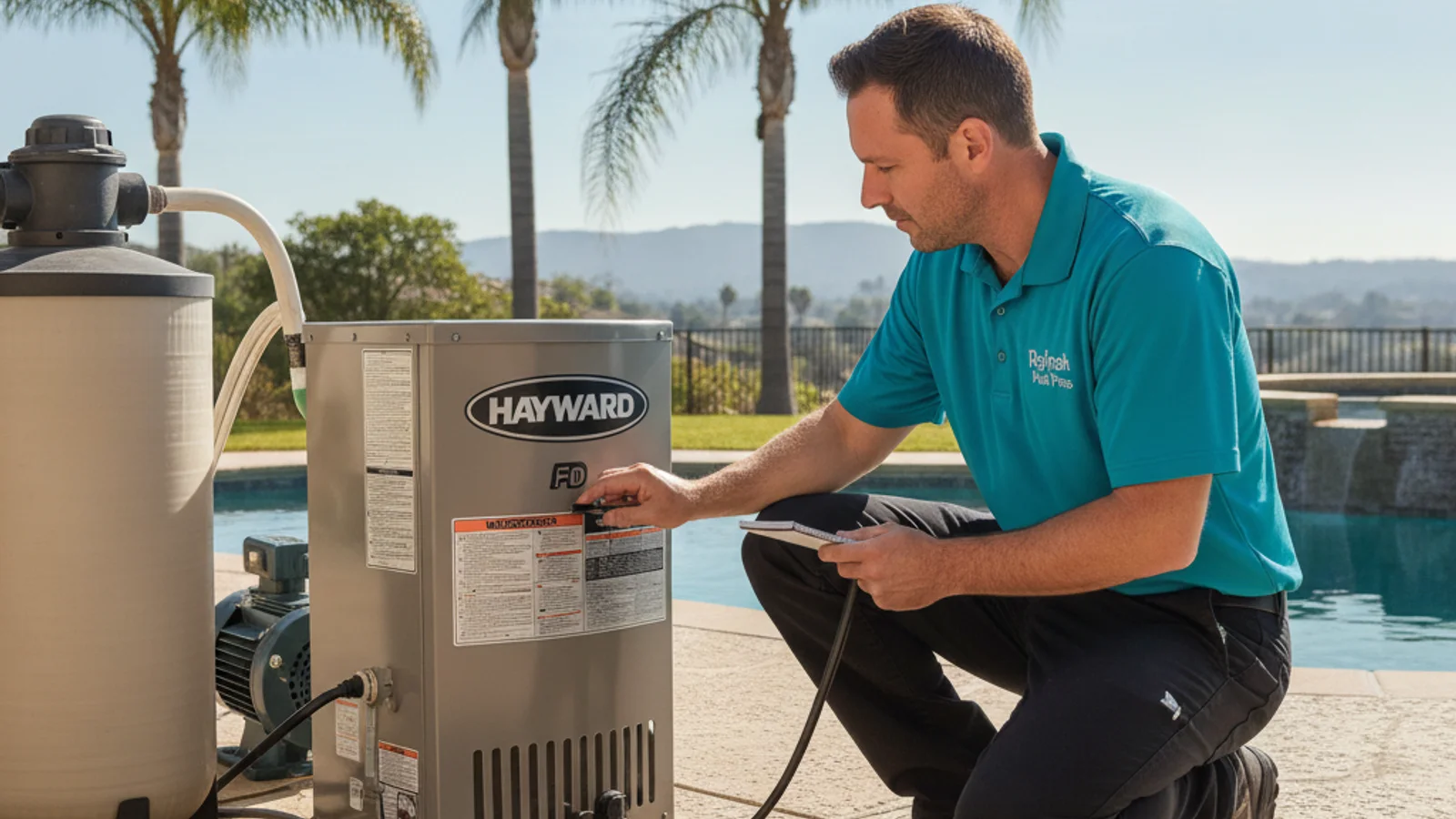
A Hayward Universal H-Series FD heater tells you what is wrong through a two-letter code on its digital display. If your heater is showing IF, LO, HS, or another pair of letters, that code narrows the problem before anyone opens the cabinet. This guide covers what each code means, why San Diego water and air cause specific failures, and when the fix needs a licensed professional.
Splash Pool SD connects you with licensed independent pool specialists who work on the FD line. We don’t perform repairs ourselves.
How the FD series reports problems
Hayward’s Universal H-Series FD family, models H150FD through H500FD, uses a two-letter display code system. That sets it apart from Raypak units, which show named sentences on an LCD, and from Pentair MasterTemp heaters, which use a different fault-string format. If you own a Hayward FD, you will never see a spelled-out message. You get two letters, and that is your starting point.
The FD line uses a separate ignition control board and a separate display board. The blower must prove airflow before ignition can begin. A cupronickel exchanger handles heat transfer. These design choices mean the diagnostic path differs from other brands, even when the underlying problem (no flame, low flow, bad sensor) sounds similar.
If your unit is a later HFN model or a heat pump, these codes don’t apply. Match the rating plate on your cabinet to the current Hayward service manual before troubleshooting. You can read more about how heat pumps differ in our gas heater vs. heat pump guide.
What the common codes mean
IF: ignition failure
The heater tried to light and couldn’t. After the maximum retry count, it locks out. IF auto-resets after 60 minutes. Repeated IF codes usually point to the igniter, the gas valve circuit, or the ignition board itself.
LO: limit string open
The safety string, which wires the water pressure switch, high-limit switch, and other safeties in series, has opened. The heater locks out, then auto-restarts about two minutes after the string closes. LO is normal if the pump is off but the heater still has power. If the pump is running and LO persists, check flow first: a dirty filter, a closed valve, or an unprimed pump are common causes.
HS: high-limit or rapid temperature rise
HS triggers when inlet water exceeds 104°F or when the inlet temperature rises 6°F within 60 seconds. Both conditions flag a possible low-flow situation. A third HS detection within one hour causes a hard lockout that clears only through a power cycle. Clogged filters, excessive bypass flow, and lime scale inside the exchanger all cause HS.
CE: communication error
The ignition board and display board lost their link. CE triggers at power-up or after a 30-second link loss. This points to a board-pair problem, not a gas supply issue.
HF: flame detected with gas valve off
The heater sees a flame signal when the gas valve should be closed. The blower keeps running until the condition clears. HF is a combustion safety trip. Don’t attempt this repair yourself.
PF: wiring fault
Reversed polarity, low voltage, or a bad ground. PF resets immediately once the wiring is corrected. On coastal pads where salt air corrodes connections, PF can indicate a real ground problem rather than a simple miswire.
AO and AC: blower vacuum switch faults
AO means the vacuum switch is open when it should be closed. AC means it is closed when it should be open. A cracked silicone tube, a stuck switch, or a failing blower causes these. AC prevents the blower from starting until the switch opens.
IO: igniter circuit open
If the igniter circuit opens while the blower is running, the heater shuts down and locks out. IO auto-restarts two minutes after the fault clears.
SF: thermistor error
SF triggers when the two thermistors disagree by 5°F or more, or when both read outside the 10 to 180°F range. The heater auto-restarts two minutes after a valid reading returns. Thermistor drift can also cause noisy HS codes.
EE: EEPROM error
A memory fault on the ignition control board. This indicates a board problem.
Sb: stuck button
A keypad button has been held closed for more than 30 seconds. The code displays but the control keeps running.
San Diego failure patterns by location
Where your heater sits in the county changes what a specialist looks for first.
Inland pads: scale is the usual suspect
El Cajon, Santee, Escondido, Ramona, and Alpine all sit on mineral-heavy water. Scale builds up inside the cupronickel exchanger over time. It restricts flow and traps heat, which triggers repeated HS or LO codes. A dirty filter or clogged strainer produces the same symptoms. Before assuming a bad board, a specialist checks flow and inspects for scale. You can read more about how local water chemistry affects pool equipment in our hard water and San Diego pools post.
Coastal pads: corrosion is the usual suspect
La Jolla, Coronado, Imperial Beach, and Carlsbad sit in the salt-air zone. Salt corrodes burner trays, gas unions, electrical connections, the blower vacuum tube, and cabinet fasteners. PF codes on these pads may reflect a genuine ground fault caused by corrosion rather than a wiring mistake at install. Descaling an inland unit and replacing corroded burner parts on a coastal unit are different jobs.
Transitional zones
North Park and similar areas can show both patterns. Your ZIP code helps a specialist decide whether to start with a scale inspection or a corrosion check.
Pre-call checklist
Before you call, gather this information. It speeds up the diagnosis and helps the specialist bring the right parts.
- Record the model and serial number from the rating plate on the cabinet.
- Write down the exact two-letter code on the display.
- Note whether the pump was running when the code appeared.
- Note whether your pool is salt-chlorinated.
- Photograph the display and the equipment pad, including valve handle positions.
- Note your ZIP code so the specialist knows which failure pattern to expect.
You can verify any contractor’s license through the CSLB online check before hiring. Our post on checking a pool contractor’s license in California walks through the process.
Repair or replace
A single-component fault on an otherwise sound unit favors repair. Commonly replaceable parts include the igniter, thermistor, water pressure switch, blower vacuum switch, and control board.
Replacement makes more sense when:
- The exchanger is scaled through or corroded beyond cleaning.
- The cabinet is rusted out.
- Repeated faults span multiple subsystems at once.
A licensed specialist weighs parts cost, unit age, and exchanger condition to help you decide. Business and Professions Code section 7048, amended effective January 1, 2026, exempts casual minor work that requires no permit, but heater replacement and most advertised pool repairs require a licensed professional. Section 7159.5 governs home-improvement contracts and caps the down payment at the lesser of a fixed sum or a percentage of the contract price.
If you are comparing options, our guide to choosing a pool repair pro in San Diego covers what to look for.
What to tell the specialist
When you call, lead with the code and the model number. Mention whether you are inland or coastal. That single detail tells the specialist whether to expect scale, corrosion, or both. It also helps them stock the right parts for the first visit.
For broader context on heater troubleshooting, our general pool heater repair guide for San Diego covers shared checks like power, flow, and ignition that apply across brands.
When to call us
Hayward FD heater repairs involve gas, combustion safety, and high-voltage components. HF codes, repeated lockouts, and any fault you can’t clear with basic flow checks need a licensed professional. Call us at (858) 400-4404 and we’ll connect you with a licensed local pool specialist.
Frequently asked questions
What does the LO code mean on a Hayward FD heater?
LO means the limit string is open. That string includes the water pressure switch, high-limit switch, and other safeties wired in series. The heater locks out, then auto-restarts about two minutes after the string closes. If your pump is off but the heater has power, LO is normal. If the pump is running and you still see LO, a specialist checks flow and the pressure switch before replacing parts.
How much does Hayward pool heater repair cost in San Diego?
There is no fixed price without a hands-on diagnosis. Cost depends on which component failed, whether it is a sensor swap or a board or exchanger job, and the condition of the unit overall. The licensed specialist you are matched with gives you an actual quote on-site before any work starts.
Do these codes apply to every Hayward heater?
No. The two-letter codes covered here apply to the Universal H-Series FD family, models H150FD through H500FD. Later HFN units are a different family with different diagnostics. Heat pumps are an entirely different machine. Always match your rating plate to the current manual.
Does hard water damage Hayward pool heaters?
Inland San Diego water is mineral-heavy. Scale builds up inside the cupronickel exchanger, restricts flow, and traps heat. The FD line reports this as HS or LO codes. Coastal units face salt-air corrosion instead. A specialist inspects for both patterns based on your location.
Should I repair or replace my Hayward heater?
A single-component fault on a sound unit usually favors repair. Replaceable parts include the igniter, thermistor, pressure switch, blower vacuum switch, and control board. Replacement makes more sense when the exchanger is scaled through or corroded, the cabinet is rusted out, or multiple subsystems are failing at once. A licensed specialist weighs parts cost, unit age, and exchanger condition.
Need professional help in San Diego County?
Splash Pool SD connects you with a licensed specialist for any service in this post.