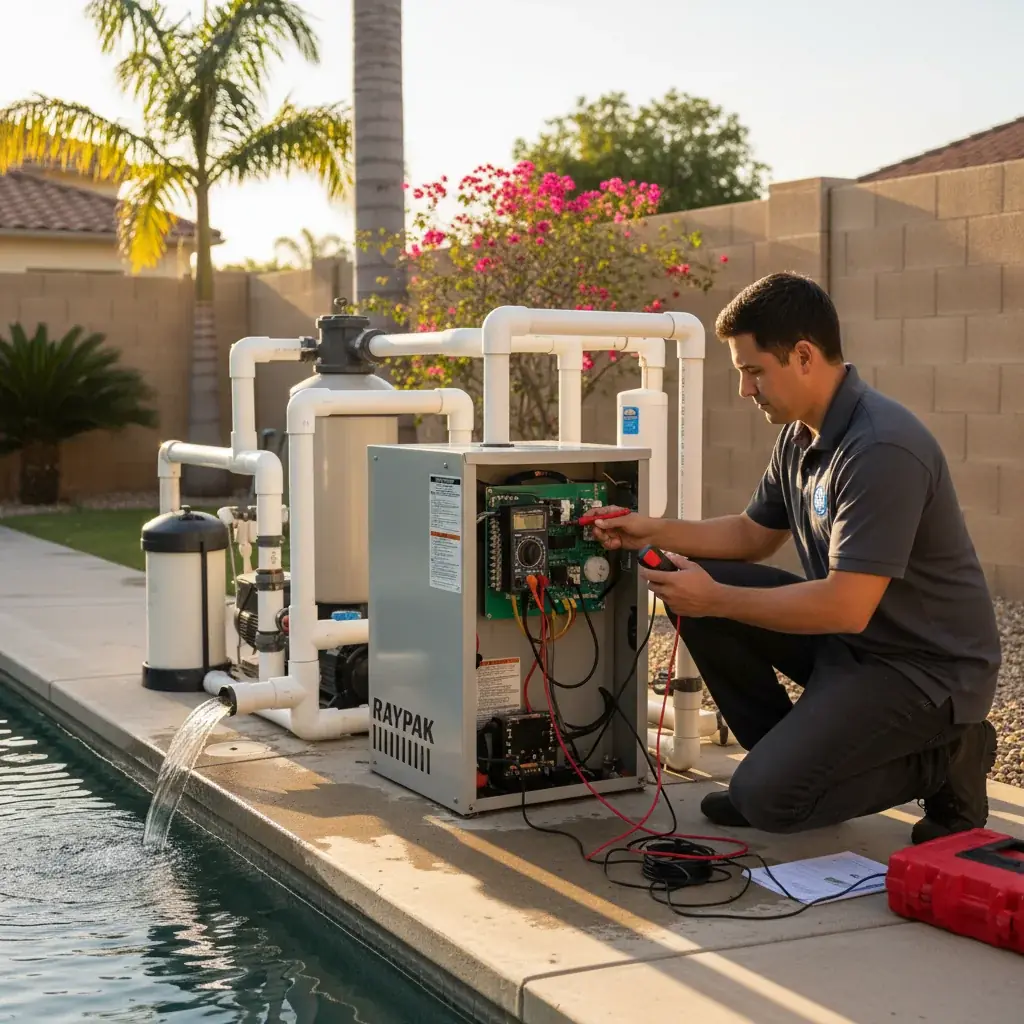
A pool heater that won’t fire usually comes down to one of three stages: power, water flow, or ignition. Knowing which stage failed tells you what to check first and whether the fix is something you can handle or something that needs a licensed specialist. This guide walks through each stage, covers the San Diego conditions that cause them, and helps you decide between repair and replacement.
The three failure stages
Every gas pool heater follows the same sequence. Power reaches the control board, water flow is confirmed, then the burner ignites. When the heater won’t start, one of those three stages has broken down.
A dark display with no lights or codes points to the power stage. The heater hums or the pump runs but no flame appears, and that’s the ignition stage. The heater starts, runs briefly, then shuts off, and that’s a safety switch tripping mid-cycle.
A specialist quotes the actual failed part, not a symptom guess. That distinction matters when you’re comparing repair estimates.
San Diego conditions that cause failures
Where your equipment pad sits in the county changes what goes wrong first.
Inland pads in El Cajon, Santee, and Escondido deal with hard water. Mineral scale builds up inside heat exchangers over time. That scale restricts flow, trips safety switches, and eventually cracks the exchanger from thermal stress. If you’re inland, hard water is the enemy of your pool equipment and your heater takes the worst of it.
Coastal pads in La Jolla, Coronado, Imperial Beach, and Carlsbad face a different problem. Salt air corrodes burners, unions, and control boards. Coastal humidity also eats through outdoor GFCI outlets faster than inland conditions do. A corroded outlet can kill power to the board and look exactly like a dead heater.
Power supply checks
Most heaters sit on a dedicated breaker, separate from the pump circuit. If the display is blank, check that breaker first. If it won’t reset or re-trips immediately, you have a deeper electrical fault. Stop resetting it and call a licensed electrician.
Some control boards run off a standard GFCI outlet near the equipment pad. Check that outlet too. Coastal humidity corrodes these faster, so a tripped or dead GFCI near the coast is a common first check.
Gas valve position
A shutoff valve is required at both the meter and the heater. Either one closed stops ignition completely. Homeowners often close the valve at summer’s end and forget to reopen it.
The handle position tells you the state. Parallel to the gas line means open. Perpendicular means closed. Check both valves before you assume the heater has failed.
If you smell gas near the unit, stop. Don’t attempt anything. Call a professional immediately.
Flow switch problems
The flow switch tells the control board that water is moving before it allows ignition. It’s a safety feature that prevents firing dry and cracking the exchanger.
Several things trip it. Debris in the filter reduces flow. A partially closed valve on the pad does the same. A pump running below the required flow rate trips it too.
Start with the basics. Clean the pump basket and skimmer baskets. Backwash or clean the filter. If flow returns to normal and the heater still won’t fire, the switch itself may have failed. Testing it requires a multimeter, and that’s a job for a licensed specialist.
Pressure switch issues
Some models use a pressure switch instead of or alongside the flow switch. A stuck or miscalibrated pressure switch produces the same no-fire symptom. It’s harder to diagnose without pressure-testing equipment. A technician checks this after flow and filtration are ruled out.
Thermostat and control board
Before you assume a hardware failure, confirm the basics. If the thermostat is set below the current water temperature, the heater won’t call for heat. Make sure the heater is in heat mode, not off or filter-only. Combined systems sometimes default to filter-only after a power interruption.
Digital boards may show a faint or flashing code on a screen that looks blank. Look closely. Each brand displays differently. Raypak units show LCD messages, Jandy JXi models display their own codes, Hayward Universal H-Series units use FD codes, and Pentair MasterTemp heaters show LCD codes. If you’re deciding between brands for a replacement, our gas heater vs heat pump comparison covers the tradeoffs.
Heat exchanger failure
A cracked or corroded exchanger can prevent ignition entirely. The control board treats it as a safety response, not just reduced output. If you see visible damage or the unit has a history of scale buildup, record the model number and describe what you see. Ask the contractor to assess repair versus replacement.
For a typical residential gas heater, HomeGuide lists about $1,500 to $4,500 installed. That’s the replacement range to keep in mind if the exchanger is beyond repair. Our pool heater replacement cost guide breaks down what drives the final number.
Clicking without ignition
Repeated clicking with no flame is different from a brief flame that goes out. Record the heater model and note which pattern you’re seeing. That information helps the contractor narrow the cause before arriving.
Ask the contractor to compare repair versus replacement. Base the decision on written scope, warranty terms, and parts availability. If you need help structuring that conversation, our pool equipment repair estimate guide covers what a fair quote looks like.
Repair versus replacement
HomeGuide publishes a general heater repair planning estimate of $150 to $750. That’s a useful planning range, but your actual cost depends on which part failed, whether it’s still in production, and how accessible the unit is.
When comparing quotes, look at more than price. Compare the written scope of work, warranty terms, and parts availability. Include a condition assessment, not just an age cutoff. A single failed part on an otherwise healthy unit favors repair. A cracked exchanger or multiple simultaneous failures often points toward replacement.
Ask whether your pump, filter, or salt system belongs in the same scope. If you run a salt system, zinc anodes provide sacrificial protection for heaters and niches, and a missing or depleted anode accelerates corrosion.
Cold weather and undersized heaters
San Diego rarely sees hard freezes, but that doesn’t mean cold weather is irrelevant. Coastal marine layer mornings drop water temperature. Inland winter nights do the same. An undersized or aging heater struggles under those conditions and mimics failure.
Often the heater is cycling on low output rather than truly off. It runs but can’t keep up with heat loss. A pro can check whether your heater is undersized for your pool volume and recommend whether a larger unit or a different heating approach makes sense.
What you can safely check yourself
Homeowners can safely handle a few things. Check the gas shutoff valve at both the meter and the heater. Reset the breaker if it tripped. Confirm thermostat settings and heat mode.
What you shouldn’t touch: gas lines, the ignitor assembly, and the heat exchanger. Fire and carbon monoxide risk from improper gas repair is real. Those jobs belong to a licensed professional.
When to call us
If your heater won’t fire after you’ve checked the breaker, gas valves, and thermostat settings, the problem is inside the unit. Safety switches, ignitors, and exchangers require a licensed pool professional with diagnostic tools. Call us at (858) 400-4404 and we’ll connect you with a licensed local pool specialist.
Frequently asked questions
Why won't my pool heater turn on?
The most common cause is a safety switch blocking ignition. Usual suspects are the flow switch, high-limit switch, or pressure switch. If the display is blank with no code and no ignition attempt, the problem is likely power or thermostat settings. A specialist reads the display, tests the safety circuit, and quotes the failed part.
How much does pool heater repair cost in San Diego?
HomeGuide publishes a general heater repair planning estimate of $150 to $750. Your actual cost depends on which part failed, whether it is still in production, and labor access. The matched independent pro gives a real quote after assessing your unit.
Can I fix a pool heater ignition problem myself?
Homeowners can safely check the gas shutoff valve, reset the breaker, and confirm thermostat settings. Gas line work, ignitor assembly replacement, and heat exchanger repairs are not safe DIY. Improper gas repair carries fire and carbon monoxide risk.
Should I repair or replace my pool heater?
Compare written scope, warranty terms, parts availability, and overall condition. Do not rely on age alone. A single failed part favors repair. A cracked exchanger or multiple simultaneous failures often points toward replacement. Ask whether your pump, filter, or salt system belongs in the same scope.
Does cold weather affect pool heaters in San Diego?
San Diego rarely sees hard freezes, but coastal marine layer mornings and inland winter nights drop water temperature. An undersized or aging heater may struggle and mimic failure. It is often cycling on low output rather than truly off. A pro can check whether your heater is undersized for your pool volume.
Need professional help in San Diego County?
Splash Pool SD connects you with a licensed specialist for any service in this post.