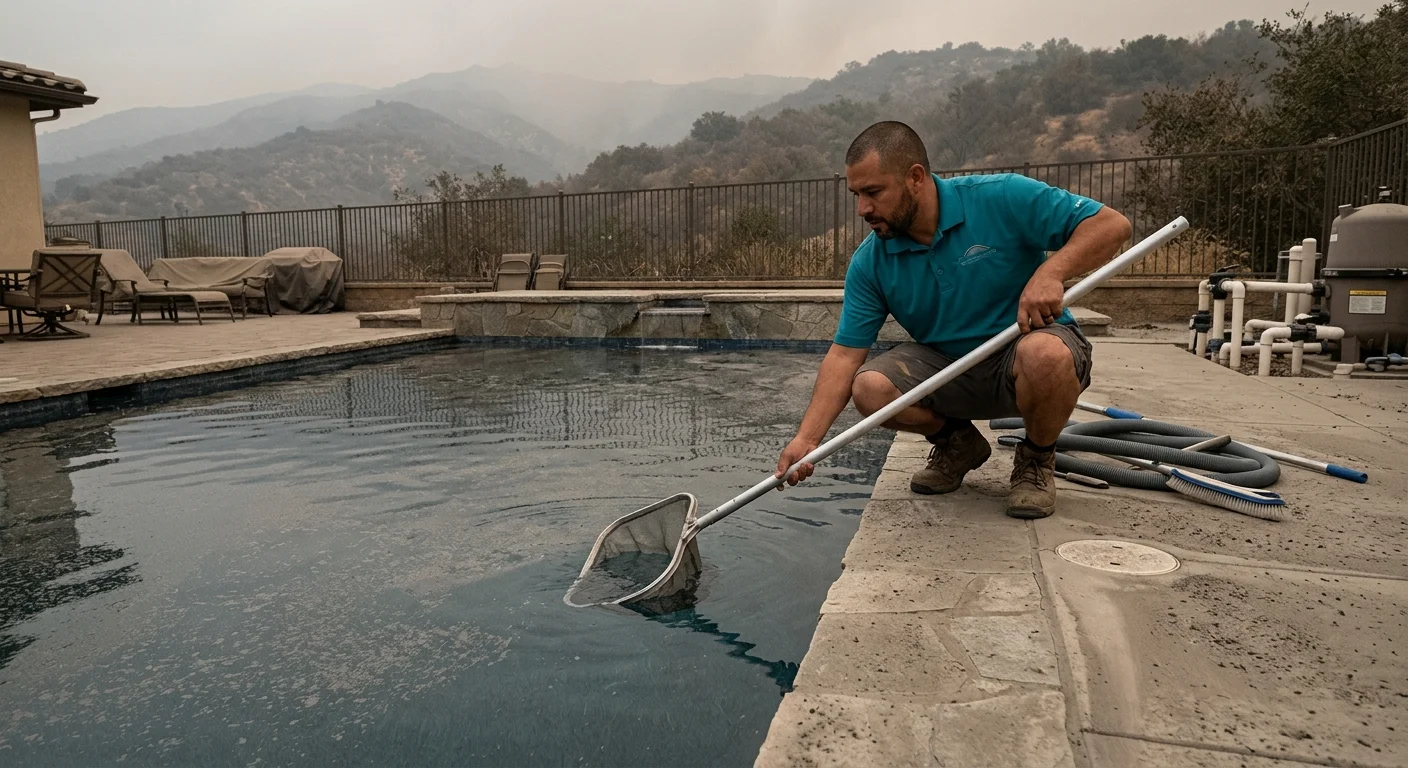
Wildfire ash in your pool isn’t ordinary dust. It is fine, wet, and stubborn, and it clings to the waterline, packs the skimmer, and dulls the plaster before you even get a test strip in the water. September is peak fire-and-ash season in San Diego County, and the cleanup follows a specific order: physical removal first, chemistry second. Splash Pool SD connects you with a licensed local pool professional who handles the full process, from skimming to filter work to rebalancing.
How ash behaves once it hits the water
Ash starts as a gray skin on the surface. Then it waterlogs and sinks. The first places you will see it are the surface, the skimmer throat, and the tile line. Steps and tanning ledges collect it because the water moves slowly there. Weak-return corners hold a silt-like ring that looks like dirt but isn’t.
Unlike leaves, eucalyptus bark, or palm fiber, ash passes straight through an ordinary mesh leaf net. A cotton rag stretched over the net catches the finer particles. That is a homeowner trick that works for light fallout. But if stirring the surface sends a cloud toward the floor, stop. Stirring ash into the plaster turns a surface film into a stain that is much harder to remove.
Once ash sinks, it behaves like silt. Hard brushing drives the grit into porous plaster. Vacuuming on the filter setting packs the media in a single pass. If you are unsure which vacuum setting to use, leave the hose alone and wait for the pro. Running a robot cleaner during active fallout grinds grit into the pump internals.
Inland and coastal yards see different fallout
San Diego County isn’t one climate zone after a smoke event. Ramona and Pacific Beach look different the morning after the same fire.
East County sits closer to dry chaparral and canyon wind. Alpine, Lakeside, El Cajon, Santee, Spring Valley, and Jamul take the heaviest accumulation. The back country toward Cleveland National Forest catches offshore fallout directly. North County inland areas like Escondido, San Marcos, Valley Center, Fallbrook, and Poway also collect fine ash overnight, especially the hills above Escondido.
Coastal yards in La Jolla, Pacific Beach, Ocean Beach, Del Mar, Encinitas, Carlsbad, and Coronado typically see a haze rather than a heavy gray blanket. The marine layer traps smoke in the morning, and the afternoon wind flips it inland. A pool two blocks from the beach still gets a fine film, but it is usually thinner than what inland yards accumulate. The South Bay, including Chula Vista, Bonita, and Otay Mesa, gets east-wind canyon dust that behaves more like inland fallout.
If your street backs to open space, treat your yard as inland regardless of zip code. Mission Gorge, the El Capitan side of Lakeside, and the Palomar foothills funnel debris into yards that might otherwise look coastal.
Santa Ana stucco dust is tan. Wildfire ash is gray. If the water has a wet-cement look, that isn’t ordinary wind dirt.
What to do before the specialist arrives
If the power is out, leave the equipment pad off entirely. A dry-run pump or a grit-filled basket turns a cleanup into a repair. Never bump the breaker to test. Wait for the pro to inspect the strainer, the water level, and the filter.
If ash is still falling, pause the automatic cleaner. Robots and suction cleaners grind fine ash internally. If your salt cell is showing a flow complaint, keep it off until the water clears. Turn the heater off too. Ash in a heat exchanger is specialist territory.
What to record
Photograph the surface and the waterline. Photograph both skimmer baskets and the pump basket. Note the filter pressure gauge reading and compare it to your normal clean baseline. Note whether the cover was on. Note the last product you added and the date. Note any pink or red residue. Note how the pump behaved: hummed, tripped, or stayed silent.
What not to do
Don’t shock a grit-filled pool. Chlorine can’t lift silt. Don’t add clarifier onto a packed filter. Don’t drain. Draining isn’t the first move, and it often harms the shell. If a drain is required later, check discharge rules with your water district. The San Diego County Water Authority is the resource for that conversation.
Don’t open the lid on a pressurized filter. That is an injury risk. Empty baskets only with the power off at the timer or breaker.
Deck ash and stormwater rules
Canyon wind or foot traffic returns deck ash to the water. Never hose the deck toward the street. San Diego County streets and gutters feed the storm system, not the sewer. Mist the deck lightly to suppress dust, then sweep into a bag. Confirm your local city’s stormwater rules before you wash anything outdoors. A specific county ordinance number couldn’t be confirmed, so check with your city directly.
Covers help, but only in light fallout
A cover helps when the ash is light. But an ash-loaded cover dumps a concentrated mess if you pull it off at once. Sweep the cover into a bag before removing it. Never rinse the cover into the pool. Mesh covers pass the finest dust. Solid covers hold the pile on top, which is easier to manage.
Filter behavior after ash
Cartridge systems load fast because the media is tight. Sand and DE systems also load. The tells are weak return flow, a rising gauge, and a strained pump sound. There is no universal pressure cutoff. Compare the reading to your own clean baseline. The specialist decides whether to rinse, backwash, or pull the media entirely.
Backwashing drops the water level, and the waste needs a legal destination. Never discharge to the driveway, the gutter, or a canyon. Confirm the approved discharge point with your city or water district first. A cartridge that won’t rinse clean needs repair or replacement. A pro who handles pool filter types in San Diego can tell you which path makes sense.
East County and inland North County yards should expect multiple filter washes after a heavy event. Coastal yards with a light film may need fewer.
Don’t wait for the pool to settle before acting. Sitting ash bonds to plaster and vinyl over time. Don’t run the pump against a packed filter either. That risks motor damage.
Chemistry comes after the physical load is reduced
Wildfire ash is burned material. It isn’t a pool chemical. People sometimes confuse it with soda ash, which is a bagged pH raiser. They are different things, and soda ash doesn’t remove wildfire ash.
Ash increases sanitizer demand because of the organic load it carries. The water may look dull even when a test strip shows chlorine present. Don’t dose by guesswork. No confirmed pH or chlorine target for ash days could be verified. Test the water, or let the specialist test it. If you want background on how shocking works in normal conditions, our guide on how to shock a pool covers the basics, but ash events aren’t normal conditions.
A dirty pool with a collapsed sanitizer level leads to algae. Algae cleanup differs from ash cleanup, and one can follow the other if the water sits ignored. Keep everyone out until the floor is visible. Our post on green pool cleaning in San Diego covers what happens when algae takes hold.
Soot, char, and fire retardant are separate problems
Soot and char may accompany ash. Fire retardant is a different issue entirely. If you see a pink or red slurry in or around the pool, that isn’t ordinary ash. Photograph it and call a licensed specialist immediately.
Equipment repair triggers
A normal ash day calls for skimming, brushing, vacuuming, a filter wash, and rebalancing. But certain signs mean the situation has moved into repair territory:
- The pump won’t prime, or the motor hums then stops.
- The filter won’t return to normal pressure after cleaning.
- The heater throws errors after the event.
- The salt cell is coated in gray film.
- The plaster is stained from ash sitting on the steps for days.
- A DE grid is torn by the sudden heavy dirt load.
If you see any of these, the cleanup has become a repair job. A pro who handles pool stain removal in San Diego can address plaster damage, and our guide on choosing a pool repair pro walks through what to look for.
Fire proximity and emergency situations
If you see scorched fencing, a melted cover, or debris on the equipment pad, that is an emergency service call. Enclosure damage is a safety issue. Never leave a fence gap unaddressed. Our page on emergency pool service in San Diego covers what qualifies.
Verifying the pro before work starts
Splash Pool SD matches you with a licensed independent specialist. We don’t hold a trade license, own trucks, or perform physical work. The pro we connect you with does the cleanup, the filter work, and any repairs. Before work begins, ask to see their license and verify it on the CSLB license-check site. Our post on checking a pool contractor license in California explains the process step by step.
The specialist quotes after inspecting the water, the pad, and the filter. What moves the price is pool size, finish type, access, equipment brand, and whether a permit is needed. No two ash events are identical, so the quote comes after the inspection, not before.
When to call us
If your pool looks like gray soup, the filter is packed, the pump sounds wrong after a smoke event, or the water won’t clear after skimming, that is the point where a licensed pro needs to take over. Call us at (858) 400-4404 and we’ll connect you with a licensed local pool specialist.
Frequently asked questions
Is wildfire ash the same thing as soda ash?
No. Soda ash is a bagged product used to raise pH. Wildfire ash is burned organic debris that falls from the sky after a fire event. They are completely different substances. Adding soda ash will not remove wildfire ash from your pool. A licensed specialist should test the water before you add any product.
Should I drain my pool after ash falls on it?
Draining is not the first response and is often wrong for the pool shell. Physical removal and filter cleaning come first. If a drain is needed later, check discharge rules with your city or the San Diego County Water Authority before you start. A county-wide dump-to-sewer figure could not be confirmed.
Can I swim after wildfire ash lands in my pool?
Stay out while the water remains cloudy. CDC healthy-swimming guidance requires that you can see the main drain and the shallow floor before anyone enters. That applies to dogs too. A specialist restores clarity and sanitizer balance before re-entry is safe.
Can I use my pool as a wildfire shelter?
No. A backyard pool is not a wildfire shelter. Follow official evacuation orders from your local fire authority. This article covers post-smoke ash cleanup, not fire survival.
When do I need a licensed specialist for ash cleanup?
Call a pro when the filter is packed, the pump sounds wrong, the heater throws errors, or the water will not clear after skimming. Splash Pool SD matches you with a licensed local specialist who handles the physical work. We do not perform service ourselves.
Need professional help in San Diego County?
Splash Pool SD connects you with a licensed specialist for any service in this post.