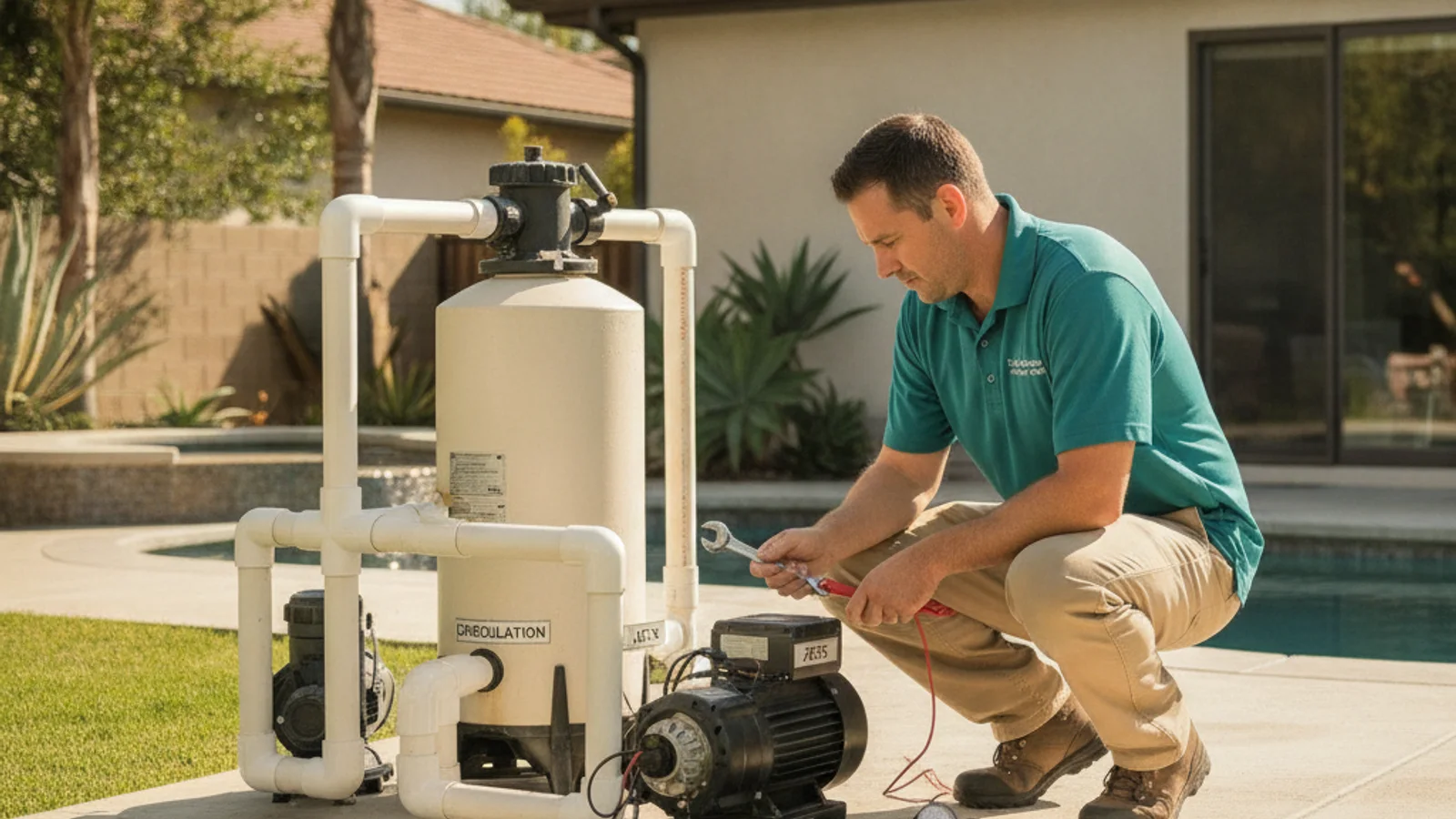
A spa pump that hums without moving water, leaks at the shaft, or delivers weak jets needs a specific fix, not a guess. In San Diego County the right repair depends on your water chemistry, your distance from the coast, and whether your spa is a portable cabinet or attached to a pool system. This page walks through what each symptom means, what drives the repair decision, and what to have ready before a licensed pro arrives.
How spa pumps are set up
Most portable spas carry two pumps. The circulation pump is smaller. It pushes water through the filter and heater during filter cycles or temperature-hold mode. The jet pump is larger and activates only when you engage the jets from the topside panel. Larger portable spas sometimes carry a second jet pump.
Identify each pump by its position inside the cabinet and which topside button controls it. Guessing by motor sound risks ordering the wrong wet end. Spa pump parts must match the spa pack, and the wet end, unions, and plug are confined inside a tight cabinet.
What the symptoms tell you
The first diagnostic split is simple. If the jets are dead but water still filters, the problem is the jet pump, a diverter, or the jets themselves. If there is no circulation, unclear water, and no heater flow, the problem is the circulation pump, a clogged cartridge, or an air lock.
Weak jets are the most common complaint and the most often misdiagnosed. A dirty filter, an air lock, or a mispositioned diverter causes weak jets far more often than a dead motor. After a refill or filter change, air traps in the wet end. The pump sounds wet but barely moves water. That is an air lock, not a failed motor. A diverter aimed at one seat starves the others. If all jets are weak, check the filter, then air, then the pump. If one zone is dead and others are strong, the diverter or that branch line is the likely cause.
A hum without water flow is different. The motor is receiving a command but the shaft isn’t turning. This points to a seized wet end or a failed start component. Shut off a humming pump immediately. A locked motor overheats and can damage itself beyond repair. The next step is testing whether the impeller is locked by scale or debris, or whether the start circuit has failed.
Water at the shaft where the wet end meets the motor indicates a shaft seal failure. Water at a union points to a gasket or a backed-off fitting. Soaked insulation, water along a hose, or a dropping waterline with no visible puddle suggests a separate leak path.
If your topside panel shows an error code, record the message before any reset. Don’t repeatedly cycle power to clear it. The spa pack switches each pump through a relay, and a failed relay can silence one pump entirely. Test power at the pump terminals, not only at the motor.
Attached spas that share a pool pump
Attached pool and spa combos often share valves. What sounds like a spa pump problem may actually be the pool pump with diverter valves routing water. If your equipment pad shows only a pool pump plus valve movement, you have a shared system. Weak attached-spa jets in this setup usually come from incomplete valve travel, a dirty pool filter, or the shared pump itself. It isn’t automatically a hidden second spa motor.
Check valve position, automation mode, and pool pump condition before ordering any spa-specific part. If a second pump runs only in spa mode, it is a booster pump. Read the nameplate to confirm. Photograph valve handles and the control mode before the specialist arrives, and don’t spin multiple valves while waiting.
San Diego factors that change the diagnosis
San Diego County spans multiple microclimates, and the same symptom points to different parts depending on where you live.
Inland East County water is mineral-heavy. In El Cajon, Santee, and Escondido, scale builds on impeller vanes, seal faces, and the circulation pump. An inland hum without flow is often a mineral-packed wet end, not an electrical fault. Cartridge filters load faster in hard water and starve both pumps, which mimics a weak motor but isn’t one. If you are in this zone, hard water is a constant factor for your pool and spa.
Coastal areas like La Jolla, Coronado, Imperial Beach, and Carlsbad face a different problem. Salt air attacks metal components on outdoor cabinets. Union nuts, fan covers, screws, and electrical lugs corrode. A coastal union leak may be a corroded fitting, not just a worn gasket. A missing cabinet panel on a coastal patio feeds salt directly onto the pumps.
Inland sunny side yards can also overheat small motor housings. Report these conditions when you place the service call. They change what the pro brings and how long the visit takes.
Wet end, motor, or full pump replacement
The repair decision breaks three ways. The wet end is the water side: impeller, housing, wear surfaces, and shaft seal. Scale, a locked impeller, or a failed seal stay at the wet-end level if the motor still spins free. The motor is the electrical side: bearings, windings, and the start component. A hum with a free impeller points here.
Full replacement makes sense when both sides are damaged, when corrosion has spread through the assembly, or when no matching wet end exists for your spa pack. A seized wet end locking the motor or a corroded cabinet also pushes toward full replacement. If the spa pack itself can’t drive the pump, that is another reason to replace the unit.
Age alone doesn’t decide. Condition and parts availability do. Isolated unions, seals, and start components support repair rather than replacement.
What to have ready before the pro arrives
Note whether your spa is a portable cabinet or attached to a pool. Count visible pumps and identify which one hums, leaks, or stays silent. Record whether jets are failing at all seats or only one zone. Describe the exact sound: hum with no water, grinding, or spinning weakly. Note where water appears: at the shaft, at a union, or elsewhere in the cabinet.
Record the date of your last filter cleaning or replacement. Photograph the topside message before any reset. Write down the spa or pump model from any readable label. Provide your ZIP code and note whether the unit sits in salt air. Confirm the water level and reseat the filter per the manual.
Leave power off on any humming pump. Opening the motor is licensed work. Don’t pry the wet end to inspect the impeller, and don’t keep resetting a tripping breaker.
Licensing and your rights
California Business and Professions Code section 7048, amended effective January 1 2026, exempts casual minor work below a threshold that requires no building permit. That exemption is void if the person advertises as a contractor or employs workers. Advertised spa pump repair must go through a licensed professional.
Section 7159.5 caps the down payment a contractor can collect at a fixed amount or a percentage of the contract, whichever is less. On larger contracts the fixed cap applies, not the percentage. Verify any contractor on the CSLB license lookup before hiring. Confirm the license name matches the name on the proposal. Our guide on how to check a pool contractor license in California walks through the lookup step by step.
Related reading
If your pump is humming but not running, our post on pool pump humming without running covers the electrical side in more detail. For broader pump issues beyond the spa, pool pump repair in San Diego covers the full range. If your spa is part of a larger repair project, spa and hot tub repair in San Diego covers heaters, controls, and shell issues alongside pumps.
When to call us
Spa pump repair involves electrical components, pressurized plumbing, and parts that must match your specific spa pack. Opening a motor housing or replacing a wet end is licensed work in California. Call us at (858) 400-4404 and we’ll connect you with a licensed local pool specialist.
Frequently asked questions
How much does spa pump repair cost in San Diego?
There is no single answer. Price depends on whether the fix is a wet end, a motor, or a full pump replacement, plus parts availability for your specific spa pack. A matched licensed pro quotes after an on-site assessment. No figure published online replaces that quote.
How do I tell the circulation pump from the jet pump?
The circulation pump is smaller and runs during filter cycles or temperature-hold mode. The jet pump is larger and activates only when you engage the jets. Identify each by its position inside the cabinet and which topside button controls it. Guessing by motor sound risks ordering the wrong wet end.
My spa pump hums but the jets are not moving water. What does that mean?
A hum without water flow usually points to a seized wet end or a failed start component. The motor is receiving a command but the shaft is not turning. Shut the pump off immediately. A locked motor overheats. The next step is testing whether the impeller is locked by scale or debris, or whether the start circuit has failed.
Does a leak at the pump always mean the shaft seal is bad?
Not always. Water at the shaft where the wet end meets the motor points to the shaft seal. Water at a union points to a gasket or a backed-off fitting. Water along a hose or a dropping waterline with no visible puddle suggests a separate leak path. The location of the water tells you which part to inspect.
Should I replace the wet end, the motor, or the whole pump?
Scale, a locked impeller, or a failed seal with a motor that still spins free points to a wet-end repair. A hum with a free impeller points to the start circuit or motor. Full replacement makes sense when both sides are damaged, corrosion has spread through the assembly, or no matching wet end exists for your spa pack. Age alone does not decide. Condition and parts availability do.
Need professional help in San Diego County?
Splash Pool SD connects you with a licensed specialist for any service in this post.