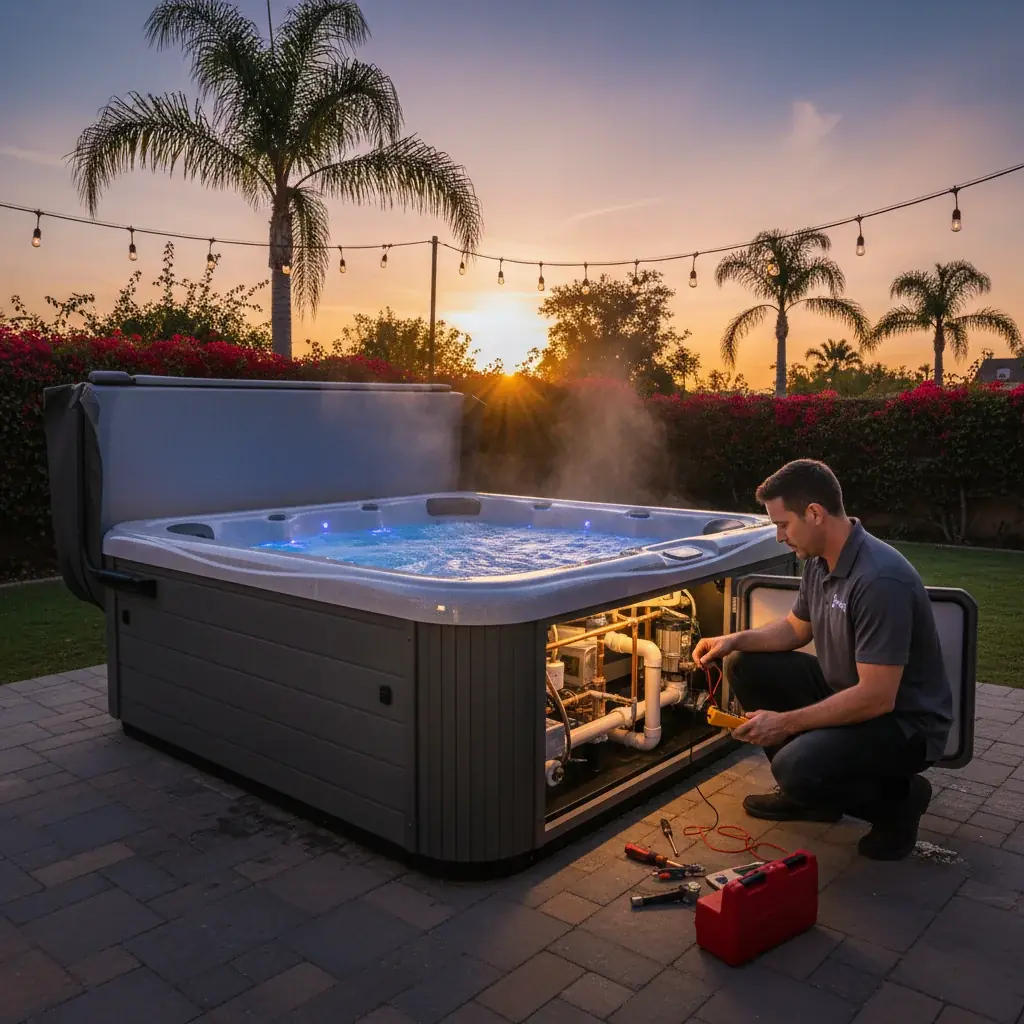
A cold spa in Carlsbad is usually a flow or control problem, not a failed heating element. Dirty filters, closed valves, faulty sensors, and controller errors all mimic a dead heater. The element itself is the last component a qualified tech replaces, because swapping it first often leaves the real fault untouched. Splash Pool SD connects you with licensed local specialists who diagnose the full system before touching the heater.
Why coastal air changes the diagnosis
Carlsbad sits in the same salt-air corridor as La Jolla, Coronado, Del Mar, and Encinitas. That exposure corrodes heater terminals, pump connections, unions, and control panels faster than inland heat alone would. Salt residue around coastal equipment gives a trained tech a diagnostic clue before any meter comes out.
Inland spas tell a different story. Hard water leaves mineral scale on heating elements and inside narrow jet openings. Because a spa holds far less water than a pool, that small volume recirculates frequently and scale builds faster. If your spa is inland, hard water is likely part of the picture.
San Diego has no true hot-tub off-season. Heaters, pumps, and jets run year-round, which means more operating hours than seasonal climates and more chances for wear to show up.
Water stays cold: the diagnostic sequence
A heater needs steady flow plus valid sensor and control signals to fire. When any link in that chain breaks, the water stays cold and the heater looks dead.
The sequence a tech follows:
- Confirm flow. A dirty filter or a circulation problem can mimic heater failure completely.
- Check sensors. A faulty temperature or flow sensor may never tell the controller to call for heat.
- Inspect the heater assembly. Corroded connections can damage the circuit while the main component still looks intact.
- Test relays and controller command. A board that never sends the signal leaves the heater idle.
Visual inspection belongs alongside electrical and flow testing. On coastal units, corrosion may hide at terminal connections while the element itself tests fine. Replacing the heater first, without this sequence, risks paying for a part that was never the problem.
For a deeper look at heater-specific faults, see our guide to pool heater repair in San Diego.
Weak or dead jets
Weak jets don’t automatically mean failed jet inserts. The common causes are low water level, a restricted filter, a closed valve, trapped air, or a circulation problem upstream.
A tech removes the filter from the diagnostic path first, then compares flow across different jet zones. If one zone is weak and the others recover, the diverter or that branch is the suspect. If all jets are weak, the pump and main circulation path come under scrutiny.
Cleaning a visible jet face won’t fix deeper branch deposits. Flow patterns get tested before any parts are ordered.
Pump leaks, hums, or stops
A union or seal leak is a different repair than a damaged wet end. Whenever possible, the tech inspects while the leak is active. Dry mineral trails help trace the water path back to its source.
A humming pump means the motor gets a start command but can’t turn. The cause may sit inside the pump, in the starting components, or in the electrical supply. Swapping the motor without checking those paths can miss the original fault.
A Carlsbad pump with corroded connections presents a different problem than an inland unit with mineral buildup. The fix follows the condition, not a template. For pump-specific troubleshooting, our post on spa pump repair in San Diego covers the full range.
Control panel blank or erratic
A blank panel doesn’t automatically mean a failed circuit board. Incoming power, the topside cable, sensors, and the controller all share the command path.
Before resetting the system, record any displayed fault code. The code may vanish after a power cycle, and with it goes a diagnostic clue.
Intermittent button response usually points to a topside control issue. If heating, pumping, and the display are all affected at once, the problem likely sits upstream. The tech checks for moisture and corrosion around plugs, terminals, and the controller enclosure.
What a repair visit looks like
The tech starts by learning when the problem appears, which modes trigger it, and whether any fault message displays. Then the visit follows a sequence:
- Confirm water level, filter condition, and valve positions.
- Reproduce the reported problem when the system permits.
- Inspect accessible plumbing, unions, pumps, heaters, and controls.
- Test components connected to the failing function.
- Re-run affected modes after diagnosis or repair.
A heater complaint may start with a circulation issue. A jet complaint may start with a valve. A control complaint may start with a sensor or cable. Ask which test identified the failed component. The quote should confirm the part fits your existing controller, plumbing, and available space.
Repair or replace: what decides
Repair suits an isolated failure when the shell is sound, parts are available, and surrounding equipment works. Examples include a seal, a union, a sensor, a cable, or a single control component.
Replacement becomes the stronger option when several major systems fail at once, when corrosion extends through the equipment bay, when concealed plumbing is damaged, or when an essential control board is no longer manufactured.
Age alone doesn’t decide. Condition and parts support matter more. A built-in spa with a sound shell and intact plumbing may only need an equipment update. Coastal inspections should check exposed unions, pump connections, heater terminals, and the control enclosure.
Water loss and shared plumbing
An attached spa that keeps losing water may point to a shared plumbing problem rather than a damaged jet. Note whether the level changes at rest, during pool circulation, or in spa-only mode. Different behavior between modes narrows the affected branch.
Valves, return plumbing, suction plumbing, and underground lines all come into play. Replacing a jet face won’t stop a leak that lives elsewhere. When the source is invisible, a leak detection specialist tests the connected system. This is especially useful when weak jets accompany ongoing water loss. Our post on spa and hot tub leak repair walks through that process.
What drives the price
The failed component sets the starting point. Access difficulty, parts availability, and connected equipment widen the job. A removable cabinet panel gives direct access to a self-contained unit. A built-in spa may hide plumbing behind masonry or decking.
Parts must match the model number, controller, pump configuration, and heater connection. Available space matters for part fit. If a compatible part is unavailable, a repairable unit becomes a replacement candidate.
Request a written quote that identifies the failed part, explains the proposed work, and separates the repair option from any replacement option. That prevents paying for parts chosen from symptoms alone. The matched pro quotes before work starts.
For broader context on what affects pool repair costs in San Diego, that post covers the range of variables.
When to call us
A spa that stays cold, loses pressure, leaks, or shows a blank panel needs a licensed professional who can test the full system, not just swap the most obvious part. Coastal corrosion, shared plumbing, and controller faults all require trained diagnostics. Call us at (858) 400-4404 and we’ll connect you with a licensed local pool specialist.
Frequently asked questions
What makes spa heater repair cost vary so much?
The failed component sets the starting point. Access difficulty, parts availability, and whether plumbing is shared with a pool all widen the scope. A written quote should separate diagnosis, parts, labor, and any replacement option before work begins.
Why are my spa jets weak even though the pump runs?
Weak jets often trace back to restricted flow, a dirty filter, a closed valve, trapped air, or a diverter issue rather than failed jet inserts. A tech tests the whole circulation path before recommending any part replacement.
My spa runs but the water never heats up. Is the heater dead?
Not necessarily. Insufficient flow, a failed sensor, a bad relay, or a controller fault can all mimic a dead heating element. Flow and control signals get verified before anyone recommends a new heater.
Should I repair or replace a leaking spa pump?
An isolated union leak, worn seal, or faulty start component may support a repair. Replacement becomes the better path when the motor or wet end is damaged, corrosion is widespread, or the part is no longer available.
My attached spa keeps losing water. Is it a jet problem?
Not always. Shared plumbing, valves, return lines, or underground plumbing can cause water loss that looks like a jet leak. Noting whether the level changes at rest, during pool circulation, or in spa-only mode helps narrow the source.
Need professional help in San Diego County?
Splash Pool SD connects you with a licensed specialist for any service in this post.