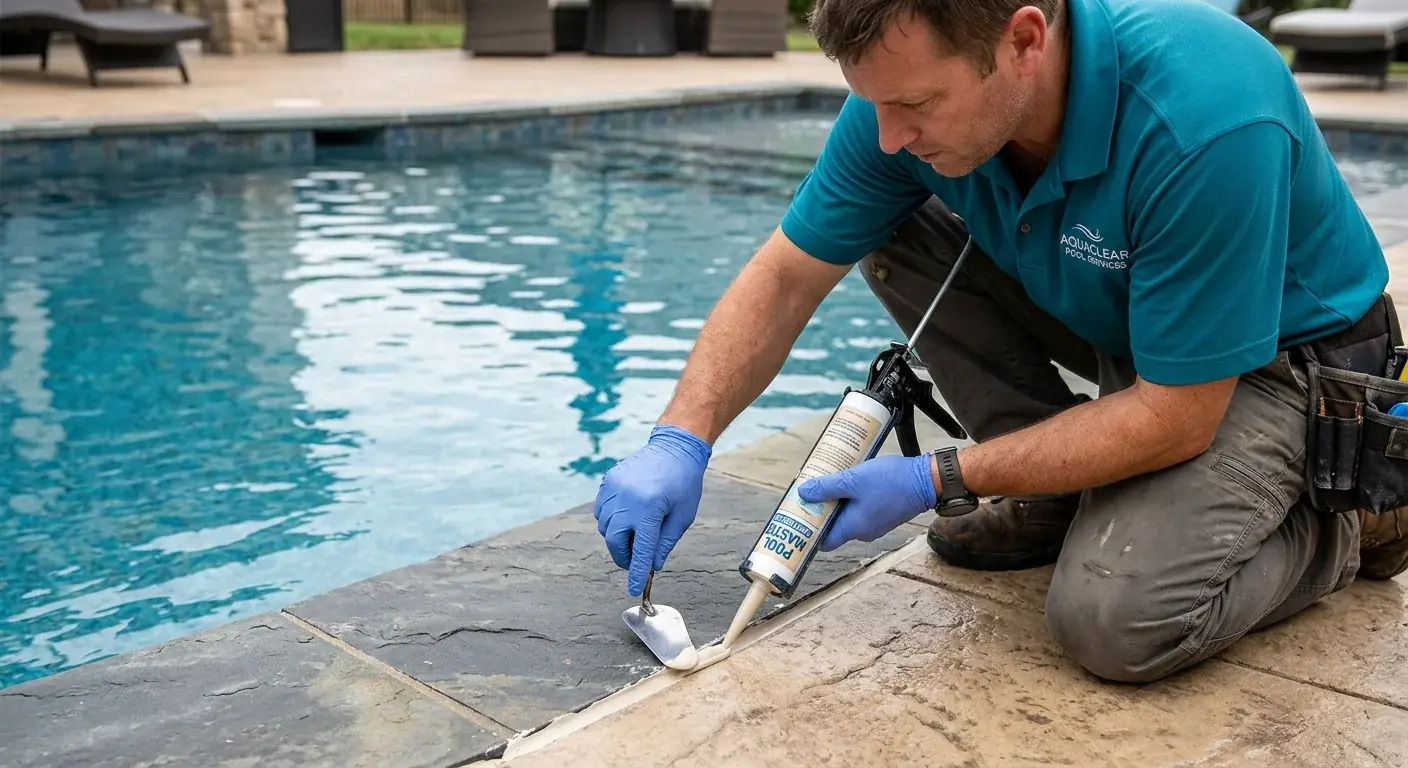
Pool mastic is the flexible sealant that fills the expansion joint between your pool coping and the surrounding deck. When it cracks, pulls away, or turns brittle, water gets in and starts causing damage you can’t see. In San Diego’s climate, most mastic lasts 5 to 10 years before it needs replacement. If yours is showing gaps, crumbling, or staining, it is time to act.
What pool mastic actually does
Your pool shell and your deck are two separate structures. They expand and contract at different rates with temperature changes. The intentional gap between them, called the expansion joint, prevents stress cracks from forming where the two meet.
Mastic fills that gap. It stretches when the joint widens and compresses when it narrows. Its primary job is acting as a watertight barrier that blocks water from penetrating beneath the deck or behind the pool shell.
Most mastic products are made from silicone, polyurethane, or proprietary blends. Deck-O-Seal is one well-known brand name in this category. The coping, which is the cap around your pool edge, sits directly above this joint.
Why mastic fails faster in San Diego
San Diego’s climate is hard on sealants. Several factors work together to break mastic down:
- UV radiation causes brittleness, cracking, and loss of flexibility over time.
- Day-to-night temperature swings stress the joint repeatedly.
- Pool water, rain, and chemicals degrade the material from the surface.
- Unbalanced pool chemistry accelerates degradation. If your water is consistently out of range, the sealant takes a beating.
- Ground settling or soil shifts can tear the sealant apart.
- Normal aging beyond the product’s designed lifespan is unavoidable.
Coastal areas like La Jolla and Encinitas add salt air to the mix, which can speed up surface erosion. Inland areas like El Cajon and Santee see wider temperature swings between day and night, putting more mechanical stress on the joint.
Signs your mastic is failing
Walk the perimeter of your pool and look at the joint between the coping and the deck. Here is what to watch for:
- Hairline cracks that are widening into visible fissures.
- Gaps where the sealant has pulled away from the coping or deck edge.
- A hard, rigid, or crumbly texture when you press it.
- Surface pitting or erosion that makes the bead look thin.
- Staining from mineral-laden or dirt-laden seepage. San Diego’s hard water makes this more noticeable. Read more about hard water and San Diego pools to understand why mineral buildup shows up here.
- Standing water on the deck near the pool edge, which suggests water is no longer shedding properly off the joint.
If you see any of these, the mastic is no longer doing its job.
What happens if you ignore it
Failing mastic isn’t just cosmetic. Once water penetrates the joint, a chain of problems follows:
Water seeps beneath the deck and erodes the soil underneath. Over time, that causes deck sections to sink or crack. If you are already seeing deck damage, our post on cracked pool deck repair in San Diego covers what comes next.
Water can also reach behind the pool shell. That creates the conditions for structural damage and plaster cracks. If the plaster starts failing, you may be looking at resurfacing sooner than expected.
The fix is always cheaper when you catch it early. Replacing mastic costs a fraction of what deck repair or shell work costs.
The replacement process
A licensed pool professional follows a specific sequence to get a lasting result.
Assessment and prep
The pro inspects the joint condition and identifies any underlying causes, like settling or drainage issues. Then all old sealant comes out completely. This step matters more than most people realize. Leftover residue compromises the adhesion of the new material.
The joint gets cleaned of debris, dirt, and old caulk. If the joint is deep, a backer rod is inserted to control the depth and give the new sealant the right profile.
Application
The pro applies a pro-grade sealant built specifically for pool environments. It must withstand local UV exposure, temperature swings, and pool chemicals. A smooth, consistent bead goes in, and the pro tools it for a clean finish and a watertight seal.
Curing and cleanup
Cure time varies by product and weather conditions. Your technician will advise you on how long to keep the area dry and free of foot traffic. The work area gets cleaned after completion.
If your coping itself is damaged or loose, that needs attention before or during the mastic work. Our guide on pool coping repair in San Diego explains the options.
What drives the cost
Mastic replacement is priced by linear foot after an inspection. The total joint perimeter around your pool is the primary driver. A larger pool means more linear feet, which means more material and more labor.
Other factors that move the price:
- Stubborn old material that is difficult to remove increases labor time.
- Joint repairs, like filling voids or addressing settled sections, add to the scope.
- Sealant type affects price slightly. Higher-performance products cost more per tube.
- Accessibility of the joint area matters. Tight spaces or obstructed sections slow the work down.
Your matched pro will provide a written estimate after inspecting the joint. The total is far less than what deck repair or shell work would cost if you let the problem grow.
DIY or hire a pro
Some homeowners attempt mastic replacement themselves. The material is available at pool supply stores. But the prep work is where most DIY jobs fall short. If you leave any old residue, the new sealant won’t bond properly and will fail within a year or two.
A licensed pro has the right tools for complete removal, knows which sealant products hold up in San Diego’s specific conditions, and can spot underlying issues like settling or drainage problems that a homeowner might miss.
If you want to understand how to vet a pro before hiring, our post on choosing a pool repair pro in San Diego walks through what to look for.
Annual inspections make sense here
Given the UV intensity and temperature swings in San Diego County, an annual check of your expansion joints is a smart habit. Catching mastic failure early means a simple replacement instead of a cascade of structural repairs. Your weekly service technician can flag it during a regular visit, or you can ask for a specific inspection.
When to call us
If your mastic is cracked, gapped, crumbly, or pulling away from the coping, a licensed pool professional should assess the joint and replace it before water damage spreads. Call us at (858) 400-4404 and we’ll connect you with a licensed local pool specialist.
Frequently asked questions
What is pool mastic and what does it do?
Pool mastic is a flexible sealant that fills the expansion joint between your pool coping and the surrounding deck. It stretches and compresses as the two structures move at different rates, keeping water from penetrating beneath the deck or behind the pool shell.
How often does pool mastic need replacing in San Diego?
Most mastic lasts 5 to 10 years in San Diego's climate. Intense UV exposure, temperature swings, and pool chemicals can shorten that window. Annual inspections help catch early failure before it causes structural damage.
Can I replace pool mastic myself?
You can, but proper prep is the hard part. All old material must come out completely, the joint must be clean and dry, and the new sealant must be a pro-grade product rated for pool environments. A licensed pro will get a longer-lasting result.
What drives the cost of mastic replacement?
The total linear footage of the joint is the main factor. Stubborn old material, joint repairs, sealant type, and accessibility also affect the price. A matched pro will give you a written estimate after inspecting the joint.
What happens if I ignore failing mastic?
Water seeps beneath the deck, erodes the soil underneath, and can reach behind the pool shell. Over time that leads to sinking deck sections, cracked plaster, and structural damage that costs far more to fix than a mastic replacement.
Need professional help in San Diego County?
Splash Pool SD connects you with a licensed specialist for any service in this post.