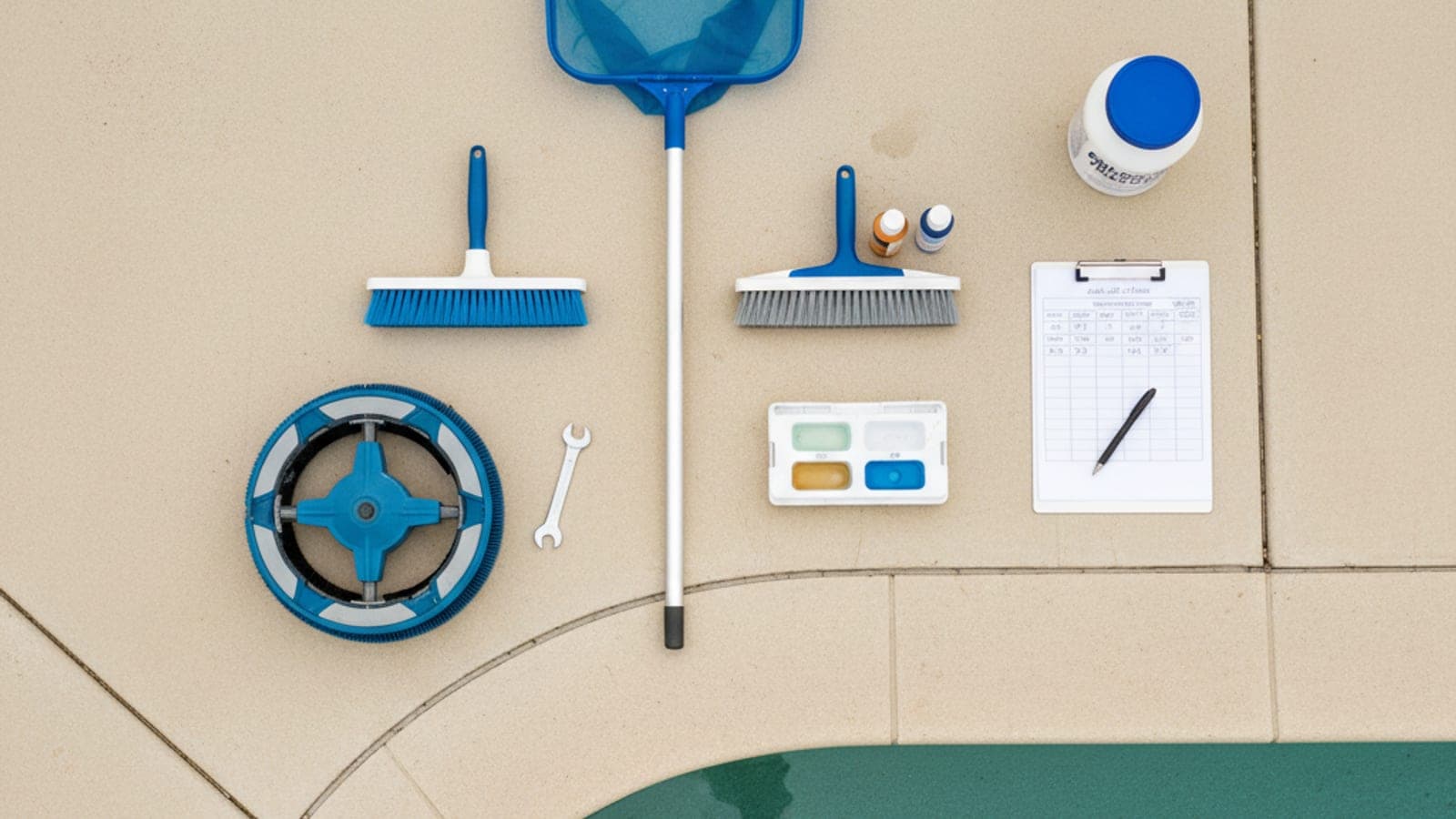
San Diego pool owners spend more time and money on maintenance than most expect, and the numbers tell a clear story. Between the county’s hard municipal water, year-round swim season, and the slow creep of total dissolved solids, a 15,000-gallon plaster pool demands consistent attention and a realistic budget. This post breaks down the real figures behind chemicals, electricity, water loss, and equipment wear so you can plan accordingly.
Chemical usage through the year
Chlorine remains the primary sanitizer for most San Diego pools. A 15,000-gallon pool burns through roughly 2 gallons per week during mid-summer. That drops to about half a gallon weekly by January, when cooler temperatures and shorter days slow demand.
Muriatic acid keeps pH in check. County municipal water runs alkaline throughout, and chlorine works best between pH 7.4 and 7.6. Expect around 1 quart per week in summer. Plaster pools with water features need more because aeration pushes pH up faster.
Three-inch tablets are the top cause of CYA buildup in this region. They add stabilizer continuously, and the only way to remove it is a partial or full drain. August startups across the county show elevated CYA as a pattern, something not typical of Arizona or Florida averages. A test kit is your best defense against this slow accumulation. We cover this in more detail in our guide to high cyanuric acid.
Saltwater pools follow a different rhythm. Initial conversion for a 15,000-gallon pool takes around 400 pounds of salt. Salt doesn’t evaporate. It leaves through splash-out, backwash, and leaks. Typical replenishment runs one or two 40-pound bags per year. Monthly chemical spend sits slightly lower with salt, but the cell needs replacement every 3 to 5 years, making lifetime costs surprisingly comparable to traditional chlorine.
Alkalinity increaser is essentially baking soda. Calcium chloride needs vary depending on your water source. If you are on hard municipal supply, you will likely need it. Our post on hard water and San Diego pools explains the local specifics.
Electricity and pump costs
The pump is the single largest electricity draw on a pool. An older single-speed unit running 8 hours daily produces a high electric bill. A variable-speed pump on low speed costs far less to operate. Roughly 90 percent of pump repairs in this area involve older single-speed units, and their motors typically last 5 to 7 years in the local climate.
About 1 in 10 pools needs a major pump repair in any given year. On variable-speed models, the electronic drive is the common failure point. If you are still running a single-speed pump, our post on variable-speed pumps in San Diego walks through the math on switching.
Water loss and evaporation
San Diego pools lose roughly a quarter inch of water per day to evaporation. Hot spells and wind push that higher. Over a year, this adds up to a meaningful water bill, especially for larger pools or those with exposed surface area.
TDS buildup and drain cycles
Total dissolved solids start at 400 to 600 ppm in tap water. Every additive you pour in raises TDS, and nothing brings it back down naturally. After several years, levels creep past 2,500 ppm. Symptoms include reduced chemical efficacy, hazy water, plaster staining, and even a salty taste in non-salt pools.
The only fix is a full drain and refill. The average local pool needs one every 3 to 5 years because of the hard, mineral-rich municipal supply.
A real example from Escondido, in the hills near Del Dios Highway, illustrates the point. A homeowner had been maintaining the pool DIY for five years. TDS reached nearly 4,500 ppm. The pool had persistent corner algae, cloudy water, and an odd feel. After a full drain and refill, chemical use dropped by roughly 40 percent. The water responded to dosing the way it should have years earlier.
Filters and heaters
Cartridge filters dominate in newer developments like Carmel Valley and 4S Ranch. Cartridges need replacement every 12 to 24 months depending on use and water quality. D.E. filter grids can tear and need inspection. Sand filters require new media every 5 to 7 years.
Heaters present a different pattern. They sit idle for months, then fail right when you need them for a spa evening or a party. Rodents nest inside over winter and chew wiring. Common failures include igniters, sensors, and pressure switches. A heat exchanger or motherboard failure can exceed half the cost of a full replacement unit.
The DIY time investment
Numbers matter, but so does your time. Here is what a typical weekly maintenance session looks like:
- Skimming the surface: about 10 minutes
- Brushing walls and steps: about 15 minutes
- Emptying skimmer and pump baskets: about 5 minutes
- Testing water and dosing chemicals: about 10 minutes
- Pool store trips: 30 to 45 minutes, weekly or biweekly
That totals at least 1 to 2 hours per week, not counting the effort of hauling heavy chemical jugs. Over a year, that is 50 to 100 hours of labor.
Annual cost breakdown
A good rule of thumb is to budget an extra $400 to $600 per year for a “what if” fund that covers surprise repairs.
Here is what a typical DIY year looks like for a 15,000-gallon plaster pool, based on the categories that matter most:
- Chemicals (chlorine, acid, and additives): $900
- Electricity (variable-speed pump): $1,200
- Water (evaporation and splash-out): $200
- Equipment repair fund: $500
- Filter cartridge replacement (pro-rated): $200
Total estimated DIY cost per year: around $3,000. That breaks down to about $250 a month, plus your time.
For a monthly snapshot, budget $80 to $120 for chemicals and another $80 to $150 for electricity from SDG&E. Those two line items alone account for most of the recurring spend.
What moves the price up or down: pool size, finish type, equipment brand, yard access, and whether you hold a current permit for any modifications. A matched pro quotes before work starts, so you always know the number before committing.
What professional service changes
A weekly pro service covers labor, transport, and most chemicals in one fee. It also prevents costly mistakes from improper balance, the kind that lead to plaster damage, equipment failure, or the TDS spiral described above. If you are comparing options, our post on pool maintenance cost in San Diego breaks down what different service tiers include.
For equipment questions, pool equipment replacement costs explains what drives the price of a new pump, heater, or filter.
When to call us
If your water stays cloudy despite correct chemistry, your pump is making unfamiliar noise, or your heater won’t fire up when you need it, that is the point where a licensed pool pro earns their fee. Splash Pool SD matches you with a local specialist who can diagnose and fix the issue. Call us at (858) 400-4404 and we’ll connect you with a licensed local pool specialist.
Frequently asked questions
How much does it cost to maintain a pool in San Diego per month?
For a DIY approach, budget $80 to $120 for chemicals and another $80 to $150 for electricity from SDG&E. Pro weekly service bundles most chemicals and labor into one fee, but water and equipment repairs stay separate.
How often should I drain my pool in San Diego?
Every 3 to 5 years is typical for San Diego. The hard, mineral-rich municipal water drives TDS up over time, and a full drain is the only way to reset it. After a drain, chemical performance improves noticeably.
Is a saltwater pool cheaper to maintain than a chlorine pool?
Monthly chemical spend runs slightly lower with salt, but the salt cell needs replacement every 3 to 5 years. Over the life of the pool, total costs end up surprisingly comparable.
What is the most common pool owner mistake in San Diego?
Using 3-inch chlorine tablets as the primary sanitizer without monitoring CYA. Tablets add stabilizer continuously, and only a drain removes it. By mid-summer, high CYA binds free chlorine and the pool turns hazy or green even though a test still reads chlorine present.
Need professional help in San Diego County?
Splash Pool SD connects you with a licensed specialist for any service in this post.