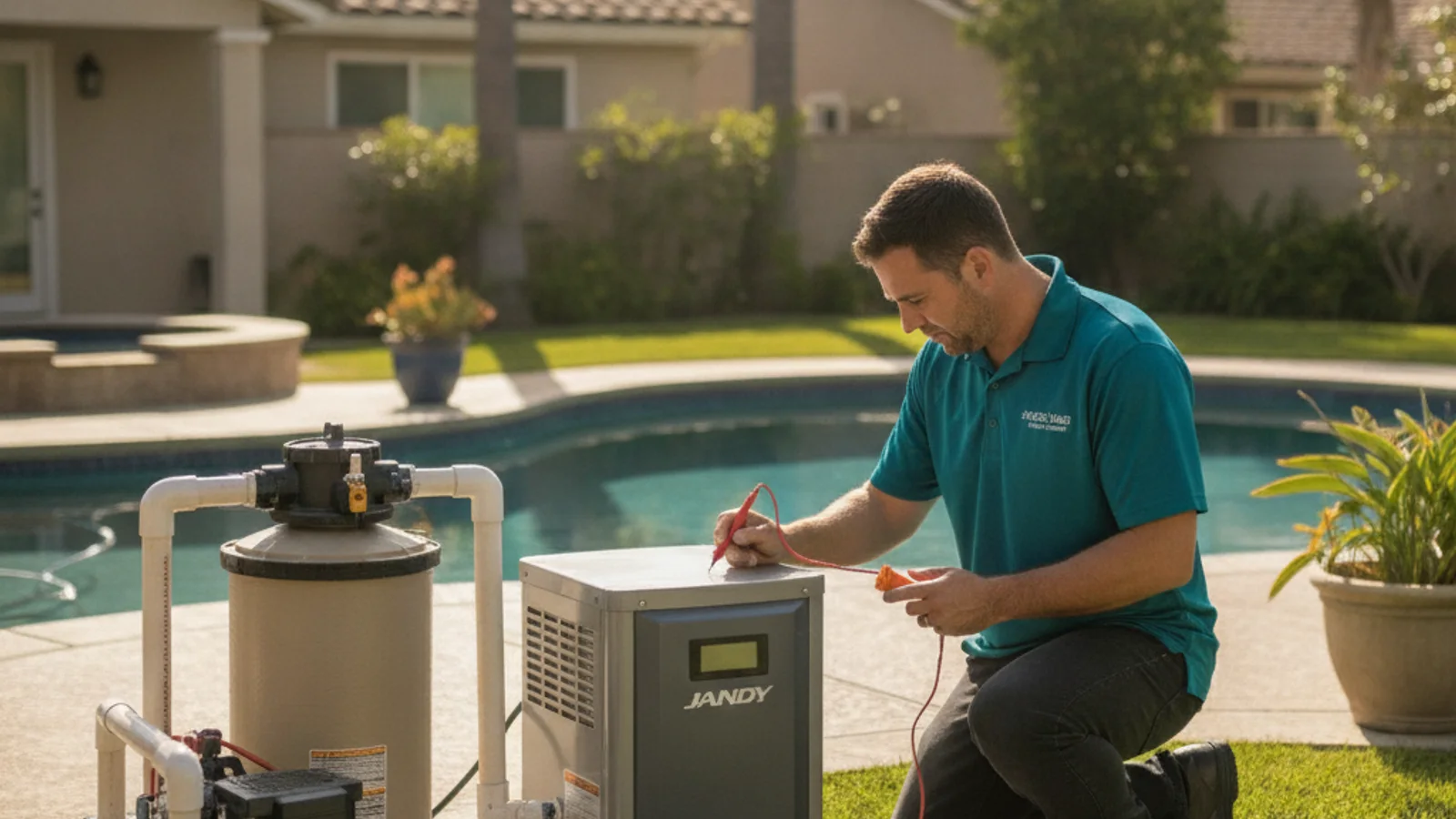
The Jandy JXi is a compact sealed-combustion gas heater rated at 84% thermal efficiency per Jandy’s product page. When it throws a fault code or stops heating, the fix depends on which component failed and where in San Diego County the unit sits. Inland hard water scales heat exchangers. Coastal salt air corrodes electrical connections and burner hardware. Hillside installs change how the pressure switch behaves. A licensed pool heater specialist who knows these local patterns can diagnose faster and get your water warm again sooner.
Splash Pool SD connects you with licensed independent pros who handle Jandy heater diagnostics and repair. We don’t perform the work ourselves.
Common diagnostic messages on the Jandy JXi
The JXi display shows specific text when something is wrong. Each message narrows the problem. Here is what the most common ones mean and what a technician checks first.
CHECK FLOW
This is the most frequent fault on Jandy heaters in San Diego. It means the pressure switch isn’t detecting enough water moving through the unit. The 200,000 BTU natural gas model requires a minimum of 30 gallons per minute and a maximum of 100 gallons per minute. The internal bypass and thermal regulator valve manage that window, but the pressure switch, factory set at 7 psi, is the gatekeeper.
The fix sequence from the Jandy manual (H0574300) starts simple: check breakers, wiring, filter condition, valve positions, and return eyeballs. If those are clear, the technician inspects the pressure switch itself and confirms the variable-speed pump speed. A VS pump set too low is a named cause of CHECK FLOW.
Heater height relative to pool level also changes switch behavior. If your JXi sits well above or below the waterline, the switch may need adjustment. This matters on hillside lots in La Jolla and Mount Helix. Grade-level installs in Clairemont are less affected.
FAULT-HIGH LIMIT
This means water temperature exceeded an internal limit or the limit switch itself failed. The JXi has two high-limit switches: one at 135°F at the first pass and one at 150°F at the outlet. A technician inspects the vent for blockage. On sheltered installs, birds, insects, and rodents can obstruct the flue.
Inland, repeated HIGH LIMIT faults often trace back to a scaled heat exchanger. Mineral deposits restrict flow inside the exchanger, trap heat, and trip the limit circuit. If you live in El Cajon, Santee, or Escondido and see this fault repeatedly, scale is the likely culprit. Read more about how hard water affects San Diego pools.
FAULT-CHECK IGN CONTROL
This covers a range of ignition problems: air-pressure tubing, the combustion blower, the hot-surface igniter, low gas supply, or no flame detected. The technician confirms whether the unit is wired for 120 VAC or 240 VAC and checks that the wiring matches.
On the coast, this fault often points to a corroded connection or a tired igniter. Salt air in La Jolla, Coronado, Imperial Beach, and Carlsbad eats at unions, burner hardware, and electrical contacts over time.
One important note from the manual: don’t keep cycling a unit that won’t light. Repeated attempts without ignition can mask the real problem and waste the igniter’s remaining life.
FAULT-HIGH FLUE TEMPERATURE
This indicates a flue temperature limit fault. The technician checks for loose connections and replaces the flue sensor if needed.
FAULT-SHORTED H2O SENSOR and FAULT-OPEN WATER SENSOR
Both point to faulty wiring or a failed water sensor. The technician inspects the sensor lead into the power interface board first.
FAULT-PUMP
This is a status message only, not a fault. It appears when the pump is off during Maintain Temp mode. No service is needed.
Ignition LED flash codes
The ignition control board has an LED that flashes in patterns. Each pattern tells you something different. Photograph the flash count before you power-cycle the unit. That record helps the technician diagnose without waiting for the fault to repeat.
- Steady on: ignition control fault. This requires a qualified service visit.
- Single flash: air flow fault. The blower, air-pressure switch, or a restricted intake or flue is the likely cause.
- Double flash: flame is present with no call for heat. This isn’t a DIY fix.
- Triple flash: ignition lockout after three failed light attempts. This is a soft lockout. Common causes are low gas pressure, a worn igniter, or a slow blower.
The ignition control tries three lights before locking out. If you see triple flash, the problem is upstream of the control board itself.
How San Diego’s geography affects Jandy heaters
Inland: hard water and scale
El Cajon, Santee, and Escondido sit on mineral-heavy water. Calcium and magnesium build up inside the heat exchanger over months and years. Scale narrows the flow path, traps heat where it shouldn’t be, and eventually trips the high-limit circuit. If your JXi throws repeated CHECK FLOW or HIGH LIMIT faults and you are inland, the exchanger is the first thing a pro inspects.
Coastal: salt air corrosion
La Jolla, Coronado, Imperial Beach, and Carlsbad all expose equipment pads to salt-laden air. Corrosion attacks unions, burner hardware, and electrical connections. FAULT-CHECK IGN CONTROL on the coast often traces to a corroded connection or a tired igniter.
If you run a salt chlorinator or an erosion feeder on the same pad, a corrosion-resistant check valve is required. Without it, sanitizer backflows into the heater and accelerates internal damage. Learn more about salt water pool systems.
Hillside lots: pressure switch behavior
When the heater sits well above or below pool water level, the pressure switch reads differently than it would at grade. Canyon pads in La Jolla and Mount Helix are the most common spots where this matters. A technician may need to adjust or replace the switch to match the actual static pressure at the unit.
Repair or replace
A single failed component on an otherwise sound unit is usually worth repairing. That includes sensors, igniters, pressure switches, fans, air-pressure tubing, and the ignition control board.
Replacement makes more sense when the heat exchanger is scaled through or corroded, the cabinet is rusted out, or the unit throws repeated faults across multiple subsystems. The specialist weighs parts cost, unit age, and exchanger condition before recommending a direction.
For broader context on heater repair decisions, see our guide to pool heater repair in San Diego. If your heater won’t turn on at all, start with this troubleshooting post.
What to have ready before the call
Having this information written down speeds up the diagnosis and helps the pro bring the right parts:
- Model and serial number from the rating plate. Confirm it says JXi.
- The exact diagnostic message on the display.
- The ignition LED flash count or whether it is steady on.
- Unit age.
- Whether the pool is salt-chlorinated.
- Whether you have a variable-speed pump and what speed it is set to.
- Your ZIP code. Inland versus coastal guides the diagnosis.
- A photograph of the display and the equipment pad.
The JXi is manufactured by Zodiac Pool Systems LLC, headquartered at 2882 Whiptail Loop #100 in Carlsbad. That address is listed in the manual but isn’t a walk-in repair counter. All service goes through a licensed field technician.
Cost considerations
HomeGuide publishes a general heater repair planning estimate of $150 to $750. Your actual cost depends on which component failed, parts availability, unit accessibility, and whether the repair involves gas-side or water-side work. The licensed pro you are matched with provides a quote before any work begins.
Under California Business and Professions Code §7159.5, a home improvement down payment is capped at $1,000 or 10% of the contract price, whichever is less. You can verify any contractor’s license through the CSLB license lookup.
Choosing the right pro
Jandy heaters involve gas, electricity, and pressurized water. The person you hire should hold a valid California contractor’s license and have specific experience with the JXi platform. Our post on choosing a pool repair pro in San Diego walks through what to look for. If you also need help with the pump on the same pad, see our guide to Jandy pool pump repair.
When to call us
Gas heater faults involve combustion, electrical wiring, and pressurized plumbing. These aren’t weekend DIY projects. A licensed specialist can read the diagnostic codes, test the pressure switch, inspect the exchanger, and confirm safe operation in one visit. Call us at (858) 400-4404 and we’ll connect you with a licensed local pool specialist.
Frequently asked questions
What does CHECK FLOW mean on a Jandy JXi heater?
CHECK FLOW means the heater is not detecting enough water moving through it. Common causes include a variable-speed pump set too low, a dirty filter, a closed valve, or a faulty pressure switch. The factory pressure switch is set at 7 psi, and anything below that threshold triggers the message.
How much does Jandy pool heater repair cost in San Diego?
HomeGuide publishes a general heater repair planning estimate of $150 to $750. Your actual cost depends on which component failed, whether parts are in stock, and how accessible the unit is. The licensed pro you are matched with will quote before any work starts.
What do the ignition LED flash codes mean on a Jandy JXi?
A steady-on LED means an ignition control fault. One flash points to an air flow problem like a blocked intake or failing blower. Two flashes mean flame is present without a call for heat. Three flashes indicate ignition lockout after three failed light attempts, often caused by low gas supply, a worn igniter, or a slow blower.
Does hard water damage Jandy heaters in San Diego?
Yes. Inland areas like El Cajon, Santee, and Escondido have mineral-heavy water that builds scale inside the heat exchanger. Scale restricts flow, traps heat, and trips the high-limit circuit. Repeated CHECK FLOW or HIGH LIMIT faults inland often point to a scaled exchanger.
When should I replace my Jandy JXi instead of repairing it?
Replace when the heat exchanger is scaled through or corroded, the cabinet is rusted out, or the unit has repeated faults across multiple subsystems. A single failed component like a sensor, igniter, or pressure switch on an otherwise sound unit is usually worth repairing.
Need professional help in San Diego County?
Splash Pool SD connects you with a licensed specialist for any service in this post.