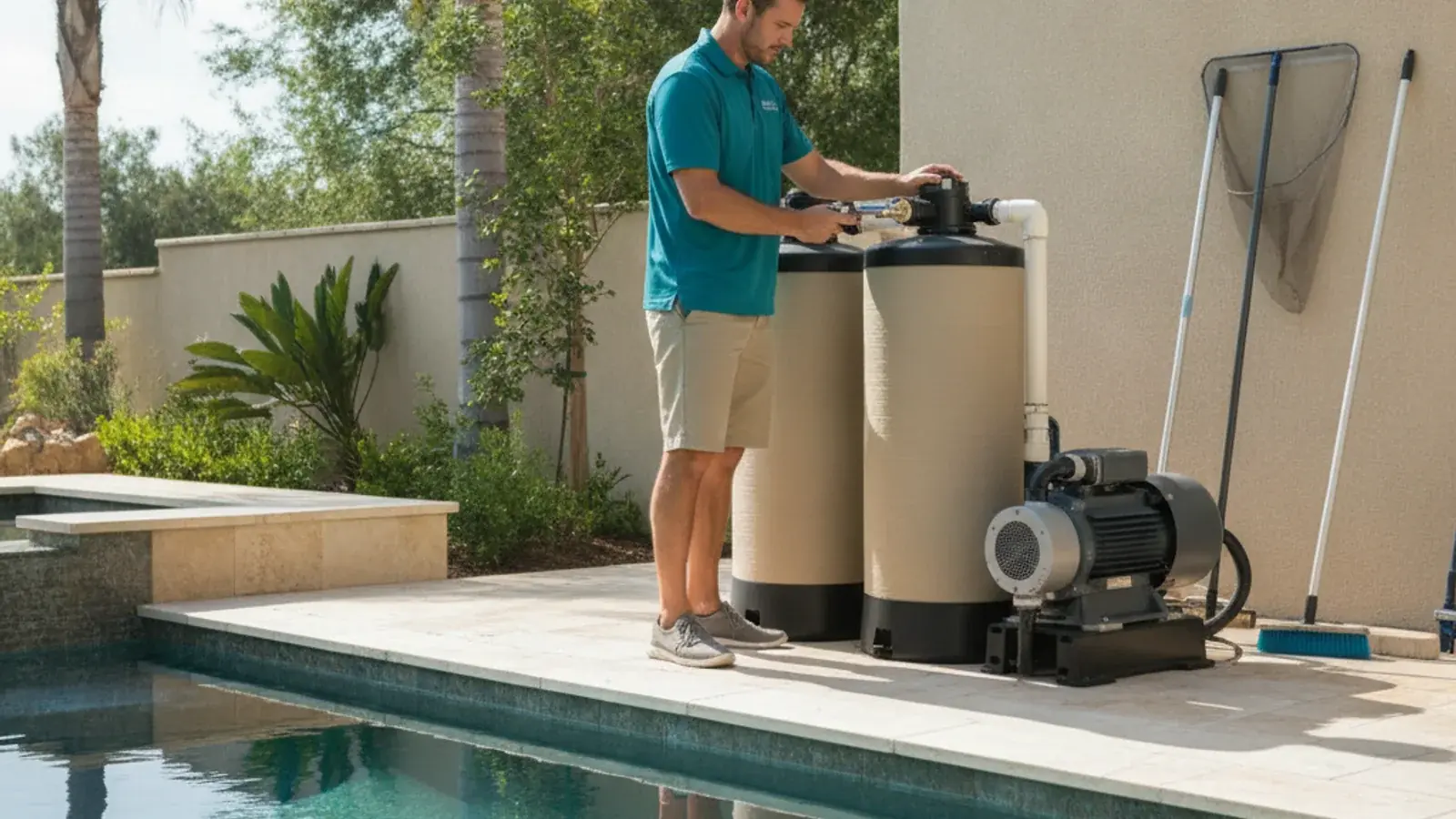
Pentair, Hayward, and Jandy are the three pool equipment brands that consistently meet San Diego’s practical requirements in 2026. No single one dominates every category. What separates them from budget alternatives isn’t sticker price. It is parts availability, warranty service through local pros, and Title 20 compliance. Here is how they compare across the major equipment types, and what to watch for when you are choosing replacements for your pad.
What makes a brand worth buying in San Diego
Three traits define a brand that holds up here over a decade of backyard use.
First, Title 20 compliance. California efficiency standards govern replacement pump specs. Any brand you install must meet them. Pentair, Hayward, and Jandy all do.
Second, strong parts availability through local supply houses. Budget brands undercut on sticker price, but their parts can take weeks to arrive. When a seal or impeller fails in July, that delay matters.
Third, a warranty processable by a licensed pool repair pro. Budget brands often route claims through overseas support. The three major brands have local channels that a pro can work with directly.
Local service depth pays off over the life of the equipment. A slightly higher upfront cost usually returns itself in faster repairs and fewer headaches.
Pumps: variable-speed is the standard now
A true variable-speed motor is essential for any new pump install. It must meet Title 20 efficiency standards, and it needs a local dealer network for parts.
The most common variable-speed families installed across San Diego County are:
- Pentair IntelliFlo
- Hayward TriStar
- Hayward MaxFlo VS
- Jandy VS FloPro
The Jandy VS FloPro is a close third option that pairs especially well with pools already running Jandy automation.
HomeGuide’s general US planning range puts a variable-speed pump at about $800 to $2,000 installed, or about $700 to $1,600 for the unit alone. That is a national planning figure, not a brand-specific or San Diego rate. Your actual quote comes from the licensed independent pro you are matched with.
Before ordering, ask two things. Does the pump fit your existing plumbing? Does it work with your existing controls or automation? A pro can confirm both on site.
For a deeper look at variable-speed options and local rebate programs, see our guide to variable-speed pool pumps in San Diego.
Filters: cartridge wins in hard water
San Diego’s water is moderately hard. That mineral content affects which filter type holds up best over time.
Pentair and Hayward cartridge filters both perform well here. Cartridges avoid the sand bed or DE powder that scale faster in mineral-rich water. Most specialists now default to cartridge for new installs.
Sand filters still have a lower upfront cost. DE filters produce the clearest water of the three types. But DE requires more hands-on maintenance, and installers with DE experience are increasingly hard to find. Fewer new pools spec DE filters anymore. Sand or DE is reserved for situations where existing plumbing favors them.
HomeGuide’s general US planning range for filter replacement is about $250 to $1,700. Again, this is a general planning figure, not a local or company rate.
Heaters: heat pump or gas
The choice between a heat pump and a gas heater depends on two things: how often you heat, and how fast you need warm water.
Gas heaters deliver fast, on-demand heat. They still make sense for pools that need occasional heating, like a spa you fire up on weekends.
Heat pumps deliver a slower, steady warm-up. They suit pools where you swim frequently and want a consistent temperature without the fuel cost of gas.
The most-installed heat pumps locally are the Pentair UltraTemp and the Hayward HeatPro. Both integrate with either manufacturer’s automation platform.
HomeGuide’s general US planning range puts an installed heat pump at about $2,000 to $6,000 and a natural gas or propane heater at about $1,500 to $4,500. These are general US ranges, not San Diego or brand-specific quotes.
For a full breakdown of which option fits your swimming habits, read our comparison of gas heaters vs heat pumps in San Diego.
Salt chlorine generators
Salt systems generate chlorine from added salt. They reduce the need to handle and store chlorine directly.
When shopping for a generator, record the model from the unit or its documentation. Compare what each quote includes: the generator itself, the salt, and labor. Check whether a pump or filter replacement is bundled in. Ask whether the generator is sized correctly for your pool’s volume.
Pentair generators allow you to order a new cell assembly when the existing one wears out, rather than replacing the entire unit.
Request written warranty and care instructions before you commit. If you are converting from traditional chlorine, read our guide on chlorine vs salt water pools in San Diego first. Cell size choice depends on the specifics of your conversion.
Automation and smart controls
Your automation system should natively control every component on the pad. Brand mismatches cause most automation frustration.
Pentair IntelliCenter controls Pentair pumps, heaters, salt cells, and lighting from a single app. Hayward OmniLogic does the same for Hayward hardware. Neither talks natively to the other brand’s equipment.
Both systems tie into Apple HomeKit and Google Home with minor setup. If your pad is a single brand, either system works well.
If your pad is mixed, a universal controller bridges cross-brand communication. It avoids running two separate apps and gives you one scheduling interface.
For a detailed head-to-head, see our post on Hayward vs Jandy pool automation.
Matching vs mixing brands on the pad
Matching brands isn’t mechanically required. Standard PVC plumbing connects any major brand to any other. A cracked Hayward filter sits fine next to a Pentair pump.
Where matching matters is automation and warranty tracking. One brand’s app won’t natively run another brand’s salt cell or heater. If you want single-app control, a matched pad is the simplest path.
If your existing pad is already mixed, a specialist can assess the combination and recommend either a brand-matched replacement or a universal controller that bridges the gap.
For a brand-by-brand breakdown of equipment lines, see our comparison of Pentair vs Hayward pool equipment.
Repair vs replacement signals
A dead pump or a heater that won’t fire is the first sign to weigh your options. The decision hinges on the age and condition of the rest of the pad.
A repair visit diagnoses whether the failure is isolated or systemic. If the whole pad is near the end of its service life, replacing multiple components at once often makes more financial sense than patching one piece at a time.
If you have no circulation and your water is turning green fast, that is an emergency situation. Don’t wait for a scheduled appointment.
For more on what drives replacement costs, read our post on what drives pool equipment replacement cost.
When to call us
Choosing between brands, sizing a generator, or deciding whether to repair or replace your pad all benefit from a licensed pro who can see your setup in person. The right answer depends on your plumbing, your automation, and how you actually use the pool. Call us at (858) 400-4404 and we’ll connect you with a licensed local pool specialist.
Frequently asked questions
Which pool equipment brand is best for San Diego in 2026?
No single brand beats all others in every category. Pentair, Hayward, and Jandy all meet the three traits that matter locally: Title 20 compliance, strong parts availability through local supply houses, and warranty service handled by licensed pool repair pros. Record your existing pad models, describe any visible issues, and consult a licensed independent pro for a scoped quote.
Is a heat pump worth it over a gas heater in San Diego?
Both can fit. It depends on how often you heat and how fast you need warm water. Gas delivers fast on-demand heat for occasional use. A heat pump delivers a slower, steady warm-up that suits frequent swimming. HomeGuide's general US planning ranges put an installed heat pump at about $2,000 to $6,000 and a gas or propane heater at about $1,500 to $4,500. These are general planning figures, not local or brand-specific quotes. A licensed independent pro provides the actual number.
How much does new pool equipment cost in 2026?
HomeGuide's general US planning range for a variable-speed pump is about $800 to $2,000 installed, or about $700 to $1,600 for the unit alone. Filter replacement runs about $250 to $1,700 per HomeGuide. A heat pump runs about $2,000 to $6,000 installed, and a gas or propane heater about $1,500 to $4,500, again per HomeGuide's general US ranges. These are separate component estimates, not a full pad total. Request an itemized quote from a licensed pro.
Do I need to match brands on my equipment pad?
Not mechanically. Standard PVC plumbing connects any major brand to any other. Matching matters most for automation compatibility. One brand's controller will not natively run another brand's salt cell or heater. If your pad is mixed, a universal controller usually bridges the gap. A specialist can assess your existing setup and recommend either a brand-matched replacement or a universal controller.
Does a variable-speed pump save money over a single-speed?
Yes. A variable-speed pump moves the same water at a lower speed, and power draw falls much faster than flow rate. It beats single-speed motors common on pre-2010 pads. Efficiency rules govern replacement pump specs. Ask a specialist which requirement applies before ordering.
Need professional help in San Diego County?
Splash Pool SD connects you with a licensed specialist for any service in this post.