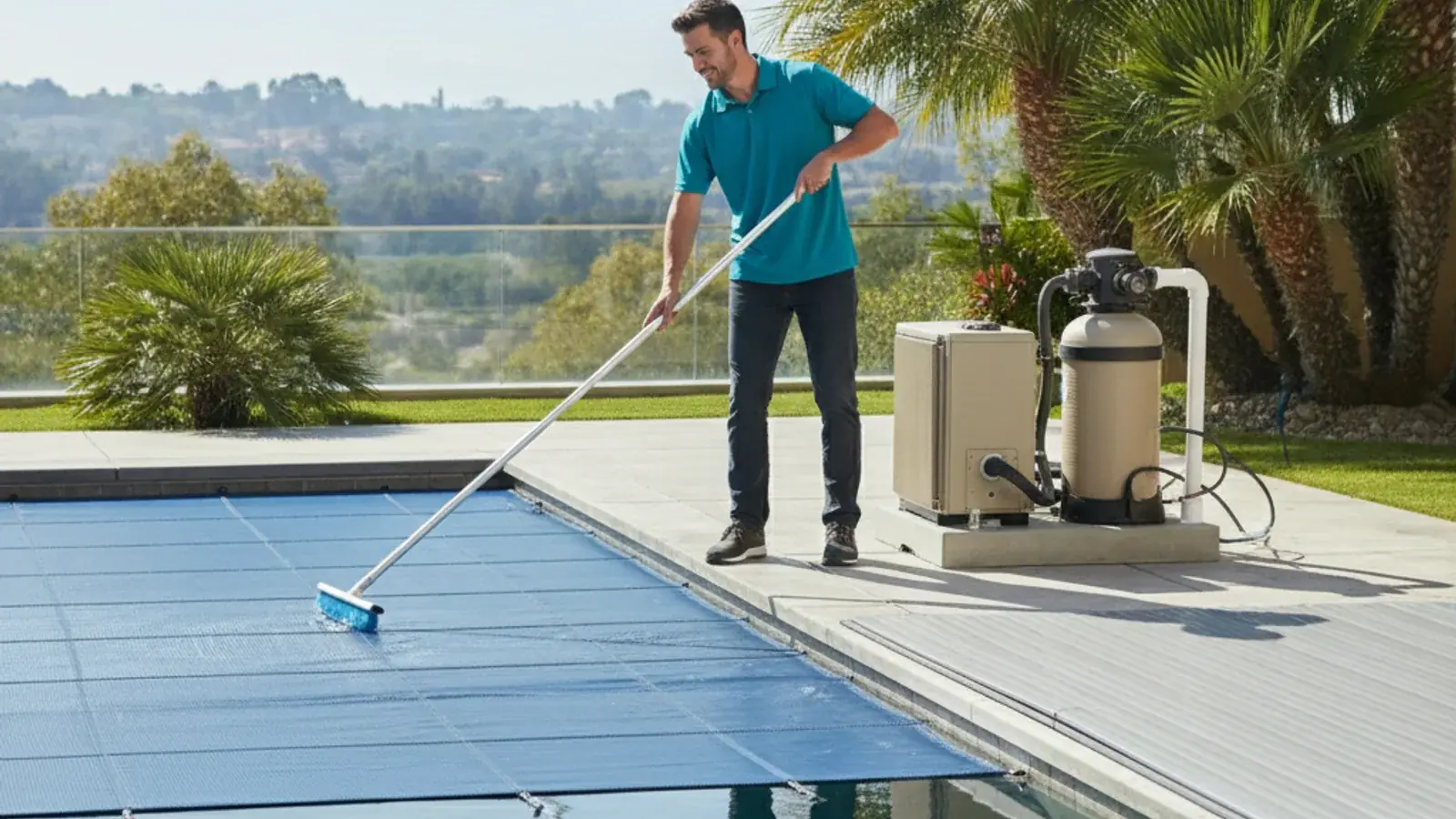
San Diego pool owners pick from three cover types: solar, safety, and automatic. Each solves a different problem, and most pools only need one. The right choice depends on whether you want to hold heat, meet a safety requirement, or get daily convenience without manual effort.
Solar covers trap heat and cut evaporation
A solar cover is a floating bubble sheet made of UV-stabilized material. It sits directly on the water surface, unattached to the deck. During the day it traps solar heat. At night it slows evaporation.
The numbers are straightforward. A solar cover adds 5 to 10°F to water temperature and cuts evaporation by up to 95 percent. That extends the swim season by weeks on both ends. For San Diego’s coastal areas where marine layer keeps mornings cool, that extra warmth makes a real difference.
Solar covers aren’t safety devices. They can’t bear weight. A child or pet that falls onto one will go through it. If safety is your concern, this isn’t the cover for that job.
Maintenance is light. Rinse the cover occasionally. Remove it from direct sun during heavy use to slow UV degradation. Expect to replace it every three to five years. An optional reel makes rolling and unrolling easier, especially on larger pools.
Safety covers anchor to your deck
A safety cover is pulled taut across the water surface and anchored to the deck through straps or a track system. Both mesh and solid vinyl options carry an ASTM F1346 rating, which means they are tested to support the weight of a child or pet.
Mesh covers allow some water to pass through, so they offer modest evaporation reduction but no heat gain. They are lighter and easier to handle. Hose debris off the surface and inspect the springs and straps each season.
Solid vinyl covers block sunlight entirely, which inhibits algae growth underneath. They also reduce evaporation more than mesh. The tradeoff is that rainwater pools on top, so a cover pump is needed to drain it. Standing water stresses the anchors over time. Check the pump’s function each fall before the rainy season starts.
Professional retensioning is recommended annually for both types. Straps stretch and anchors shift with San Diego’s soil movement, especially in areas with expansive clay.
Automatic covers add convenience at a higher tier
An automatic cover is a motorized safety cover that runs on an edge-mounted track. You operate it with a button or a phone app. It carries the same ASTM F1346 rating as a manual safety cover and provides significant evaporation reduction.
The convenience is real. You can cover and uncover the pool in seconds without physical effort. That makes daily use practical in a way that manual covers often aren’t.
Keep the track clear of leaves and debris. Don’t place furniture or toys on the cover surface. An annual motor and cable inspection is advised to catch wear before it becomes a failure.
Automatic covers sit in the highest cost tier. The motor, track hardware, and custom fabrication all add to the price.
What California law requires
California’s drowning-prevention law applies to newly permitted or remodeled residential pools. It requires a minimum of two features from a list of seven approved options. An ASTM F1346-rated safety cover counts as one of those features.
A solar blanket doesn’t qualify. It floats unanchored and can’t bear weight, so it fails the safety standard entirely.
Other approved options include an isolation fence, exit alarms, and pool alarms. The most common pairing in San Diego is a safety cover plus a fence. That combination satisfies the two-feature minimum and gives layered protection.
If you are pulling a permit or preparing a home for sale, check with your local building department for the current list of approved features and any updates to the code.
Evaporation and water savings in San Diego
San Diego pools lose roughly a quarter inch of water per day during summer. Loss increases on hot, dry, windy days, which describes most of our inland valleys and East County afternoons. Nearly all of that loss happens at the exposed water surface.
A solar or automatic cover cuts that loss by 90 percent or more. Over a summer, that adds up to thousands of gallons kept in the pool instead of evaporating into the air.
If your covered pool is still losing water quickly, evaporation is no longer the explanation. A leak is the likely cause. A bucket test can help you tell the difference before you call for leak detection.
Chemical savings add up too
UV sunlight depletes free chlorine in uncovered pools. When the surface is covered, chlorine lasts longer and the pool needs fewer rebalancing sessions for pH and alkalinity. That means lower annual chemical cost with consistent cover use.
This matters more in San Diego than in cooler climates because our UV index stays high year-round. Even in winter, direct sun breaks down chlorine faster than in overcast regions. A cover works passively to reduce that demand every day it is on the pool.
What moves the price
Cover cost varies by pool shape and hardware needs. Freeform pools cost more than rectangles because the cover must be custom-cut to fit irregular edges. Raised spas increase the price. Multiple steps or a Baja shelf add complexity and material.
Deck anchor type and track hardware also affect the final number. Concrete decks, paver decks, and natural stone each require different anchor solutions.
No two pools are identical, so a matched pro will measure yours and provide a quote before any work starts. That quote should reflect your specific shape, deck material, and the cover type you choose.
Choosing the right cover for your situation
Here is a simple way to think about it.
If your goal is lower water and heating bills only, a solar cover with a reel does the job at the lowest entry point.
If you are pulling a new permit or preparing for a home sale, a mesh or solid safety cover satisfies one of the two required drowning-prevention features.
If you have young children or frequent guests, pair a safety cover with an isolation fence. That gives you two approved features and layered protection.
If you want daily convenience and prefer the cover out of sight when not in use, an automatic cover is the right call. It costs more upfront but removes the friction that keeps manual covers rolled up and unused.
For more on how covers interact with your broader equipment setup, see our guide on pool equipment installation. If your cover already has damage, our post on pool cover repair in San Diego walks through what is fixable and what needs replacement.
When to call us
Cover installation, anchor setting, and track mounting require precise measurement and proper fastening to your deck. A licensed pool professional handles the fabrication, fitting, and hardware so the cover performs as rated. Call us at (858) 400-4404 and we’ll connect you with a licensed local pool specialist.
Frequently asked questions
Does a solar cover count as a safety cover under California law?
No. A solar blanket floats on the water unanchored and cannot bear weight. California's drowning-prevention law requires features rated ASTM F1346, and solar covers do not carry that rating. Only anchored safety covers, whether mesh or solid vinyl, qualify.
What moves the price of a pool cover in San Diego?
Pool shape is the biggest factor. Freeform pools cost more than rectangles because the cover must be custom-cut. Raised spas, multiple steps, and Baja shelves add complexity. Deck anchor type and track hardware also affect the final quote. A matched pro will measure your pool and quote before any work starts.
How much water does a pool cover actually save?
San Diego pools lose roughly a quarter inch of water per day in summer, mostly through evaporation at the surface. A solar or automatic cover cuts that loss by 90 percent or more. If a covered pool is still losing water quickly, a leak is the likely cause.
Do I still need a fence if I have a safety cover?
California law requires at least two of seven approved drowning-prevention features for newly permitted or remodeled pools. A safety cover counts as one. Pairing it with an isolation fence is the most common way to meet the two-feature minimum. Check with your local building department for current requirements.
How long does a solar cover last?
UV-stabilized solar covers typically last three to five years before the material degrades. Rinsing the cover occasionally and removing it from direct sun during heavy use helps it last longer. A reel makes daily handling easier and reduces wear.
Need professional help in San Diego County?
Splash Pool SD connects you with a licensed specialist for any service in this post.