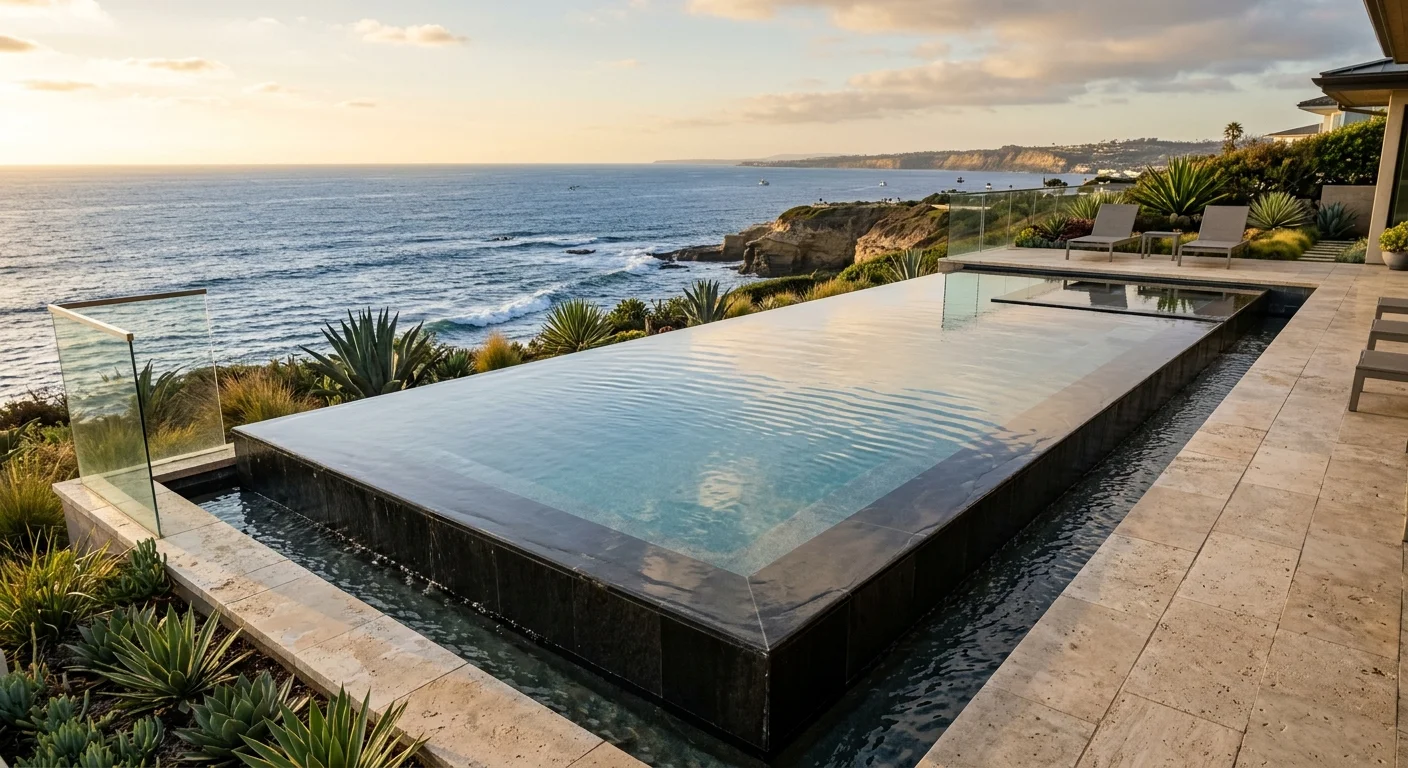
A vanishing-edge sheet on a La Jolla bluff or a Del Mar terrace looks still from the house. At the weir, marine wind and a thin tile lip take the weather all afternoon. When the waterline drops overnight, you need to know if the catch trough is leaking or the breeze is tearing the sheet apart.
A pool zero edge in San Diego County usually means one of two overflow designs. On a view lot, it is almost always a vanishing edge, also called an infinity edge or a negative edge pool. Water spills over a lowered weir into a catch trough, then a pump sends it back. On a flat Coronado courtyard, the same search term often means a deck-level pool, where the water sits flush with the stone and drains into a slot. Neither is a zero-entry pool. A zero-entry is a beach-style ramp. The repair work is different, and mixing the names sends the wrong specialist to the pad.
Why vanishing edges lose water on coastal lots
Coastal lots from La Jolla through Del Mar and down to Coronado sit in wind. The weir is a thin wall of moving water. An onshore breeze across that wall pulls droplets off the sheet before they reach the trough. Santa Ana days do the opposite: dry, hot air raises evaporation on the pool and the catch basin. Either way, the auto-fill runs more than it would on a still inland yard in El Cajon.
Salt air sits on the weir tile and on any stainless hardware at the edge. White crust on the lip is not only hard water. It is marine spray plus splash, drying in the sun. That crust changes how the sheet falls. A weir that used to run as a clean glass pane starts to break into fingers. Those fingers throw water onto the slope below the trough, onto the hillside, or onto the deck. That water never returns to the basin.
View lots in Rancho Santa Fe and the canyons above Del Mar add another load. The trough is often built into a downhill wall. If the basin plaster or waterproofing is tired, water can leave through the downhill face instead of through the return line. From the house you still see a horizon. Under the weir, the soil can be wet.
A vanishing edge also has more surface in play than a standard skimmer pool. You have the main pool, the weir face, and the trough. Each one evaporates. Each one can stain. Each one can leak. That is why coastal vanishing edge pool repair starts with the lot and the wind, not with a guess about a hidden pipe.
The San Diego County Water Authority tracks regional supply and conservation. It does not publish a figure for how much a given weir loses to wind. Confirm makeup-water use with the licensed specialist on site, and with your water bill, before anyone opens the basin.
Trough, weir, and tile failures a pool pro sees
The matched licensed pool pro looks at three parts that a regular pool does not have.
The weir is the lowered wall. Tile on that wall has to stay true. A popped piece, a hollow-sounding tile, or a hairline at the knife of the edge will break the sheet. Salt and thermal swing along the coast open those joints faster than they open on an inland freeboard pool. A chip you can see from the patio may be cosmetic. A chip that lets water behind the tile is a path into the shell.
The trough, or catch basin, sits below the weir. Debris collects there because every leaf that hits the sheet ends up in that low tank. If the trough suction is clogged, the basin can overflow on a windy afternoon and starve on a still night. Stained trough tile, a wet downhill wall, or a basin that will not hold a level overnight are the usual tells.
The third part is the plumbing between the trough and the main pool: the surge or balance tank, the overflow pump, and the returns. A noisy, cavitating pump on the edge circuit is often air from a low trough, not a dying motor. Confirm that with the pro. Do not assume the pump is the repair.
Pros also watch the difference between a perimeter-overflow slot and a vanishing-edge trough. Deck-level infinity edge pool repair on a flat lot is usually about the slot drain, the balance tank, and a deck that has moved. A negative-edge repair on a hillside is usually about the weir, the catch basin, and the downhill waterproofing. Same search phrase. Different holes in the ground.
Stainless fittings, light niches, and rails near the edge pit in salt air. Splash Pool SD does not publish a coating or a lifespan figure for those parts. Ask the specialist what they see on your hardware, then decide from the inspection.
Leak testing versus wind-driven evaporation
A falling waterline on a zero-edge pool is not proof of a leak. Wind across the weir can throw more water in one afternoon than a pinhole loses in a week. Marine-layer mornings look calm. Afternoon west wind on a La Jolla ridge does not.
A licensed specialist will separate those two before anyone talks about opening a wall. Bucket tests on the main pool still help, but they miss the trough. The trough has to be tested as its own vessel. Dye at the weir tile, at trough corners, and at penetrations tells you if water is leaving the structure. Pressure or listening tests on the edge circuit tell you if the buried line between basin and equipment is the path.
If the downhill soil is damp, or you hear water in a canyon after the pumps shut off, treat that as a leak until a test says otherwise. If the sheet is broken into fingers, the auto-fill is running, and the hillside is dry, start with wind, weir level, and evaporation. Our guide on pool leak or evaporation in San Diego walks through that fork in plain terms.
When testing points to a real loss, pool leak detection is the next step, not a trough patch on hope. A cosmetic edge chip and a trough leak can look similar from the house. They are not the same job. Dye and a dry hillside settle the argument.
Confirm any permit need with the city building counter before structural work on the basin. We could not verify a county-wide fee or a single rule for trough repairs. The city that issued the original pool permit is the one that sets the current counter process.
Finish and coping repairs that hold on a view lot
The edge is a finish problem as much as a water problem. Tile that has lost bond, plaster that has worn at the weir, and coping that has opened at the joint will all break the sheet. On a view lot, people notice the sheet first. The pro still has to fix the surface that makes the sheet.
Coping at a vanishing edge is often a thin stone or a custom pour, not a standard bullnose. Movement in that cap shows up as a gap, a hollow sound, or a stain line. Our notes on pool coping repair in San Diego cover why coastal stone and grout fail. The same salt and sun hit the weir tile.
If the interior finish is worn, stained, or delaminating, a local patch at the weir may not last. Water sheets over that band all day. Pool resurfacing is the conversation when the wear is around the pool, not only at one chip. The matched pro decides whether a weir rebuild, a tile reset, or a full interior is the honest repair. We do not publish a price list for those choices. Ask for a written scope after they see the edge, the trough, and the interior in the same visit.
Materials marketed as lasting a set number of years are not a verified figure here. Skip the catalog lifespan. Ask what the specialist will actually set on your weir, and how they will detail the joint at the trough.
A Lautner or knife-edge profile is less forgiving than a standard vanishing weir. The slot is tight. A small lip error shows as a wet deck or a noisy fall. Do not grind that profile as a weekend project. The licensed pro sets the edge to the waterline they can hold, then the pumps keep it there.
When the trough needs more than a surface patch
A stained tile in the basin can be a clean-and-regrout job. A trough that will not hold water is not. Once dye leaves through a crack, a cold joint, or a failed coating, the basin is a structure, not a finish.
Downhill catch basins on La Jolla, Del Mar, and Rancho Santa Fe lots take soil load on one face and water on the other. Hairline map cracks in the plaster can sit on top of a wider crack in the shell. Patching the plaster and leaving the shell is how the same wet slope comes back after the next wind event.
The pro may need to drain the trough, open the waterproofing, and rebuild the interior of the basin. They may need to re-level a weir that was poured out of true, because a weir that is off will always throw water. They may need to replace the suction in the trough if it sits too high to pick up a low waterline. None of those are chemistry tricks you run from the patio.
If the main pool finish is failing at the same time, bundling the trough rebuild with resurfacing is often cleaner than two mobilizations. That is a sequencing call for the specialist and, if a permit applies, for the building counter. Check the contractor on the CSLB license lookup before anyone starts.
Work priced under $1,000 is exempt from California contractor licensing only when it is also casual, minor, and does not need a permit, a threshold in effect January 1, 2026. Splitting a job to stay under that number does not create an exemption. Unlicensed contracting is a misdemeanor. On a home improvement contract, the down payment cannot exceed $1,000 or 10 percent of the contract amount, whichever is less. Confirm the contract math with the pro. We match you with licensed independent specialists. We do not pull the permit, and we do not open the trough.
When to call us
Call when the sheet breaks, the auto-fill will not keep up, the hillside below the weir is wet, or the trough tile is hollow or cracked. A licensed pool specialist can test the basin, reset the weir, and repair the finish without treating wind as a leak. Call us at (858) 400-4404 and we’ll connect you with a licensed local pool specialist.
Frequently asked questions
What does a zero-edge pool mean?
In San Diego searches, a zero-edge pool is an overflow pool. On a view lot it usually means a vanishing, infinity, or negative edge, with water sheeting over a weir into a catch trough. On a flat lot it can mean a deck-level pool whose water sits flush with the stone and drains into a perimeter slot. It is not a zero-entry beach ramp.
Is a zero-edge pool the same as an infinity or negative-edge pool?
Builders use the names in overlapping ways. Infinity edge, vanishing edge, and negative edge describe a lowered weir that spills into a hidden trough, common on La Jolla, Del Mar, Rancho Santa Fe, and Coronado view lots. A true deck-level zero-edge, or perimeter overflow, spills on all sides into a slot. A licensed pool pro will name which system you have before they repair it.
How much does zero-edge pool repair cost in San Diego?
Splash Pool SD does not publish a price list, and no verified local repair schedule is in our claims ledger. Cost follows the weir, trough, tile, plumbing, and whether the catch basin is leaking. The matched licensed specialist quotes after they see the edge. Confirm any permit with the city building counter before you pay a deposit.
Why is my vanishing-edge pool losing water?
Wind across the weir throws water off the sheet. Salt crust and an out-of-level lip make that worse. The trough can also leak through tile, cracks, or downhill waterproofing. A licensed pro tests the basin as its own vessel instead of treating every drop as evaporation or every breeze as a leak.
Is a zero-entry pool the same as a zero-edge pool?
No. A zero-entry pool is a sloped, beach-style walk-in. A zero-edge pool is an overflow edge. Drawbacks people list for zero-entry, such as a long shallow ramp, do not describe a vanishing weir or a catch trough. Ask for the overflow system by name when you book the visit.
Need professional help in San Diego County?
Splash Pool SD connects you with a licensed specialist for any service in this post.