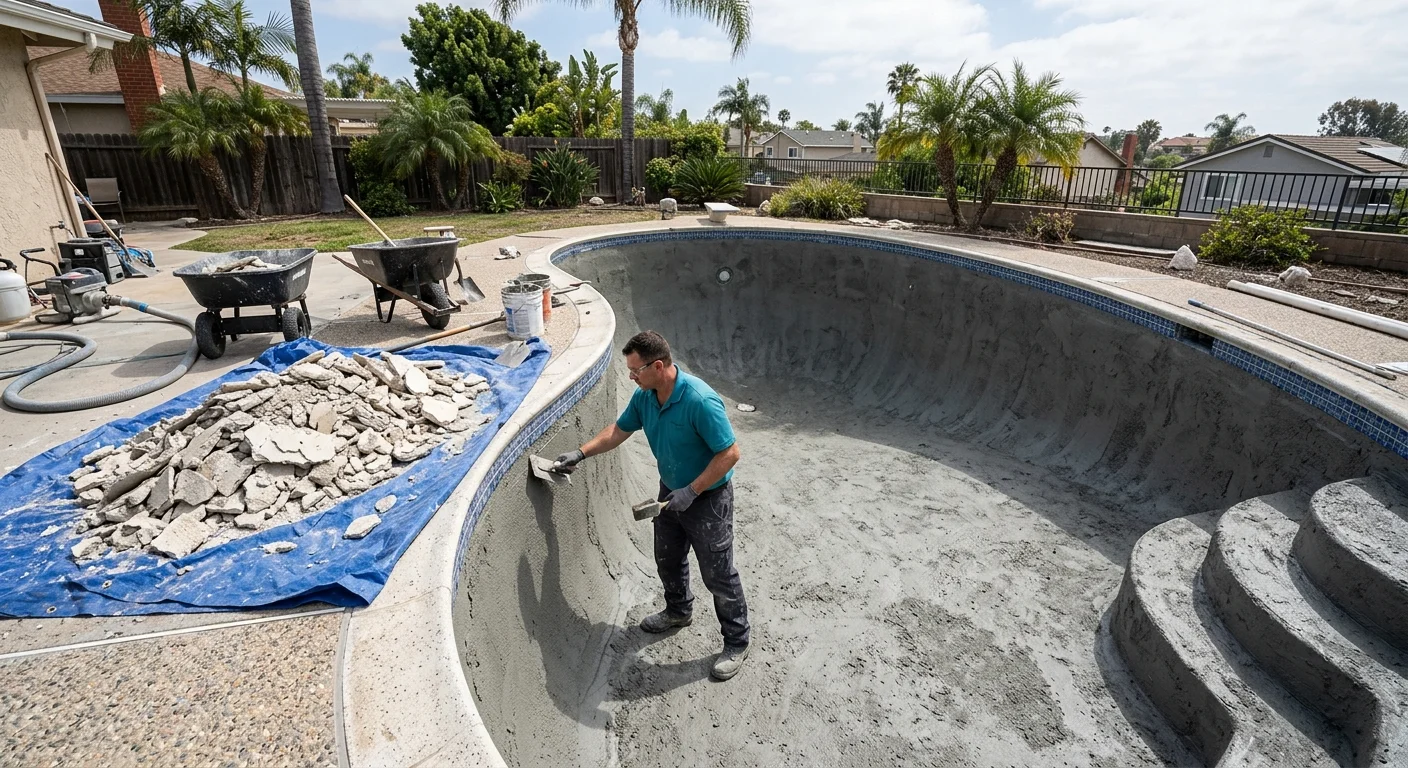
The bag says Pool-Krete. The plasterer says bond coat. On a drained gunite shell in La Mesa, those two phrases get mashed into one line item. They describe different layers. Pool krete, as people search it, is a vermiculite-and-cement premix for a vinyl liner base. The layer under new plaster in San Diego County is a bond coat after chip-out. Get that stack wrong and the finish can sound hollow by the next East County summer.
What pool krete is and where it sits in a resurface
Pool-Krete (you will also see Pool Crete) is a factory blend of expanded vermiculite, portland cement, and additives. The crew adds water on site and trowels it. On a vinyl liner pool, that mix is the hard bottom under the liner. It is a base, so the liner sits on a smooth bed instead of packed sand. It is not the swimming finish on a gunite pool.
That is the product the bag pages describe. It is also why “pool krete” and “krete pool plaster” land in the same search. Homeowners hear “krete” on a plaster walk-through and go looking for the bag.
Walk a block in Clairemont, El Cajon, or Chula Vista and the drained pools on those lots are gunite shells. The surface you swim against is plaster, quartz, or pebble. When those shells go through pool resurfacing, the sequence is chip-out, then a bond coat, then the new finish. A liner premix does not sit in the middle of that sandwich on a gunite job.
Vinyl liner pools do exist in the county, including kit installs. If your pool is vinyl, Pool-Krete is a liner-base conversation with the matched licensed pro. If your pool is gunite, keep the quote on chip-out, bond coat, and the finish you actually want: white plaster, quartz, or pebble. Pebble, plaster, and quartz are the look. The bond coat is the grab.
Some crews use “krete” as slang for any cementitious coat. That shorthand is how a homeowner in Encinitas thinks they bought pebble and the ticket was a base mix. Ask for the product name in writing.
A worn interior and a bond-coat miss are different shells. Thin, rough plaster that stains and brushes away is age. Large sheets that sound hollow, or lift in panels, point at the layer under the finish. If you are still deciding whether the shell is ready, start with the signs your pool needs resurfacing.
Vermiculite is one ingredient. Pool-Krete is vermiculite already blended with portland cement and additives. Loose vermiculite still has to be batched with cement on a driveway in Escondido. Treat them as different products on the quote.
Chip-out, bond coat, and why skips show later
The old finish has to come off far enough for the new coat to key into sound material. That is the chip-out. Crews chip, chip-hammer, or water-blast until they are on gunite that does not sound dead. East County rectangles from the 1960s and 1970s often carry more than one old plaster generation. Those shells take more chip time than a single thin coat in a newer Chula Vista yard.
Leaving a skin of unsound plaster and rolling a bond coat over it is how a pretty week-one finish lets go. Dust and plaster fines on the gunite face do the same thing. A dry, dusty shell in Santee will not take a coat the way a properly cleaned and wetted face will. The matched licensed plasterer sets that prep on site.
The bond coat is the scratch layer. It is cementitious. It is meant to grab the gunite and give the new plaster something to hold. It is not the color you see when you swim. If a quote jumps from “drain” to “new pebble” with no chip-out and no bond coat named, you are buying a finish with no substrate story.
Skips show later in the places San Diego sun and traffic hit first: the waterline, the steps, the bench, and the deep-end floor. Inland, a thin finish cooks. If the bond coat was missed, rushed, or laid over dust, you get hollow spots and islands of finish that pop. A worn finish looks uniformly thin and sandy. A bond-coat failure looks like patches still stuck and patches that let go.
Splash Pool SD matches you with a licensed independent plasterer. That pro chips the shell, trowels the bond coat, and places the new plaster. This brand does not chip, trowel, or own a yard of bags.
No verified thickness, bag count, or cure-day figure sits in our claims file, so this page will not invent one. Ask what they chip to, how they clean the shell, and which bond product they trowel. Then get that language on the contract.
Inland heat versus coastal cure on San Diego jobs
El Cajon, La Mesa, Lakeside, and Ramona cook a drained shell. Dark gunite in July can flash-dry a coat on the face while the mass is still wet. That is an inland placement problem. The same crew, same product, and a treeless pad in Otay Ranch is a different morning than a shaded side yard in La Mesa.
Carlsbad, La Jolla, Del Mar, and Encinitas sit under marine layer many mornings. The same bond coat and plaster stay damp longer. Wind off the water still strips moisture. Shade from a two-story in Pacific Beach is a different job than an open pad in Escondido. Coastal salt air can stain an old finish. Stain on the face is a surface issue. Hollow sound under that stain is still a bond or substrate issue.
Cure time for Pool-Krete, and for a plaster bond coat, is not a number this page can confirm from a primary source. Manufacturer sheets exist for the bag on the truck. Weather on that street changes the wait. A single countywide cure day, quoted without standing on your deck, is a guess. Ask the matched pro for the product name and the hold time before the next coat, the liner, or the fill.
Inland jobs often want earlier morning placement and sun protection on the fresh coat. Coastal jobs often want patience on damp mornings. Neither schedule is a warranty from this brand. It is why an East County plasterer talks about heat, and a North County coastal plasterer talks about fog.
Refill water comes from your local district. The San Diego County Water Authority is the regional wholesaler. Fill chemistry still belongs to the pro who starts the new plaster. We do not publish hardness grains or a fill recipe. Confirm start-up with the plasterer who placed the finish.
What a plaster quote should name besides the finish
A plaster quote that only names the finish is incomplete. Pebble, plaster, and quartz are the color and texture you see. The work you cannot see is the chip-out and the pool plaster bond coat.
Ask the quote to line-item drain and disposal, chip-out of the old finish and what they chip to, the bond coat with a product name, the new finish with the material, waterline tile and coping if those are in scope, and refill plus start-up. Ask who pulls a permit if the city wants one.
Permit fees and a countywide rule that every replaster needs a permit are not in our verified claims file. Confirm at your city building counter in San Diego, Chula Vista, El Cajon, Oceanside, or wherever the pool sits. Unincorporated parcels go to the County of San Diego.
California home-improvement down payments are capped. The down payment shall not exceed $1,000 or 10 percent of the contract amount, whichever is less. On a large resurface, that cap is $1,000.
Check the plasterer on the CSLB license lookup before anyone sets a chip hammer on the deck. To compare pool refinishing quotes, line up those same headings. A low number that skipped chip-out is a different job.
Splash Pool SD publishes no price list. Retail bag prices for pool krete are a materials number, not a San Diego plaster stack. The matched licensed pro prices the work after seeing the shell.
Questions to ask before anyone drains the shell
Name the pool type first. Vinyl liner and gunite plaster are different quotes. If the pool is vinyl, ask whether the base is Pool-Krete, sand-cement, or another named product, printed on the ticket. If the pool is gunite, ask what they chip to and which bond coat they trowel.
Ask how they read this shell: worn finish versus a coat that is already letting go. Bring photos of hollow-sounding panels, lifting sheets, or an old patch that failed. Roughness, staining, and exposed aggregate on a shell that still sounds solid is a wear conversation. Sheets that move are a bond-coat conversation.
Ask how inland heat or coastal marine layer will change the placement day on your street. An El Cajon afternoon and a Carlsbad June gloom morning are not the same hold. Ask who calls the building counter about a permit. Ask for the CSLB number, then look it up yourself.
Ask what the down payment is, and whether it stays under $1,000 or 10 percent of the contract, whichever is less.
Drain after the plasterer is on the calendar. A drained shell in East County heat is a clock. The matched licensed plasterer should be booked before the water leaves.
When to call us
Call when a quote talks about chip-out, pool krete, or a bond coat, and you want a licensed plasterer to read the shell before it is empty. Call when a finish is lifting, not only staining. Call us at (858) 400-4404 and we’ll connect you with a licensed local pool specialist.
Frequently asked questions
What is Pool-Krete?
Pool-Krete is a factory premix of expanded vermiculite, portland cement, and additives. The crew adds water on site and trowels it as a hard bottom under a vinyl liner. On a San Diego gunite pool, the layer under new plaster is a bond coat after chip-out. Ask the quote to name the product, not a nickname.
Is Pool-Krete the same as vermiculite?
Vermiculite is the lightweight aggregate in the mix. Pool-Krete is that aggregate already blended with portland cement and additives, so the crew adds water and trowels. Loose vermiculite still has to be batched with cement on site.
How long does Pool-Krete take to cure?
No single cure time is verified here. Hold time depends on the bag on the truck, sun, wind, and whether the shell sits in El Cajon heat or under a Carlsbad marine layer. Ask the matched pro for the product sheet and the wait before liner set, the next coat, or fill.
How much does pool crete cost?
Splash Pool SD publishes no price list, and no verified San Diego job figure is on file for bags or a full plaster stack. Retail bag prices are a materials number. The matched licensed pro quotes chip-out, bond coat, and finish after seeing the shell.
Is a plaster bond coat the same as Pool-Krete?
On most San Diego gunite pools, the plasterer is talking about a scratch layer on chipped gunite so new plaster, pebble, or quartz can grab. Pool-Krete, as bagged and searched, is a vinyl-liner base. Have the ticket print the product name.
Need professional help in San Diego County?
Splash Pool SD connects you with a licensed specialist for any service in this post.