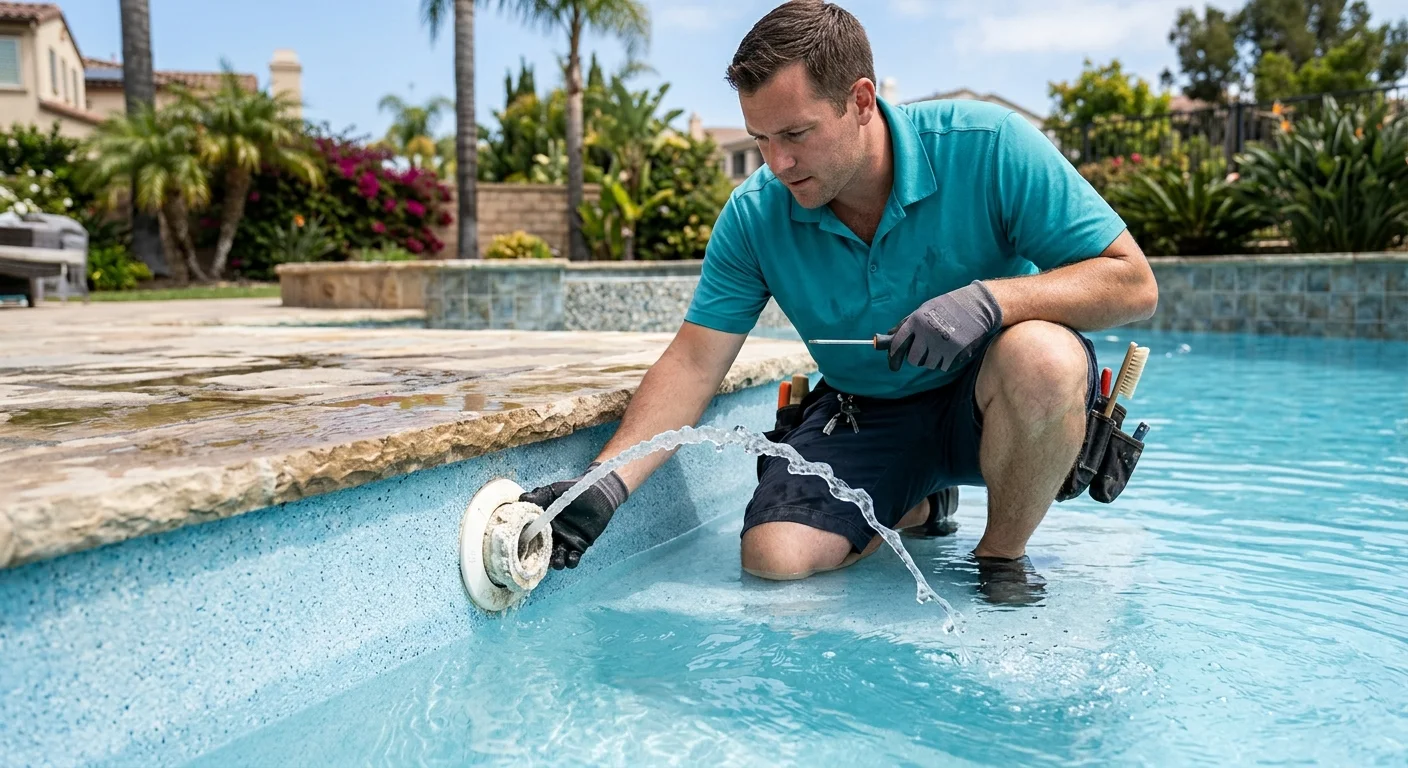
A gunite pool in El Cajon and a saltwater bowl in Pacific Beach both depend on a small wall fitting most owners never notice. Water leaves the filter, hits the pool return jet, and should sweep the bowl toward the skimmer. When that fitting throws a thin mist, sits cocked, or goes quiet, debris parks in a corner and the far end clouds first. A licensed pool specialist can tell whether the eyeball, the scale, or the line is at fault.
What a return jet is supposed to do
The return is the last stop before water re-enters the pool. After the pump and filter, the line hits a wall fitting. In most San Diego gunite shells that fitting holds a directional pool eyeball. You twist the ball, and the stream should follow. Vinyl and some fiberglass pools use a faceplate kit instead of a plaster-set eyeball. The job is the same: push water so the whole bowl moves.
A healthy jet should feel like a firm rope. On a rectangular backyard pool in Clairemont or La Mesa, that stream is usually aimed along the long wall, toward the skimmer, so leaves and film don’t stall in the deep end. On a freeform gunite in Alpine or Rancho Santa Fe, returns get aimed to kill pockets behind steps and benches. If you have two or three returns, they should share the work. One screaming jet and one dead one is a warning.
Still water in a south-facing Escondido yard grows algae faster than a stirred bowl. The CDC’s healthy swimming pages are about water that is safe to swim in. A dead return fights that, because filtered water never reaches the far corner.
The return is the outlet. The skimmer is the intake. If the weir is stuck or the basket is packed, the loop starves and every jet looks weak even when the eyeballs are fine. A pool skimmer that is not pulling belongs in the same check as a quiet wall fitting. Watch both ends: what goes in at the skimmer, and what comes out at the wall.
Spa jets and pool returns get mixed up on shared equipment. A spa hydro-jet is a different assembly, often with air mixed in. A pool return is a quieter fitting meant to turn the bowl. If the spa side is roaring and the pool side is dead, look at a diverter or a closed valve at the pad before you blame the eyeball.
Parts bins also hold hydrostream-style fittings and rubber flow directors. Those are different shapes for the same job: control how water leaves the wall. Gunite eyeballs, vinyl inlet kits, and spa jets are the three you are most likely to be looking at. A licensed pro matches the part to the shell in front of them.
Clogged eyeballs, stripped threads, and dead zones
San Diego water leaves scale. Inland North County and East County show it first: Escondido, San Marcos, El Cajon, Santee, Lakeside. White crust on tile is the same mineral load that locks an eyeball. Calcium on pool tile is the version you notice from the waterline. On the fitting it is a frozen ring, a narrowed hole, and a stream that fans or dies.
The San Diego County Water Authority supplies much of the county’s imported water. Hardness varies by district, and this page does not publish a grains-per-gallon number. The practical test is on the fitting: white crust, a tight opening, a ball that will not turn.
Coastal returns fail a different way. Pacific Beach, Ocean Beach, Imperial Beach, Coronado, and Oceanside pick up sand, grit, and salt crust after wind and foot traffic. The jet can look clear from the deck, then spit grit or collapse to a dribble. Saltwater pools add crust around the opening. That can be a restricted nozzle with a healthy pump.
Stripped threads show up on older gunite. Mid-century and 1970s shells in Mission Hills, North Park, and older Chula Vista have eyeballs that have been twisted for decades. The ball no longer holds aim. It spins freely, or it will not turn. You set it toward the skimmer in the morning and find it staring at the floor by evening. That is a worn pool eyeball fitting.
Dead zones follow. Algae on the shady wall. A dust line that never moves. Warm and cold patches in the same bowl. One return aimed at the surface can even push water over the coping on a windy Point Loma afternoon while the floor stays still.
Leave the screwdriver in the garage. Chipping scale off a brittle fitting can crack plaster or strip what threads remain. A licensed specialist can soak, extract, or replace the piece without chewing the wall.
When the problem is the line, not the nozzle
A clean eyeball on a starved line still looks like a pool jet not working. Closed return valves, a spa-priority setting left on, a packed filter, or a pump that has lost prime will all fake a nozzle failure. Walk the pad. Confirm the valves. Then look at every return, not just the one you noticed.
If every jet is weak, the restriction is upstream. If one jet is dead and the others are strong, the fault is local: that fitting, that branch, or a blockage in that run. Older gunite plumbing in East County can collect scale inside the line the same way it coats tile. Coastal laterals can pack with sand. Swapping the eyeball will not open a pipe that is not passing water.
A bubbling return can be air. Suction-side leaks show up as champagne at the wall. That is pad work under pool equipment installation and upgrades, not a new nozzle.
Wet soil along the run, a sinking deck, or a pool that loses water while the pad stays dry points past the fitting. The eyeball is the part you can see. It is not always the leak.
Line size, flow, and thread pitch get confirmed on site. A typical pipe size or gallons-per-minute figure for a given San Diego backyard could not be verified for this page. Guessing those numbers does not help the repair.
What a pool pro replaces versus what you can see
You can see the stream, the crust, and whether the ball turns. You cannot see the gasket behind the wall, the female threads, or a wad of scale two feet into the line.
The matched licensed pool pro decides what comes off. Confirm that license on the CSLB lookup. Often it is the eyeball and a gasket. Sometimes the entire wall fitting has to come out because the threads are gone. On vinyl, the faceplate, gaskets, and screws are the wear items, and a bad gasket can leak toward the liner. On gunite, a seized fitting can take plaster with it if someone forces it. This is not a home rebuild from a parts photo.
The pro also checks aim against the rest of the system. A new pump, a different filter, or a remodel that moved a skimmer can leave old jets pointing at the wrong wall. That larger conversation is in the pool equipment upgrade guide.
Splash Pool SD matches you with a licensed independent specialist. That person sources the fitting, opens the line if needed, and stands behind their own work. Part cost varies with shell type, color, and whether the wall fitting itself is shot. Ask the specialist for the figure that applies to your pool. There is no published price list on this site.
If the jet is one piece of a tired pad, treat it as a system. Replacing one eyeball on a starved loop wastes the visit.
How to describe the spray when you call for a match
When you call for a match, skip the guess about thread size. Describe what the water is doing.
Say how many returns you have, and which ones fail. “The deep-end jet in our El Cajon gunite is a mist, the shallow one is still a rope” is useful. A thread size you have not measured is not.
Say the shape: tight rope, wide fan, sputter, bubbles, or nothing. Say the aim: floor, surface, stuck, or spinning. Say whether it changed after a windy week, a hose fill, a salt-cell clean, or a filter cleaning. Coastal owners should mention sand. Inland owners should mention scale on tile.
Mention shell type: gunite plaster, pebble, vinyl, or fiberglass. Mention salt or chlorine. Mention if the spa shares returns. Mention if a valve was moved. A deck-level photo and a close crop of the eyeball save a wrong-part run.
Photograph the fitting in place. Do not unscrew it to inspect size before the visit. The specialist will confirm the match against the wall, not against a search result.
That description is enough to route the right licensed pro. They bring the fitting, the tools to free a seized eyeball, and the judgment to stop at the nozzle or keep going into the line.
When to call us
A clogged, misaimed, or silent pool jet nozzle is a circulation failure you can see from the deck. When the eyeball is scaled, stripped, or the return line is restricted, the work belongs to a licensed pool specialist. Call us at (858) 400-4404 and we’ll connect you with a licensed local pool specialist.
Frequently asked questions
What are the two types of jet nozzles?
There is no official pair of types that covers every pool. In San Diego you mostly see a directional eyeball in gunite walls, a faceplate inlet kit on vinyl, and a tighter hydrostream-style fitting on some returns. Spa hydro-jets are a separate assembly. A licensed pro matches the part to the shell in front of them.
Where can I find replacement pool jet nozzles?
The licensed specialist you get matched with sources the eyeball, gasket, or vinyl inlet kit that fits your return. Random online listings often miss thread, color, and shell type. Confirm the part against the fitting in the wall before anyone orders.
What size thread does a pool jet nozzle typically use?
A single typical thread size could not be confirmed for every San Diego pool. Gunite, vinyl, and spa returns use different fittings. The matched pro measures the existing return instead of assuming a size.
Why is my pool jet not working?
Scale, sand, a stuck or stripped eyeball, or a restriction in that return line can kill the spray. A packed skimmer, closed valve, or weak pump can make every jet look dead. Describe the stream, which returns fail, and your shell type when you call for a match.
Can I replace a pool eyeball fitting myself?
You can look, photograph, and note aim. Forcing a scaled or brittle fitting can crack plaster or strip threads. Opening the line or replacing the fitting is work for a licensed pool specialist.
Need professional help in San Diego County?
Splash Pool SD connects you with a licensed specialist for any service in this post.