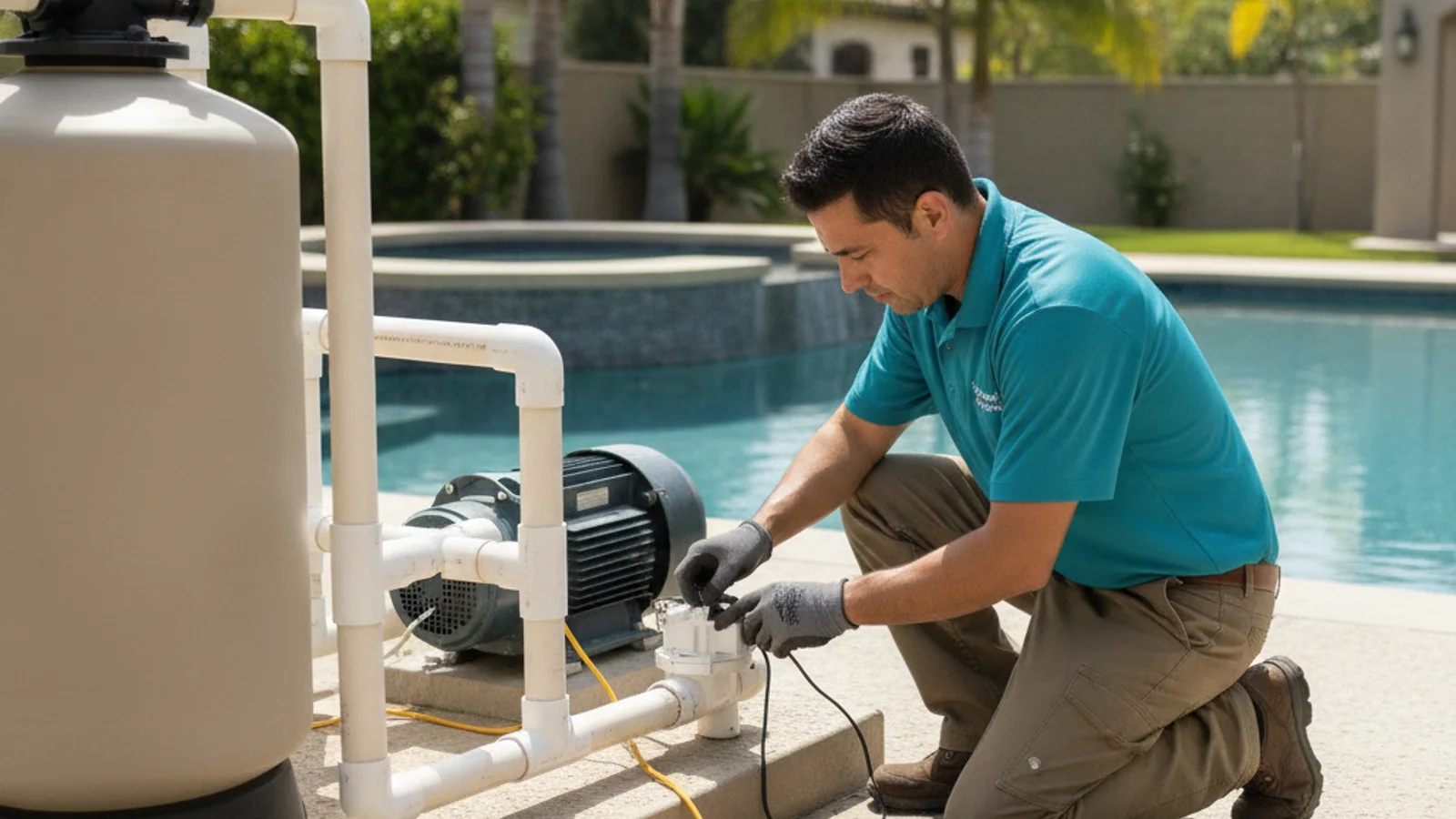
A pool actuator is the small motor on top of your diverter valve that routes water between the pool, spa, and features. When it fails, you get clicking without movement, a spa that won’t heat, or a waterfall that won’t shut off. In San Diego, the two biggest killers are mineral scale in inland water and salt-air corrosion on the coast. Splash Pool SD connects you with a licensed local specialist who diagnoses which component failed and quotes before any work starts.
What an actuator actually does
The actuator is a 24-volt motor mounted on top of a diverter valve, typically a Jandy-style valve body. Your automation panel sends a low-voltage command, and the motor rotates the diverter to the correct port. That port might send water to the spa, to a water feature, or through a heater bypass.
It isn’t the control panel. It isn’t the pump. It is the piece that physically turns the valve. On pool-and-spa combos, the actuator handles the switchover every time the system changes mode. Water features on timers cycle the valve the same way, so the actuator works year-round, not just seasonally.
Pentair, Jandy, and Hayward all manufacture valve actuators. The Pentair IntelliValve, part number 521485, pairs with a 2-inch 3-way valve, part number 263026, and shows up in MasterTemp automatic bypass kits. Actuators aren’t universally interchangeable. The replacement must match your existing valve, voltage, and control system.
Symptoms that point to actuator trouble
Clicking without rotation is the most common sign. The motor is fighting a stuck diverter. The gears may still be intact at that point, but repeated spa-mode commands against a seized valve will strip them.
Spa water mixing into the pool means the diverter stalled partway. Both ports are partly open. The spa won’t heat because the diverter never reached the spa position, and the heater requires flow to fire. A waterfall or deck jet stuck on uses the same mechanism.
Silence is a different problem. It can mean a dead motor, an open wire, or a command the panel never sent. If your pump, lights, and heater still respond to the app or panel, the panel itself is likely alive. The fault is downstream.
A broken receiver or worn cams cause the motor to turn but never stop at the right position. The valve overshoots or fails to arrive at the correct port.
How San Diego conditions cause failures
Inland East County water is mineral-heavy. El Cajon, Santee, and Escondido pools build scale inside the valve body over time. That scale freezes the diverter, and the actuator clicks against it. Replacing the actuator alone in this situation dooms the next motor. The valve needs attention too, or the new actuator will fight the same seized diverter.
Coastal pads in La Jolla, Coronado, Imperial Beach, and Carlsbad face a different problem. Salt air corrodes the motor housing, mounting screws, and wire connectors. Mounting screws can seize so badly the actuator won’t lift off the valve. Snapping a fastener risks a worse leak. A pro who works these pads regularly knows how to handle corroded hardware without escalating the repair.
A half-open valve that continuously mixes spa water into the pool isn’t just an inconvenience. It runs your heater longer than it should and dilutes your spa chemistry. The fix is the same: get the diverter moving to its full travel position.
For more on how San Diego’s hard water affects pool equipment, see our guide on hard water and San Diego pools.
What to document before you call
Write down what you hear: clicks, hums, or silence. Note whether the valve moved at all. Note whether spa water is mixing into the pool, whether the spa won’t heat, or whether a feature is stuck on.
Record the brand and model marks on the actuator and the valve. Record the automation brand on your panel. If the panel shows an error message about the valve, write that down too. Record your city, because inland versus coastal changes the inspection approach.
Photograph the motor on the valve, the wiring, and the panel display. Don’t disconnect wires for cleaner photos. Don’t force the valve handle with a wrench on a pressurized line. A snapped diverter escalates this into a much larger repair.
What to expect from a quote
No standard line item exists for actuator repair in most estimating guides. The quote depends on which component failed: the motor, the valve body, or the wiring. Ask for separate findings on each.
A new actuator on a calcified valve guarantees a repeat visit. A new actuator on an open wire will never activate. A valve-only fix with stripped gears leaves you a dead motor. The written scope should state which component was tested and which was replaced.
If a proposal jumps straight to a full panel replacement, ask for justification. What test ruled out the actuator, the valve, and the wire? Panel replacement is a separate scope entirely. For more on what drives equipment repair pricing, read our post on pool equipment repair estimates.
Your matched pro quotes after an on-site pad inspection. Pricing varies with pool size, equipment brand, access to the pad, and whether the valve body needs replacement alongside the motor.
Safety and licensing
Cut breaker power before anyone removes an actuator. Live-circuit removal is dangerous and is licensed work only.
California Business and Professions Code §7048, amended effective January 1 2026, exempts only casual minor work that needs no permit. The exemption is void if the person advertises as a contractor or employs others for the work. Verify your specialist through the CSLB license check tool. Our post on how to check a pool contractor’s license in California walks through the steps.
California Business and Professions Code §7159.5 governs downpayment caps on covered home improvement contracts. The cap is the lesser of a fixed amount or a percentage. Your pro should explain this before you sign anything.
Choosing the right pro for this repair
Actuator work sits at the intersection of plumbing, electrical, and automation. Not every pool tech handles all three. You want someone who can test the 24-volt signal, inspect the valve body for scale, and confirm the panel is sending commands correctly.
If your system uses Pentair, Jandy, or Hayward automation, brand familiarity matters. The wiring color codes and terminal layouts differ. Our guide to pool automation systems in San Diego covers the major platforms.
For broader guidance on selecting a repair specialist, see how to choose a pool repair pro in San Diego.
When to call us
If your actuator is clicking, your spa won’t switch over, or a water feature won’t shut off, this needs a licensed pool professional who can test the motor, valve, and wiring together. Attempting DIY fixes on a pressurized, electrically live system risks injury and a costlier repair. Call us at (858) 400-4404 and we’ll connect you with a licensed local pool specialist.
Frequently asked questions
What is a pool actuator?
A pool actuator is a 24-volt motor that sits on top of a diverter valve. It rotates the diverter to route water between the pool, spa, water features, or heater bypass. Your automation panel sends it a command, and it turns the valve to the correct position.
Why does my pool actuator click but not turn?
Clicking usually means the motor is fighting a stuck diverter. Scale or debris inside the valve body can lock it in place. The gears may still be intact, but repeated commands against a seized valve will eventually strip them.
Why won't my spa switch over or heat?
If the diverter never reaches the spa position, water never flows through the spa plumbing. The heater requires flow to fire, so no flow means no heat. A half-open valve can also mix spa water back into the pool.
What drives the cost of actuator repair in San Diego?
The price depends on which component failed: the motor, the valve body, or the wiring. Inland areas with hard water often need valve replacement too. Coastal pads may have corroded fasteners that add labor. Your matched pro quotes after an on-site inspection.
Do I need a full automation panel replacement?
Usually not. If your pump, lights, and heater still respond to the panel or app, the panel is likely alive. A broken actuator, seized valve, or wiring fault is a separate fix. Ask your pro what test ruled out each component before agreeing to panel work.
Need professional help in San Diego County?
Splash Pool SD connects you with a licensed specialist for any service in this post.