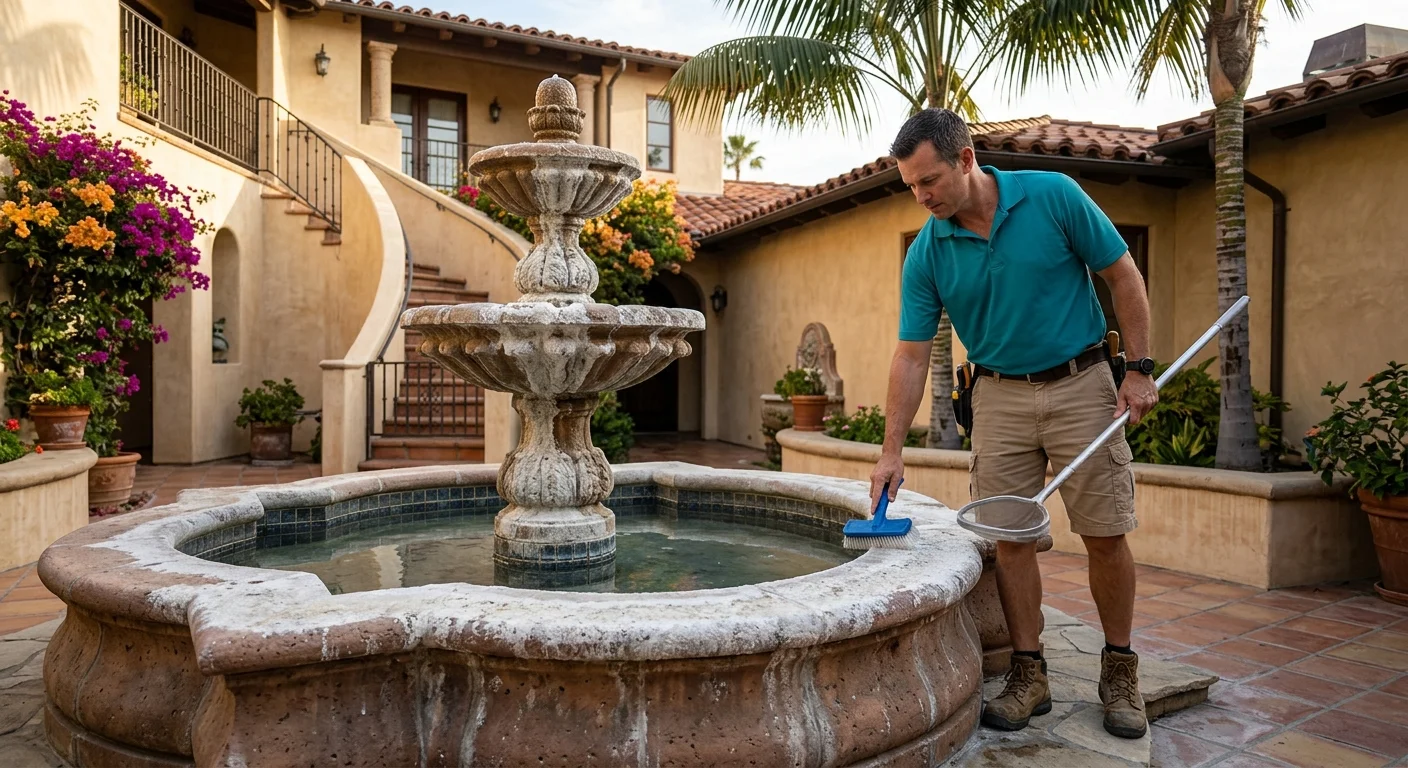
White crust on a courtyard bowl in the Village is the usual first sign. The sheet thins, the pump starts to hum, and the basin lights go dark after a few seasons of salt wind. Fountain repair in La Jolla is a coastal job: marine air, hard City of San Diego water, and open bowls on view lots that dry out in the afternoon breeze.
Why La Jolla fountains scale and stall in salt air
La Jolla sits on a point that takes wind off the Pacific. Homes in Bird Rock, La Jolla Shores, and the west face of Mount Soledad catch spray that never reaches an inland pad. That salt lands on wet tile, bronze nozzles, and stainless screws. It dries into a white film, then a crust that pinches the water sheet until the fall looks ragged.
The water in the bowl works against you too. La Jolla is part of the City of San Diego. Homes here take treated water from City of San Diego Public Utilities, and that supply runs hard. Hard water leaves mineral scale on weirs and jets the same way it marks pool tile. Pair that with salt air and the bowl scales faster than a fountain a few miles inland. For the county mineral picture, read our note on hard water in San Diego pools.
Wind across an open view-lot bowl speeds the cycle. Water sheets evaporate on the lip. Minerals stay. The pump keeps circulating a shrinking volume until the strainer clogs or the unit runs dry. A stalled fountain is often a scaled nozzle plus a pump that has been gasping for weeks.
Marine layer keeps vault lids damp. Corrosion starts on the lid, then the unions, then the cord. By the time the sheet stops, the equipment may already be the bigger half of the job. The San Diego water-feature repair overview covers the county baseline. La Jolla adds salt and wind on top of hard water.
The San Diego County Water Authority describes the region’s water mix at a high level. A specific hardness number for La Jolla could not be confirmed from a current utility report for this page. Treat the water as hard, and have the matched licensed pro test the fountain itself. Courtyard bowls and pool scuppers often sit on separate loops.
Pumps, bowls, and lights that fail on view lots
View-lot fountains in the Muirlands, La Jolla Farms, and along the Soledad ridgeline sit in wind. A low wall still leaves the sheet open to afternoon gusts. Those gusts blow water over the coping, drop the bowl, and leave the pump sucking air. A dry run ruins seals. The next symptom is a noisy motor, then a dead one.
Pumps on these lots often hide in a hillside vault or under a travertine lid beside the spa. Salt air gets into the box every time someone opens it. Unions stain. Lids pit. Cords crack. The matched licensed pro should pull the lid, check for standing water, and see whether the unit is still serviceable before anyone talks about a new pump.
Bowls fail in their own way. Thin plaster in a fire-and-water bowl checks in the sun. Grout in a pebble basin opens. A tile weir on a vanishing-edge pool fountain loses the sharp line that makes the sheet. Once the lip is uneven, the water fans and spots the glass behind it. That is a finish repair as much as a plumbing repair.
Lights sit in the basin or under the weir. Salt and scale cloud the lens. A failed gasket lets water into the niche. On a view lot a dark bowl kills the night view. Electrical work on a wet niche belongs with a licensed pro. Confirm GFCI protection and the cord path before anyone puts a new lamp in a wet hole.
A pool fountain in La Jolla (scuppers, sheer descents, deck jets tied to the pool) shares water with the pool. When those stall, the pool pump, valves, and cleaner lines are in play too. A standalone courtyard fountain is a smaller, separate loop. The quote should say which system you have.
Village courtyards versus hillside HOA entries
La Jolla fountain repair splits by setting. The Village is one job. The hillside is another.
Courtyards off Girard Avenue and Prospect Street are tight. Access is a side gate, a lobby, or an alley. Bowls are often glazed tile or mosaic, built to stay quiet for neighbors and diners. Pump vaults hide under planters. A stalled sheet is a sound problem as much as a look problem. The matched pro needs room to work without blocking a shared walk. Parking is short. Materials come in by hand.
Hillside HOA entries along Soledad Mountain Road, Hidden Valley, and the Muirlands are monument fountains. They sit at the gate, lit from below, with a larger basin and a vault in the slope planting. Wind is stronger. Ice plant and eucalyptus clog strainers. Common-area water usually needs the manager or the board. The matched licensed pro should put hours, noise, and shutoff on the quote.
Private view-lot fountains sit between those two. You own the bowl. You still live on a slope. Stairs, retaining walls, and long hose runs from the street are normal. If the home is in an HOA, exterior changes to tile or lighting may still need written approval. That rule comes from the association. Ask the manager before anyone chips the weir.
Water feature repair in La Jolla also shows up as wall scuppers in newer remodels and as older center-jet bowls in 1950s courtyards. Same salt, same hard water, different parts. A center jet clogs at the nozzle. A wall scupper fails at the lip and the catch basin. The pro should name the type on the first visit.
What a fountain pro should put on the quote
The matched licensed pro should walk the bowl, the vault, and the path in. Splash Pool SD publishes no price list. The person who sees the site sets the figure after that visit.
A useful quote names the fountain type: courtyard sheet, monument basin, pool scupper, or fire bowl. It records access, including a Village gate, hillside stairs, or HOA entry hours. It says whether the pump is identifiable and whether it primed on the visit. It describes scale on the nozzles and the weir, and the method planned to remove it. Chemical doses belong to the person testing that water.
The quote should cover lights and wet-niche electrical, unions and lids, and the bowl finish. If a leak is suspected, it should say how they will look for it. Underground line work is a different scope from a clogged jet.
A specific City of San Diego fountain-repair permit fee could not be confirmed for this article. City of San Diego Development Services decides when a permit is required. Ask them before anyone opens a wall, changes plumbing, or replaces electrical. California contractor law also applies. As of January 1, 2026, work is exempt from licensing only when the full contract is under $1,000, the work is casual and minor, and no building permit is required. All three have to be true. Splitting a job to stay under that figure is not an exemption. Anyone who advertises as a contractor loses the exemption at any price. Confirm the license on the CSLB license lookup.
On a home improvement contract, California law caps the down payment at $1,000 or 10 percent of the contract amount, whichever is less. On a large job that cap is $1,000. The quote should show the deposit in those terms.
For the service itself, start at our fountain and water feature service page, then have the matched pro write the La Jolla-specific scope on top of it.
How this job differs from a South Bay entry fountain
A Chula Vista HOA entry fountain is a heat and committee job. A La Jolla fountain is a salt and wind job.
South Bay monument basins sit in master-planned entries with less marine spray and more summer heat on open water. Boards, landscape contracts, and shared meters shape the work. We wrote that pattern up in fountain repair in Chula Vista. A Village courtyard still needs its own walkthrough.
La Jolla bowls take Pacific salt. They sit on cliffs and in tight tiled courts. City of San Diego water and City of San Diego Development Services are the utility and the permit counter. Chula Vista has its own city hall and its own water agencies. Access in the Village is a gate. Access on Soledad is a slope. Access at a South Bay gate is a landscape easement and a board calendar.
La Jolla still runs mid-century courtyards, custom view-lot remodels, and a few newer scupper walls. Chula Vista HOA entries are often later monument kits with larger basins and newer vaults. Scale chemistry is still hard water in both places. The salt film on a Bird Rock nozzle is the extra layer inland fountains skip.
If you are comparing two quotes, read them for those site facts. Have each licensed pro walk the actual bowl and price the wind, the vault, and the access.
When to call us
Call when the sheet stalls, the pump hums, the basin lights go dark, or white scale takes over the weir. Those are licensed-pro jobs on a wet, electrical, salt-air system. Call us at (858) 400-4404 and we’ll connect you with a licensed local pool specialist.
Frequently asked questions
Why does a La Jolla fountain scale so fast?
Pacific salt spray lands on wet bowls in Bird Rock, La Jolla Shores, and west-facing Soledad lots. City of San Diego water also runs hard, so minerals bake onto weirs and nozzles. Wind dries the film into crust. A matched licensed pro should test the fountain water and inspect the pump, because those two problems often arrive together.
Does fountain repair in La Jolla need a city permit?
It depends on the work. A specific City of San Diego fountain-repair permit fee could not be confirmed for this page. Ask City of San Diego Development Services before anyone opens a wall, changes plumbing, or replaces electrical. As of January 1, 2026, California also requires a contractor license unless the full contract is under $1,000, the work is casual and minor, and no building permit is required.
Who does the work if I call Splash Pool SD?
We match you with a licensed independent local pro. That specialist performs the fountain repair. Confirm the license on the CSLB lookup before work starts.
How is La Jolla fountain work different from Chula Vista?
La Jolla jobs take salt air, cliff wind, Village courtyard access, and City of San Diego water. Chula Vista entry fountains are more often South Bay HOA monuments with heat, boards, and a different city counter. Have the matched pro walk the actual bowl in La Jolla.
What belongs on a La Jolla fountain quote?
Fountain type, access, pump condition, scale plan, lights and electrical, bowl finish, leak check, permit status with the city or HOA, the pro's license number, and a down payment that follows California's $1,000 or 10 percent cap, whichever is less. Splash Pool SD publishes no price list.
Need professional help in San Diego County?
Splash Pool SD connects you with a licensed specialist for any service in this post.