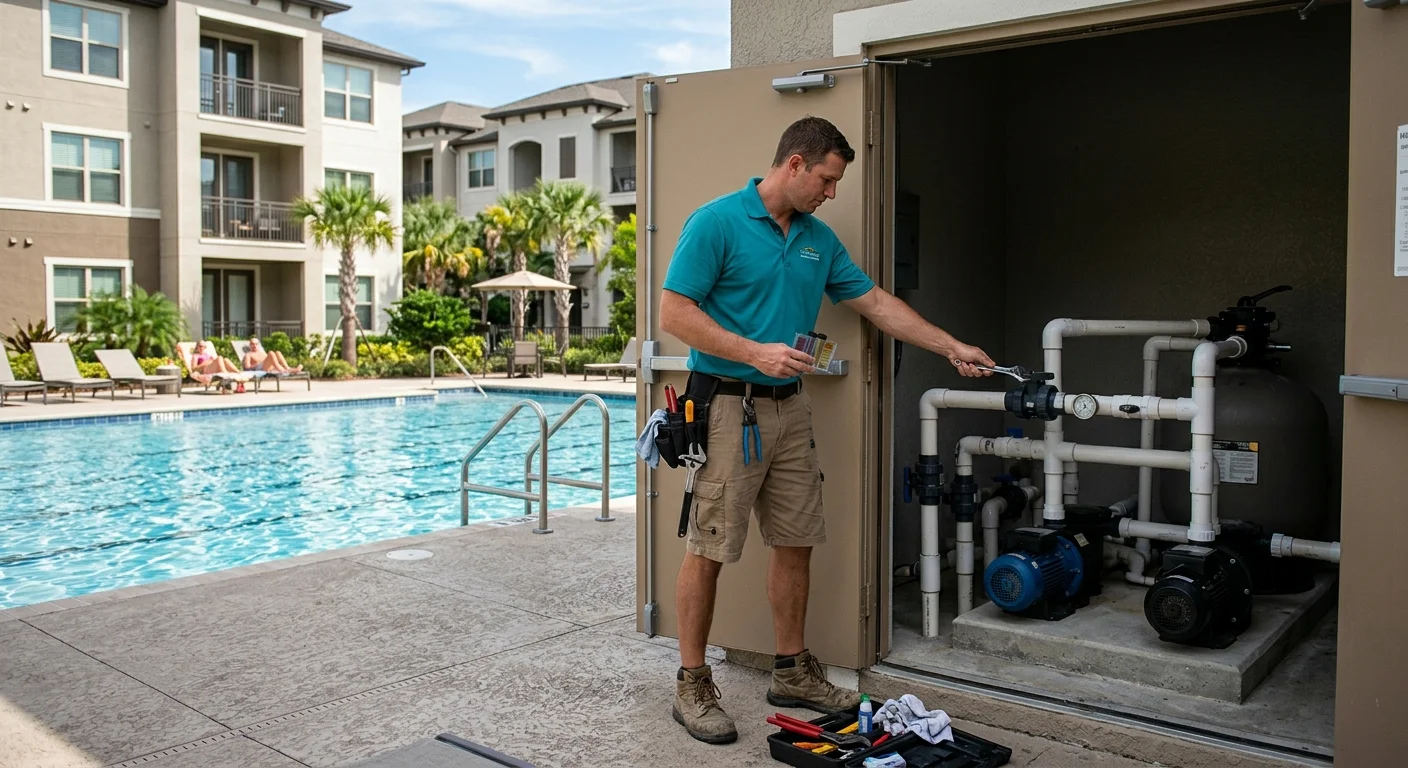
A commercial pool pipe failure in San Diego County affects more than the water. It touches guests, residents, maintenance vendors, and the operators responsible for keeping the facility open. The repair itself follows the same physics as a residential job, but the coordination around it is what makes commercial work different. Splash Pool SD connects facility operators with licensed local pool pros who handle pipe repair and relining. The matched specialist diagnoses the failure, proposes a method, and completes the work under their own license.
How commercial pipe repair differs from residential
The pipe itself is identical. What changes is the operating environment. A commercial leak crosses multiple stakeholder responsibilities. A hotel coordinates front-desk staff, housekeeping, and facilities teams. An HOA coordinates residents, board members, and maintenance vendors. An apartment complex may involve a property manager and a separate contractor for landscaping or hardscape.
Equipment rooms in commercial settings often sit far from the suspected leak. That distance means the specialist must build a system map even when original records are incomplete. The map should cover the pool, spa, equipment pad, valves, deck penetrations, water features, and visible pipe runs. A licensed specialist isolates sections systematically to narrow the failure point.
San Diego access considerations
San Diego County isn’t one layout. A coastal hotel near I-5 deals with tight loading zones and guest proximity. An inland HOA may have a large shared deck between the equipment pad and the water. Mission Valley properties sometimes involve multiple building departments or operating teams. A downtown hotel, a Chula Vista apartment complex, and a North County HOA each present different loading areas, quiet periods, and vendor entry routes.
The matched pro maps vendor entry via I-5, I-8, or I-805 depending on the site. Material staging and debris removal locations need confirmation before work starts. Each layout changes the access plan significantly, and the proposal should reflect that.
Leak detection before demolition
Wet soil or unexplained water loss alone isn’t enough to justify opening finished surfaces. Detection narrows the search first. The specialist should require a marked repair area before any demolition is approved. The drawing shows the suspected line, test points, access routes, and areas of uncertainty. This step protects the facility from unnecessary surface damage. For more on how detection works, see how pool leak detection works.
Three repair methods
Once the failed section is located, the specialist chooses from three options: excavation, rerouting, or relining.
Excavation
Excavation provides direct access to the failed pipe or connection. It can affect decks, landscaping, walkways, and finished areas. The proposal must identify opening, hauling, backfilling, and restoration as separate line items. Don’t assume those tasks are included unless the scope says so.
Relining
Relining treats the existing pipe from inside its current path. It may reduce the amount of finished surface that needs opening. Suitability depends on pipe condition, bends, fittings, branch connections, access points, and the location of the failure. The specialist must state which portion gets lined and what remains outside scope.
Rerouting
Rerouting abandons the failed section and runs new pipe along a different path. This method suits situations where the original route is inaccessible or where repeated failures suggest a systemic problem with that run.
Neither relining nor excavation is automatically superior. Access, pipe condition, fittings, and routing all matter. A licensed specialist must inspect before recommending one method over another. For a broader look at underground line repair, see pool plumbing repair for underground lines.
Method comparison checklist
Before approving a proposal, confirm these points:
- What evidence identifies the failed section?
- Is one defect addressed, or the complete affected run?
- Which fittings and branches are included?
- What testing follows the repair?
- What surfaces must be opened or restored?
- What conditions could change the approved scope?
- Are confirmed locations distinguished from estimated ones?
Unseen pipe route proposals require extra caution. If the specialist can’t confirm the route without opening surfaces, the proposal should say so plainly.
Health department and regulatory requirements
No confirmed San Diego County code section was identified that governs commercial pool pipe repair specifically. No universal reopening checklist exists. Don’t substitute a generic online checklist for local requirements.
The California Department of Public Health pools and spas page is a starting point. Before repair begins, contact the applicable local authority and ask:
- Is closure required during each stage?
- Is a permit or plan review needed?
- Are inspections or test records required before reopening?
- Who approves routing or equipment changes?
- Which records stay in the facility file?
Get answers in writing and embed them in the project scope. No blanket rule ties a specific repair method to a specific approval. The operator defines access control, notices, and status communication.
Downtime planning
A downtime plan is a sequence, not an unsupported reopening date. Separate diagnosis, access, repair, testing, restoration, and approval into distinct stages. List affected amenities: pool, spa, water feature, deck, path. These amenities may not share the same operating status.
The contractor explains what must be isolated. The operator writes notices matching the actual scope. Hotels should coordinate front-desk and facilities teams around one approved closure description. HOAs should decide who updates residents, vendors, and the board. Mixed messages create premature reopening pressure.
Ordered checkpoints
- Confirm suspected line and repair boundaries.
- Confirm access and surface-opening responsibilities.
- Complete approved pipe work.
- Record the contractor’s testing.
- Finish required surface restoration.
- Complete inspection or reopening steps per the authority.
- Document the operator’s return-to-service decision.
Don’t promise a completion date before these stages are defined. Hidden routes, inaccessible fittings, or a wider failure can change scope. The proposal must explain how discoveries get reported and approved. One person owns schedule updates and shares only confirmed milestones.
Post-repair documentation
Keep the following records where future facilities staff can find them:
- Final scope: repaired pipe, access locations, routing changes
- Before-and-after photos with labels
- Pressure or isolation test results and conditions
- Signed proposal and approved change orders
- Contractor business name and license information
- Marked pipe map or updated site drawing
- Product and material information
- Surface restoration details
- Permit, inspection, or authority records if applicable
- Written warranty terms from the contractor, if any
Not every item is necessarily required by law. Exact legal and health documentation requirements couldn’t be confirmed for San Diego County. A clear pipe map prevents the next diagnosis from guessing.
Contractor verification
Use the CSLB license lookup to verify the contractor before signing. Confirm the license belongs to the business named in the proposal. Keep a copy of the lookup with the contract file. For a step-by-step guide, see how to check a pool contractor license in California.
Warranty terms come from the matched contractor, not from Splash Pool SD. Review those terms before signing. If you need help evaluating a proposal, choosing a pool repair pro in San Diego covers what to look for.
When to call us
Unexplained water loss at a commercial pool, a suspected underground line failure, or a repair proposal that needs a licensed specialist’s review are all reasons to bring in a pro. Call us at (858) 400-4404 and we’ll connect you with a licensed local pool specialist.
Frequently asked questions
Is relining always better than excavation for commercial pool pipes?
No. Neither method is automatically superior. Pipe condition, bends, fittings, branch connections, and access all determine which approach fits. A licensed specialist must inspect the line before recommending one over the other.
How should a facility plan downtime during a commercial pipe repair?
Build the plan around ordered stages: diagnosis, access, repair, testing, restoration, and authority-confirmed reopening. Avoid announcing a reopening date before all stages are defined. One person should own schedule updates and share only confirmed milestones.
Does San Diego County have a specific health code for commercial pool pipe repairs?
No single San Diego County code section was confirmed for this topic. The California Department of Public Health pools and spas page is a starting point. Contact the applicable local authority before repair begins and get answers in writing.
What records should a facility keep after a commercial pipe repair?
Keep the signed scope, contractor license information, before-and-after photos, pressure test results, a marked pipe map, material details, change orders, and any permit or inspection records. Store them where future facilities staff can find them.
Need professional help in San Diego County?
Splash Pool SD connects you with a licensed specialist for any service in this post.