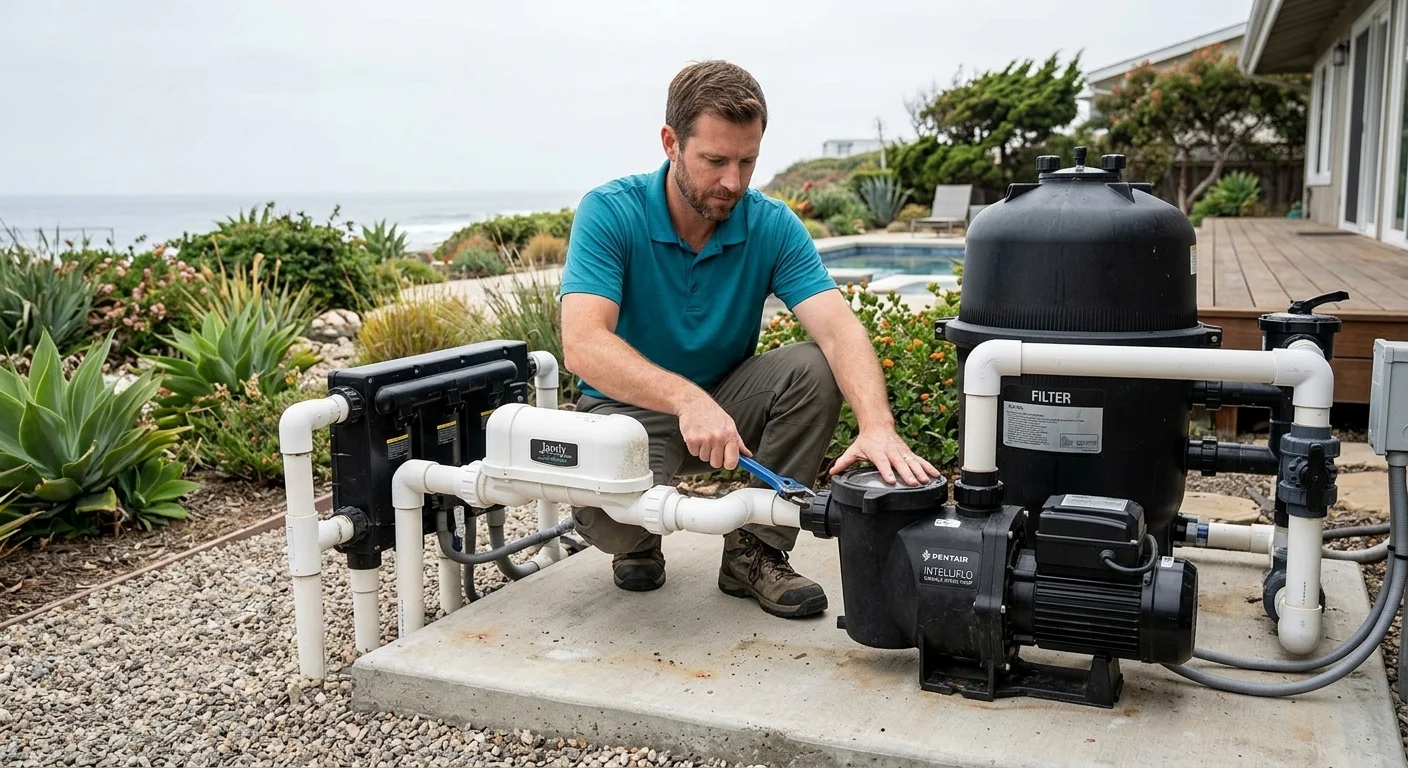
A salt cell west of I-5 in Encinitas lives in marine air, not inland heat. Morning layer soaks the pad, spray rides in off Moonlight and Swami’s, and the plates crust sooner than they do a few miles east. If you want a salt water pool Encinitas homeowners can actually keep running, start with that pad, not a county-wide sales pitch.
Why Encinitas salt cells scale in marine air
A salt system does not replace chlorine. It makes chlorine from dissolved salt as water moves through a cell. The cell is a stack of plates inside a PVC vessel. When scale coats those plates, output drops and the box starts throwing codes.
Coastal Encinitas adds a second salt source the inland county does not: the air. West of Interstate 5, the marine layer sits on Leucadia, Old Encinitas, and Cardiff-by-the-Sea for long stretches of the year. Pads on Vulcan Avenue, Coast Highway 101, and the bluff streets take that moisture every morning. Unions stay damp. Lids weep. Calcium that would stay in solution in warmer water drops onto the plates while the cell is working.
Hardness in grains per gallon is not confirmed for this page. San Dieguito Water District and Olivenhain Municipal Water District serve different parts of the city, and each posts its own water-quality report. Ask the matched pro to read the current report for your street, then test the pool. Do not guess a city-wide number.
What you can treat as local fact is the climate. Cool, wet pads slow drying on fittings. Salt film from the beach corridor coats vents and boards. A cell that looks spent on a Cardiff pad is often scaled, not finished. The salt cell not working path starts with output, flow, and the salt reading, then scale.
Keep the vessel and the control box out of standing spray if the pad layout allows it. Rinse film off the housing. Do not acid-wash plates on a homemade schedule. The manufacturer sheet sets the cleaning method and the salt range. If that sheet is missing, photograph the model sticker and have the specialist pull it. The CDC healthy swimming guidance still applies: the water needs a working sanitizer residual, whether the chlorine came from a jug or from the cell.
Cardiff and Leucadia pads versus Olivenhain inland
Encinitas is one city on paper. The pads are not one climate.
Leucadia and Cardiff sit on the ocean side of I-5. Equipment often lives in a tight side yard, under a deck, or on a bluff lot that takes wind off the water. Eucalyptus and fig drop into skimmers. The marine layer keeps the pad cool through late morning. Salt spray reaches lids that face west. Those cells scale, and the electronics in the box see damp air they were not designed to sit in all year.
Olivenhain sits east of the freeway, up toward the hills and the lagoon’s inland edge. Pads there run warmer in the afternoon. Direct beach spray is less of a factor. Canyon dust and plant debris show up more than salt film. A cell in Olivenhain can still scale, because the generator still works against the water’s mineral load. It often does so on a different clock than a Leucadia cell ten minutes west.
Encinitas Ranch and the lots along El Camino Real sit in between. They get some marine influence without the full 101 exposure. A one-size service plan that treats every Encinitas salt water pool the same will miss that split.
If the lot is on a private well, say so when you match. Well chemistry is not the same as district water, and this page does not carry a verified well profile for Olivenhain. The specialist tests that water instead of assuming the city supply.
Walk the pad before you talk conversion or salt cell replacement. Note shade, standing water, whether the box faces the ocean, and how far the equipment sits from the house. Those notes matter more here than a generic North County brochure.
Cell, board, and flow faults a pool pro sees
Most Encinitas salt calls are not “the pool needs more salt” as a first guess. The matched licensed pool specialist looks at three things: the cell, the board, and flow.
The cell fails dirty before it fails old. Scale on the plates is the coastal pattern. A low-salt warning can be true low salt, a dirty sensor, or a cell that can no longer read because the plates are coated. This page does not publish a salt ppm target. That number lives on the maker’s sheet for that model. Write the reading you see. Do not add bags until the pro says the water is actually low.
The board and the box fail wet. Cardiff and Leucadia boxes that sit open to spray corrode terminals and throw ghost codes. A blank display, a repeating inspect-cell message, or a unit that runs then dies after the marine layer burns off is often the board or the wiring, not the plates. Do not hose the box. Photograph the error and the sticker.
Flow faults are the third pile. A salt cell needs water moving through the vessel. A dirty filter, a failing pump, a closed valve, or a bypass that was left wrong will shut the cell down to protect it. Coastal pads with standing water around the pump also hint at union leaks and poor drainage. The cell is the symptom. The pad is the job.
The specialist may pull the cell, inspect the plates, check the flow switch, and meter the box. None of that is DIY electrical work on a wet Encinitas pad. If the contract is $1,000 or more, or the work needs a permit, California contractor licensing rules apply. Confirm the person at the CSLB license lookup. Splitting a job into smaller invoices does not dodge that rule.
Hours on the cell, if the display shows them, help. They do not, by themselves, prove the cell is due. Coastal scale can retire a cell early on paper and leave another one running. Let the pro compare the plates to the sheet, not to a rumor about a set number of years.
When a conversion still fits a coastal lot
A salt water conversion still fits a lot of Encinitas backyards. It fits when you want the generator to make chlorine in the pipe, you will keep the cell cleaned, and the pad can keep the box reasonably dry. It is not a personality upgrade. It is equipment.
It is a weaker fit when the pad is a wet hole with no cover, when stainless or other metals on the job have not been checked against the salt-system sheet, or when you were sold a chlorine-free pool. Salt water pools still carry chlorine. The chlorine versus salt water choice is about how that chlorine is made and what the pad will demand, not about skipping sanitizer.
Compatibility is a pad-by-pad call. Heaters, rails, light niches, and filter tanks vary. This page does not list banned materials from memory. The matched pro checks what you have against the manufacturer sheet for the cell you are buying. If a filter or heater has to change, that is part of the quote, not a surprise after the salt goes in.
If a dedicated pool pump motor is being replaced as part of the pad work, California’s Title 20 rule may apply. Replacement dedicated-purpose pool pump motors at or above 0.5 hp, manufactured on or after July 19, 2021, must be variable-speed, per the California Energy Commission and CCR Title 20 section 1605.3(g)(6). That rule is about new replacement motors from that date forward, not a mandate to rip out every single-speed pump in Encinitas today. Confirm with the pro whether your motor is in scope. Do not count on a bill-savings figure. None is verified here.
Conversion cost is not published as a Splash Pool SD price, and no verified Encinitas install figure belongs on this page. Cell size, plumbing, electrical, and any equipment that has to change all move the number. The licensed specialist quotes after seeing the pad. If the City of Encinitas requires a permit for the electrical or plumbing portion, that is the city’s call. Ask before work starts.
A coastal lot in Cardiff can still convert. Plan for cell cleaning, a drier box, and honest chemistry. That is the trade, not a promise of a maintenance-free pool.
What to record from the cell readout before a match
You help the match when you send the readout, not a vibe.
Stand at the box and write what it shows: salt level, output percent, water temperature, and any inspect-cell, low-salt, or no-flow code. If hours or a cell-life bar is on the screen, write that too. Do not reset the unit first. The history is useful.
Photograph the display, the model and serial sticker, the cell vessel, the unions, and the whole pad from a few feet back. Include the pump and filter. Note the neighborhood: Leucadia, Cardiff, Olivenhain, Encinitas Ranch, or near Moonlight. Note whether the box faces the ocean and whether water sits on the pad after the marine layer.
If you recently added salt, say how many bags and which brand if you know it. If you acid-washed the cell, say so. If the pump has been priming hard or the filter pressure is up, say that too. Flow problems masquerade as cell problems.
Keep the manufacturer’s sheet if you still have it. If you do not, the sticker is enough for the specialist to pull the spec. Do not guess a salt ppm from a forum. Do not drain the pool to “start over” before someone has looked.
That packet is what a licensed local pool specialist needs to tell cell, board, and flow apart on an Encinitas pad. It is also what they need to say whether a conversion still belongs on that lot.
When to call us
Call when the Encinitas cell is coded out, the water will not hold sanitizer, or you want a coastal lot converted and need someone licensed to inspect the pad, the metals, and the readout. Call us at (858) 400-4404 and we’ll connect you with a licensed local pool specialist.
Frequently asked questions
What is the downside of a salt water pool in Encinitas?
The cell, board, and pad take marine air and salt spray west of I-5. Scale on the plates cuts chlorine output. Damp boxes fault. Some heaters, rails, and fittings need a compatibility check against the maker's sheet. A salt system still makes chlorine, so water testing does not go away. Cell life in years is not confirmed on this page. Use the model sticker and the manufacturer sheet.
Is it worth switching to a salt water pool on a coastal Encinitas lot?
It can be, when you want generator chlorine and will keep the cell clean and the pad dry. It is a poor fit if the pad stays wet, the box sits in spray with no cover, or you expected zero chemistry work. A licensed pool specialist walks the lot in Leucadia, Cardiff, or Olivenhain and says whether the existing pump, filter, and metals can stay.
How much does a salt water pool conversion cost in Encinitas?
Splash Pool SD publishes no conversion price list, and no verified Encinitas job figure is on this page. Cost depends on cell size, whether the pump or filter has to change, and what the pad needs for power and plumbing. The matched licensed pro quotes after seeing the equipment, not from a website range.
Why does an Encinitas salt cell scale so fast?
Coastal pads in Leucadia and Cardiff sit in marine layer and salt spray. Cool, wet fittings and calcium in the water leave film on the plates. Inland Olivenhain pads run warmer and take less direct spray, so they often crust later. Hardness in grains per gallon was not confirmed for this city. Test the pool and read the current water-quality report for your district.
What should I record before I call about a salt cell?
Write the salt reading, output percent, water temperature, any flow or no-flow code, and hours on the cell if the display shows them. Photograph the model sticker, the vessel, and the board box. Note whether the pad is west of I-5 and whether the box sits open to spray. That packet is what a matched specialist needs.
Need professional help in San Diego County?
Splash Pool SD connects you with a licensed specialist for any service in this post.