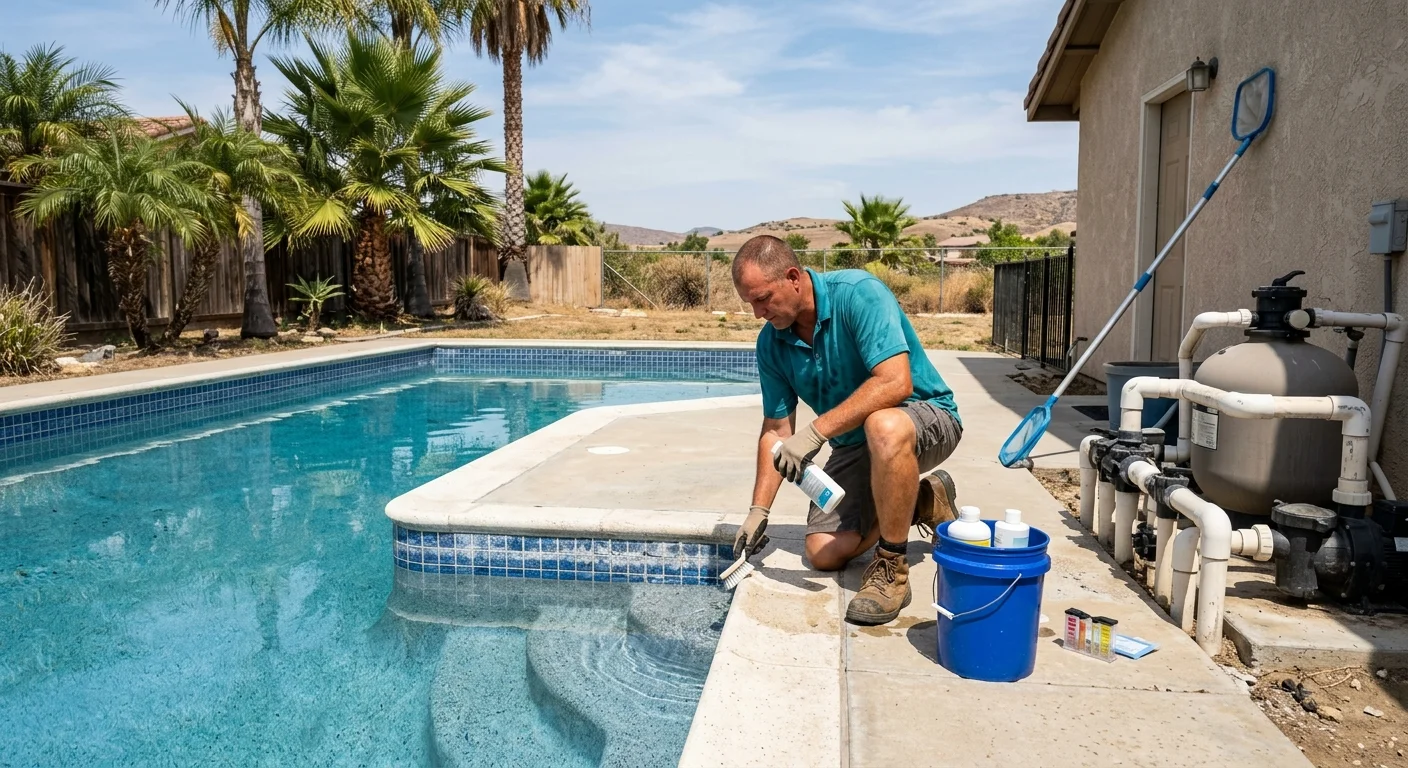
A backyard pool east of I-805 in Chula Vista lives in mesa heat. Otay Ranch, Eastlake, and Rolling Hills Ranch sit farther from San Diego Bay than National City. Plaster, waterline tile, and the side-yard pad take that sun all afternoon, then hard water paints scale on the same surfaces. Pool repair here is usually that combination, not a coastal salt-air story. Splash Pool SD matches you with a licensed local specialist. The pro does the work.
Why Chula Vista plaster and pads fail in mesa heat
The marine layer that cools National City and the westside along I-5 thins as you climb toward San Miguel Mountain. Eastlake Parkway, Olympic Parkway, and the Otay Ranch villages sit on that warmer bench. A south-facing gunite wall can feel dry to the touch by midafternoon in July. Plaster that dries and wets every day etches. Hairline crazing shows first at the steps and the shallow bench.
The pad is the other weak point. Many Eastlake and Otay Ranch lots tuck the pump, filter, and heater in a side yard between stucco walls. Shade is scarce. Pump lids bleach. Unions get brittle. Salt cells crust. A heater that short-cycles in still, hot air is working against the weather, not a mystery defect.
West of I-805 the pattern shifts. Telegraph Canyon Road and H Street drop toward the Sweetwater and Otay drainages. Lots are older. Pads are still tight, but the heat load is milder. Failures there often start as leaks and tired plumbing, then show up as a wet slab. East of the freeway, heat and mineral come first.
None of this is a reason to replace a whole system from a phone photo. A licensed specialist looks at the shell, the pad, and how the pool has been run. Some plaster only needs a targeted repair. Some pads only need a union, a lid, or a motor. The climate explains why the same parts fail here more often than they fail on a shaded bay-side court. It does not set the scope by itself.
Chula Vista pool cleaning will not reverse cooked equipment. Weekly service can keep chemistry in range and catch a drip early. It cannot unbake a faded pump lid or dissolve a heater full of scale. When the failure is mechanical or in the shell, you want a repair match, not another bottle of shock.
Otay Ranch HOA lots versus older westside gunite
Otay Ranch, Eastlake, Rancho del Rey, and Rolling Hills Ranch were built as master-planned neighborhoods from the 1990s into the 2000s. Backyard pools there often share a look: white builder plaster, waterline tile, a raised spa, and an HOA that cares how the yard reads from the sidewalk. Access is a real constraint. Side yards are narrow. Gates are standard width. Equipment sits on a small concrete pad against a property-line wall. A specialist who has not walked an Otay Ranch lot will underestimate hose runs and the carry path for a heater or a filter tank.
HOA rules also change the job around the waterline. Tile that is scaled or popping is visible from the house and sometimes from a common walk. Community fountains and entry water features are a different system. If that is the failure, use our notes on fountain repair in Chula Vista rather than treating it as a backyard pool repair.
The older westside is another city. Gunite pools near downtown Chula Vista, west toward National City, and along the older streets south of H Street were poured in a different era. Shells are often smaller. Decks are original concrete. Plumbing is older. Equipment may sit in a wooden enclosure that never got a proper slab drain. Those yards need leak thinking and plaster thinking together. A wet spot by the skimmer on a 1960s gunite pool is not the same diagnosis as a cooked salt cell on an Eastlake pad.
Rancho del Rey sits between those two stories: planned, but older than the newest Otay villages. Millenia and the eastern edge toward Otay Mesa add wind and dust off the mesa. The repair is local to the lot. Encinitas salt air and El Cajon inland heat are not this map. Chula Vista holds both the HOA stock and the westside gunite stock inside one city limit.
Pool service in Chula Vista has to name that split on the first visit. An Eastlake spa spillway with white crust is a mineral and heat problem. A westside gunite floor that sounds hollow is a surface-age problem. Mixing those diagnoses wastes the homeowner’s time.
Hard water, scale, and summer equipment load
Eastern Chula Vista is largely Otay Water District territory. Much of the westside is Sweetwater Authority. Both systems are known for hard water. We do not publish a grains-per-gallon figure here because district reports move, and a stale number helps nobody. What you can see without a lab is the white crust at the tile line, the roughness on plaster, and the flaking inside a heater header. For broader context on supply, the San Diego County Water Authority tracks regional water sources. It does not set a repair price.
That mineral load is why we keep a separate guide on hard water in San Diego pools. Scale is not dirt. Brushing it like algae just polishes the deposit. A licensed pro decides whether the fix is chemistry, a tile clean, a heater descale, or a salt-cell replacement. Guessing with acid on a waterline is how tile glaze gets ruined.
Summer makes it worse. Heat raises evaporation. Minerals concentrate. Pumps run longer to keep the water moving. Heaters, when they are on, see hotter incoming water and more scale. A single-speed motor that has hummed along since the house was built is doing more hours in August than it did in March.
If that motor is being replaced, California has a separate rule. The California Energy Commission states that replacement dedicated-purpose pool pump motors with total horsepower of 0.5 or greater, manufactured on or after July 19, 2021, shall be variable-speed replacement motors (CCR Title 20 section 1605.3(g)(6)). The rule is about replacement motors made on or after that date. It is not a mandate to rip out every working single-speed pump on a Chula Vista pad this week. The matched pro and the CEC page are the right place to check whether a given motor is in scope. Do not treat a sales pitch about bill savings as a fact. We do not publish savings percentages.
Otay Water District rates and Sweetwater Authority rates are not listed here. Confirm current charges with the district that prints your bill. A repair estimate and a water bill are different documents.
Repairs a licensed pool pro handles on these yards
Chula Vista pool repair is a set of on-site jobs, not a weekly skim. Common work on these yards includes pump seals and motors, filter tanks and multiport valves, heaters that will not fire, salt cells that will not make chlorine, waterline tile, plaster patches, lights, and leak tracing when the water line drops faster than weather explains.
Splash Pool SD does not perform that work. We match homeowners with licensed independent specialists. Check the licence yourself on the CSLB licence lookup before you sign. Our walkthrough on how to check a California pool contractor licence shows the screens. For the hire itself, how to pick a pool repair specialist in San Diego covers the questions that belong on the written estimate.
California contractor law still applies even when the job looks small. Work is exempt from licensing only when the total for labor, materials, and everything else is under $1,000, the work is casual and minor, and no building permit is required. Both the dollar cap and the no-permit condition must hold. The $1,000 threshold is the current figure, effective January 1, 2026. Splitting a job to stay under the cap does not create an exemption. Acting as a contractor without a licence is a misdemeanor under Business and Professions Code section 7028.
On a home-improvement contract, the down payment may not exceed $1,000 or 10 percent of the contract amount, whichever is less. On a large plaster or equipment job, that cap is $1,000, not 10 percent of the total. Confirm the numbers on the paper in front of you. We publish no price list, and no figure in this article is a Splash Pool SD quote or an operator’s rate.
If the interior is past patching, resurfacing is a different scope. If the loss is underground, leak detection is a different scope. The specialist should say which path you are on before anyone drains the pool. If a permit is issued for construction or remodel of a pool at a private single-family home, California Health and Safety Code section 115922 requires at least two of seven drowning-prevention safety features. That rule attaches to the permit. It is not a blanket retrofit on every existing Chula Vista pool.
Homeowners insurance is its own conversation. Sudden accidental damage is sometimes covered. Wear, scale, and gradual leaks often are not. Ask the carrier in writing before you file.
What to photograph before you request a match
Photos cut the back-and-forth. Stand at the shallow end and shoot the whole waterline, including any white crust or missing grout. Shoot the floor and steps in raking light so etching and stains show. Then walk the pad.
On the pad, photograph the pump, filter, heater, and any salt or automation box from a few feet back, then a close shot of each nameplate. If a lid is cracked or a union is wet, get that in frame. Shoot the slab itself. Standing water, rust stains, and a missing drain tell the specialist how the equipment has been living.
Add three context shots. The side-yard gate and the path to the pad. The closest hose bib. The street or alley a truck would use. Otay Ranch and Eastlake lots often look open from the kitchen and tight from the equipment side. Westside lots can hide the pad behind a fence that does not swing far enough for a filter tank.
Write down what you already know: neighborhood (Eastlake, Otay Ranch, Rancho del Rey, westside), roughly when the pool was built if you have it, whether an HOA will need notice, and any error code on a control pad. Do not drain the pool for photos. Do not add acid to test scale. The specialist will want the water where it is.
If the only symptom is cloudy water or a green tint, that may be a chemistry and cleaning problem rather than a repair. Say so in the note. The match should follow the actual failure.
When to call us
When a Chula Vista pool is losing water, the pad is wet, the heater will not fire, or the plaster is past a brush-and-hope, it is time for a licensed pool specialist. Call us at (858) 400-4404 and we’ll connect you with a licensed local pool specialist.
Frequently asked questions
Does homeowners insurance cover swimming pool repairs?
Coverage depends on the policy. Sudden accidental damage is sometimes covered. Wear, scale, plaster age, and gradual leaks often are not. Ask the carrier in writing before you file, and keep the licensed specialist's written estimate.
What does pool repair in Chula Vista usually cost?
Splash Pool SD publishes no price list, and no figure here is a quote. A licensed specialist prices the job after seeing the shell, the pad, and the access. Confirm every dollar amount on the written estimate before you pay.
What repair issues show up most on Chula Vista pools?
East of I-805, heat-cooked pads, waterline scale, and tired builder plaster in Otay Ranch and Eastlake are common. Older westside gunite more often adds plumbing age, wet pads, and leak questions. A licensed pro sorts which one you have.
How much does it cost to replaster a 10,000 gallon pool?
A verified local figure for that size is not on our claims list. Finish, access, drain-down, and chemistry history all change the number. Ask the licensed specialist for a written estimate on your shell.
Do I need a licensed contractor for Chula Vista pool repair?
California law exempts some work only when the total is under $1,000, the work is casual and minor, and no building permit is required. Both conditions must hold. Check the licence on the CSLB site before you hire.
Need professional help in San Diego County?
Splash Pool SD connects you with a licensed specialist for any service in this post.