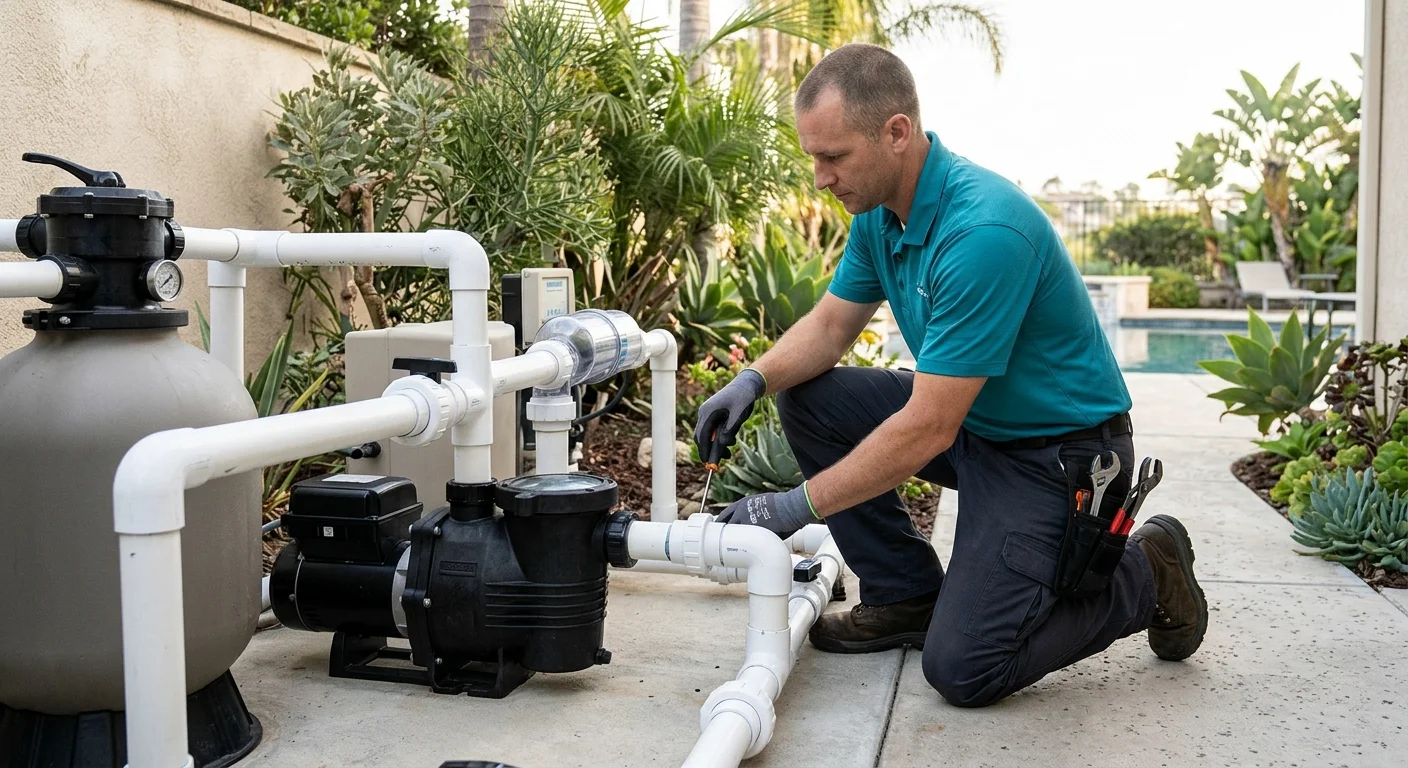
The Hayward vs Pentair salt cell choice is a pad decision, not a logo contest. On a San Diego backyard, the cell, the board, and the app have to match the pump, the controller, and the weather that pad actually lives in. A licensed pool specialist reads that match before anyone orders a box.
What actually differs on the cell, board, and app
A salt chlorinator is three pieces that have to agree. The cell is the vessel with metal plates that turn dissolved salt into chlorine. The board is the power and logic box on the pad. The app, if you have one, is only a window into that board.
Hayward and Pentair both sell that stack. They do not share cells. A Hayward cell is built for a Hayward chlorinator. A Pentair cell is built for a Pentair chlorinator. Mixing them is not a clever workaround. Confirm fit against the current manufacturer sheet for the exact model on your wall.
The cell is the wear part. Scale coats the plates. Cables crack in the sun. Unions weep. When a chlorinator cell is not working, the first job is to separate a dirty or spent cell from a board that has stopped talking to it. That call belongs to the licensed pro, not a parts catalog photo.
Boards differ in how they show faults, how they reverse polarity to knock scale off the plates, and how they talk to a controller. If your pad already runs Hayward automation, a Hayward salt system keeps one app and one wiring language. If it already runs Pentair automation, a Pentair cell does the same. If you have no controller yet, the cell choice is also an automation choice. Our Pentair vs Hayward pool equipment roundup covers pumps, heaters, and panels. This page stays on the salt cell.
Apps do not make chlorine. They show output, salt status, and error codes. A clean phone screen will not save a cell that is undersized, starved of flow, or coated in scale. Ask the pro to show you, on the manufacturer sheet, which cell that brand rates for your pool volume. We do not publish those ratings here. They change by model, and the sheet is the source.
Genuine OEM cells and aftermarket cells both exist. Fit, output, and any remaining manufacturer coverage have to be confirmed in writing. Do not assume an aftermarket cell keeps the original coverage. Do not assume the OEM cell is the only part that will ever work. Have the quote name the part number.
Coastal pads versus inland heat on these systems
San Diego County is not one climate for a salt cell.
West of I-5, pads in La Jolla, Pacific Beach, Ocean Beach, Coronado, Imperial Beach, Encinitas, and Carlsbad sit in marine air. Mornings stay cool under the layer. Metal cabinets, terminals, and cell cables take salt spray and damp. Corrosion on a lug can look like a dead cell. The pro should open the box, not just swap the vessel.
Inland pads in Escondido, San Marcos, Poway, Santee, El Cajon, and Alpine live a different life. Summer heat on a west-facing wall cooks boards and power supplies. Evaporation concentrates whatever is in the water, including salt and minerals. A system that ran quietly in March can throw low-output codes in August because chemistry and flow changed. That is not proof the badge on the cell failed.
Hard water is the county-wide background. The San Diego County Water Authority is the wholesaler for much of the region. Treated tap water is still mineral-bearing. Scale on salt cell plates is a local maintenance fact, not a brand defect. The matched pro inspects the plates, checks flow, and follows the cleaning method on that model’s sheet. We do not publish a grain-per-gallon figure for your city. District reports move, and a made-up hardness number does not help you buy a cell.
Coastal owners often worry about salt air eating equipment. Inland owners often worry about heat killing electronics. Both are real pad conditions. Neither one crowns Hayward or Pentair. Shade, bonding, unions, and a cell sized for the pool matter more than the logo.
South Bay pads in Chula Vista and National City catch marine air too, with warmer inland afternoons just a few miles east. One county, two wear patterns, sometimes on the same street grid. The inspection has to match the yard, not a statewide average.
If you are still deciding between tablet chlorine and salt at all, start with chlorine vs salt water for San Diego pools. The cell brand comes after that call.
When the job is a cell versus a whole salt system
Homeowners search Hayward vs Pentair salt cell when the box on the pad is already a salt system. They search Hayward vs Pentair salt system when they want to change to a salt water pool. Those are different jobs.
A cell-only job is in play when the control board still powers up, the model is still supported, the unions and vessel are sound, and the fault traces to the cell. That is a salt cell replacement path. The replacement cell has to match that chlorinator. Brand loyalty to the other logo does not help if the board on the wall is Hayward.
A whole salt system is in play when you are converting from chlorine, the board is dead, the cell line is discontinued, or the existing unit was never sized for the pool. Conversion is plumbing, electrical, bonding, a cell, a board, and a startup. That is the salt water conversion path, not a cart checkout for a vessel.
Do not order a Pentair cell for a Hayward box because a forum thread liked the plates. Do not replace a working board because a salesperson prefers the other app. The licensed pro tests output, inspects plates, reads fault codes, and tells you which part actually failed.
We publish no conversion price, no cell price, and no typical installed figure on this page. Those numbers were not verified for this brand. A written quote after a look at your pad is the number that matters.
If the pool is green, the cell is not the first conversation. Clear the water, then diagnose the chlorinator. A new Hayward or Pentair cell will not fix a filter that is not turning the water over, and it will not hide a leak.
San Diego pools run most of the year. A cell that is already fading in May will not catch up in July by turning the output to 100 percent and hoping. Output at the board is not the same thing as chlorine in the far end of a lagoon-shaped yard in Rancho Bernardo or a deep end in Point Loma. Sizing and flow still have to be right.
What a pool pro checks before you buy either
Before anyone picks a Hayward or Pentair cell, the matched licensed specialist should walk the pad and the water, not the brochure.
They confirm the existing brand and model. They check whether the board still communicates. They inspect the cell plates for scale, coating, and physical damage. They verify flow at the cell. Low flow is a pump, filter, or plumbing problem wearing a salt-cell costume.
They look at the rest of the pad. A salt cell starved because the pump is weak, the filter is packed, or a valve is half closed will fail on either brand. Pipe size, run length, and how the cell is plumbed after the filter all affect the reading the board trusts.
They check water chemistry against the manufacturer’s current sheet for that model, not against a memory of last year’s target. We do not list salt ppm, cyanuric acid, or output percentages here. Those targets are model-specific. The sheet and a test at the pool are the sources.
They note the climate the pad actually sits in: marine air west of I-5, or inland heat in East County and Escondido. They look for sun on the board, standing water on the pad, and corroded lugs.
They confirm the person doing the work is licensed. Look the contractor up on the CSLB license check before you sign. Splash Pool SD matches you with licensed independent pros. We do not hold the trade license and we do not install the cell.
Healthy swimming still depends on sanitizer in the water, whichever badge makes it. The CDC’s healthy swimming guidance is the public-health frame. A salt cell is one way to produce that chlorine. It is not a pass to skip testing.
Ask the pro to show you the cell off the unions if the codes point at output. A board error and a plated-over cell can throw similar messages. Buying the wrong half of the pair is how people end up with two invoices.
Questions to ask on a written conversion quote
If you are converting, or replacing a whole Hayward vs Pentair salt system, get the answers on paper before parts are ordered.
Ask which brand and which exact cell and board are being quoted, with part numbers. Ask why that stack fits this pool: volume, existing automation, pad space, and the pump already there.
Ask whether this is a cell-only replacement or a full conversion. Those line items should not look the same.
Ask what stays. Existing unions, existing controller, existing pump. A quote that swaps a cell and quietly adds a new controller is a different job.
Ask whether the cell is OEM or aftermarket, and what that does to manufacturer coverage. Have the pro write it. Do not take a verbal claim that it is the same.
Ask how the system will be bonded and grounded, and who pulls any permit the city requires. We did not confirm a countywide permit rule for a salt-cell swap on this page. Your city building department and the licensed pro set that.
Ask what startup includes: salt addition, testing, output setting, and who shows you the board. Ask what is excluded: plaster issues, a failing pump, a packed filter, a heater that will not light.
Ask how you will know the cell is sized for this pool. The answer should point at the manufacturer sheet, not a round number from memory.
A clean quote lets you compare Hayward and Pentair as systems on your pad. A vague quote only compares logos. If two quotes pick different brands, the useful difference is the pad work, the part numbers, and what is left off the page.
When to call us
Call when the chlorinator cell is not working, when you want to change to a salt water pool, or when a Hayward vs Pentair salt cell quote does not match what is already on the pad. A licensed pool specialist diagnoses the cell, the board, and the conversion before parts get ordered. Call us at (858) 400-4404 and we’ll connect you with a licensed local pool specialist.
Frequently asked questions
Can I put a Hayward salt cell on a Pentair system?
Usually no. Hayward and Pentair cells are built for their own chlorinators, boards, and cables. Confirm the exact part number on the current manufacturer sheet with a licensed pool specialist before you buy.
Is the job a new cell or a whole Hayward vs Pentair salt system?
A cell-only swap fits when the board still powers up, the model is still supported, and the fault traces to the vessel. A conversion or a dead board is a whole system. The matched pro diagnoses that on the pad.
Does coastal San Diego treat salt cells differently than inland heat?
West of I-5, marine air hits cabinets, terminals, and cables. Inland pads in Escondido and El Cajon take more heat and evaporation. Neither climate crowns one brand. The pro inspects the pad you actually have.
Which is better, a Hayward or Pentair salt cell?
The better cell is the one that matches your controller, plumbing, and pool size. If the pad already runs one brand's automation, stay in that family unless the pro shows a reason to change the whole stack.
What should a salt conversion quote include?
Part numbers for the cell and board, OEM or aftermarket, what stays on the pad, bonding and any permit, startup, and what is excluded. We publish no conversion price. The written quote after a look at your pad is the figure that matters.
Need professional help in San Diego County?
Splash Pool SD connects you with a licensed specialist for any service in this post.