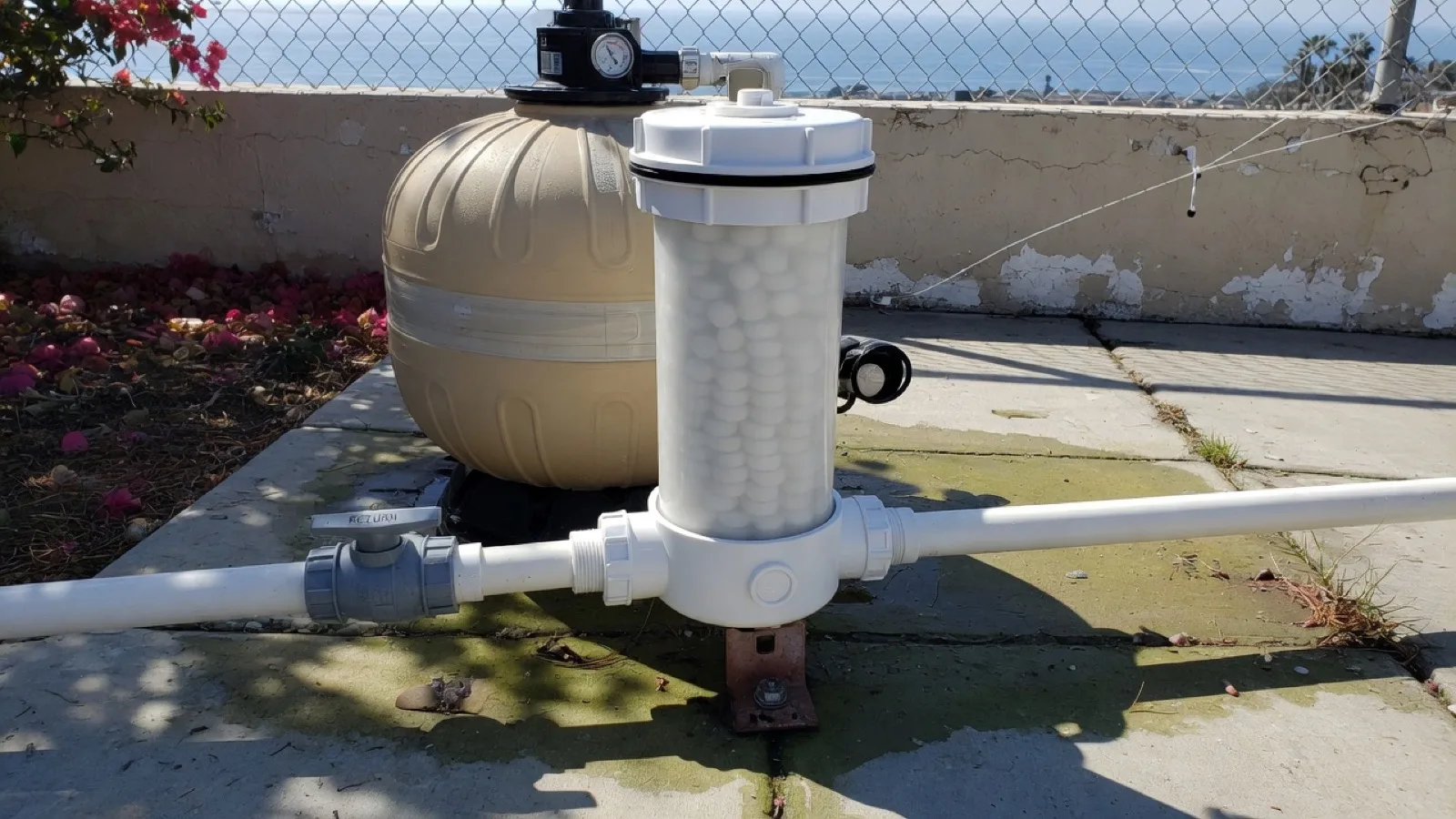
The white canister on the return line is an erosion feeder. Tablets sit in it. Water washes over them. That is the whole machine. When owners say “the chlorinator is not working,” they often mean a Hayward CL100/CL200/CL220-class in-line or off-line tablet feeder, or a cousin from another brand. They do not mean the salt cell on the same pad.
If your sanitizer is salt, stop here and use salt cell not working. Mixing those two jobs is how a working feeder gets replaced and a dead cell gets ignored.
Dry tablets, wet tablets, no chlorine
Three different pictures.
Canister dry, tablets whole. No flow through the feeder. On in-line models the control valve may be closed. On off-line models the inlet and outlet tubes clog with scale, or the unit was plumbed against the flow arrows. Hayward’s feeder manuals put a check-valve assembly in the body so water does not run backwards into the canister when the pump shuts off. That check valve sticks. When it sticks closed, the tablets sit in a dry bucket.
Canister wet, tablets not shrinking. Flow is too low, the control is barely open, or the tablets are the wrong type for that feeder. Follow the feeder’s own tablet instructions. Do not dump cal-hypo into a trichlor feeder because a store bin was closer.
Tablets gone, test still reads zero. The feeder did its job. Demand, sunlight, a dirty filter, or a bad test is the rest. Shock and CYA live on other pages. Do not open the feeder while the pump is running.
Never open a feeder under pressure. Pump off, then the lid, the way the model’s manual shows. Trichlor gas off a wet lid is not a casual smell. If the lid will not break free, that is the licensed pro, not a hammer.
O-rings, lube, and the leak at the cap
Hayward’s CL200/CL220-class owner’s manual is specific: never use petroleum-type lubricants on the cover O-ring. They specify their own lube. Petroleum swells or wrecks the ring, then the cap weeps. A weep at the lid is usually that ring, the retainer hardware, or a warped cap. A crack in the body is a new feeder.
Off-line units leak at the tube nuts when those nuts are loose or the barb is scaled. In-line units leak at unions. None of those are a salt-cell problem.
Hard San Diego fill (inland East County especially) scales the inlet screen and the check valve. Coastal salt air does less to the plastic body and more to nearby metal. Tell the pro which city the pad is in.
What a licensed pro checks
A matched licensed pool contractor will:
- Confirm it is a tablet feeder, not a salt cell, not a erosion feeder tied into automation as a “chlorinator” output.
- Pump off, then open per the manual. Photograph the control position, the water line, and the check valve.
- Clear the inlet path and the screen. Replace the cover O-ring with the part the maker lists for that model.
- Confirm flow with the pump back on, from a safe distance, lid secured.
- Separate “feeder failed” from “the pool ate the chlorine.”
Ask for the part names on the written estimate. We publish no feeder price. Look up the contractor on the CSLB license check. Splash Pool SD matches you with licensed independent pros. We do not fill feeders, hold the trade license, or warranty the repair.
If the pad is moving off tablets entirely, that is a salt-water conversion conversation, not a lid O-ring.
How to describe the fault when you request a match
Say “tablet chlorinator” or “in-line feeder,” and the brand on the canister if you can read it. Say whether the canister is dry or wet. Say whether the lid leaks. Say it is not a salt cell. Photograph the unit from the pad, pump off.
Call (858) 400-4404 and we will match you with a licensed local pool specialist.
Frequently asked questions
Why is my pool chlorinator not working?
On an in-line or off-line tablet feeder, 'not working' usually means tablets sitting dry, a closed control valve, a clogged inlet, a failed check valve inside the feeder, an air lock, or a lid that will not seal. It is not a salt cell showing low salt. If your sanitizer is a salt chlorinator, go to the salt-cell page.
Hayward chlorinator not filling with water. What is that?
Water has to pass through the feeder for tablets to erode. A closed flow-control handle, a clogged inlet screen, an off-line feeder plumbed backwards, or a check-valve assembly that will not open will leave the canister dry. Photograph the control handle position and the water line in the canister before the visit.
The feeder leaks at the lid. Do I need a new unit?
Often the cover O-ring is the part. Hayward's CL200/CL220-class owner's manual tells you never to use petroleum lubricant on that O-ring and to use the lubricant they specify. A cracked body is a replacement. A missing O-ring is not.
Tablets dissolve but the pool still has no chlorine. Why?
The feeder can be working while demand is high, CYA is pinning the test, or the test kit is dead. Confirm with a fresh test. High inland bather load and full sun in El Cajon eat chlorine. That is water care plus the feeder, not only the canister.
Is this the same as a salt chlorinator not working?
No. A salt system makes chlorine from salt at a cell. A tablet feeder erodes trichlor or similar tablets in a canister on the return. Different parts, different page.
Need professional help in San Diego County?
Splash Pool SD connects you with a licensed specialist for any service in this post.